
Source: https://www.dreamstime.com/stock-vector-illustrations-clipart
There is currently much confusion in understanding how big the task will be, and how long it will take, to decarbonise Australia’s energy supply. In particular, electricity generation is being used interchangeably with energy demand in communications from the Government and much of the general media. This confused situation is not helping us understand the current heated debate about the path forward for the energy transition.
The chart below shows how Australia’s energy mix has changed from the 1980s to the present. The energy units are Petajoules (PJ). One PJ is the heat energy content of about 43,000 tonnes of black coal or 29 million litres of petrol.

Source: DCCEEW (2024) Australian Energy Statistics, Table C
Currently, fossil fuels (coal, oil and natural gas) account for almost all (91 per cent) of Australia’s primary energy mix. (https://www.energy.gov.au/energy-data/australian-energy-statistics; https://www.energy.gov.au/publications/australian-energy-update-2024)
Latest Data on Australian Energy Consumption by Fuel Type
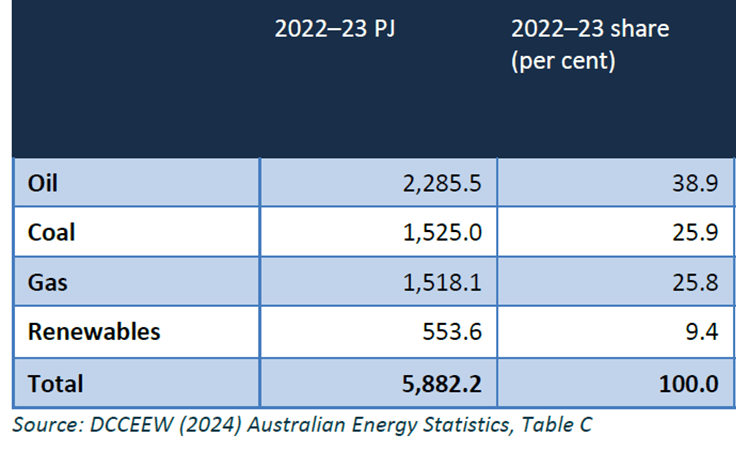
Oil, including crude oil, liquefied petroleum gas (LPG) and refined products, make up the largest share of energy consumption (39 per cent), with coal and natural gas both at 26 per cent.
Although renewable electricity generation has more than doubled over the last decade, it still only accounts for 9% of Australia’s total energy consumption. It will be a surprise to many to learn that combustion of biomass such as firewood and bagasse (the remnant sugar cane pulp left after crushing in Qld & northern NSW) makes up about a third of all renewable energy generation in Australia.
But wait a minute, aren’t we being told that renewables make up 37% (solar-16%, wind – 12% and hydro-6%) of the total amount of electricity currently being generated in Australia?
So where does this 37% number come from, when renewables only make up only 9% of the total energy mix?
Well, the fact is that electricity generation currently only makes up about one-quarter or 25% of the total current energy demand. 25% of 37% is 9.2%.
So, both numbers (9% and 37%) are technically correct, it just depends on what they are referring to.
On the one hand, this means that we are now almost half way to the Australian Government’s current target of 82% renewable electricity by 2030. However, even if we do make that target it means that we are still less than one quarter of the way to decarbonising Australia’s energy supply by 2050. That leaves a huge gap between 2030 and 2050.

Source: https://www.dreamstime.com/stock-vector-illustrations-clipart
If that gap is to be made up of wind, solar and hydro alone then it would mean having to install and connect nearly 10 times more generating capacity (with associated storage) than we have in 2025. This will be a truly mammoth undertaking, noting that between now and 2050 the earlier solar and wind installations (and associated battery storage) will need to be replaced up to two times.
My next instalment is Australia’s Energy Resources – Where our “Power” Comes from.
 My Blog has become My Nuclear Journey