Japanese Tsunami March 2011
A magnitude 9.0 earthquake, centred to the east of Sendai caused a wave 10m high travelling at 800 kph . The highest wave hitting the coast of Japan was 23m. It travelled inland for 10 km in some places. The Hawaiian Islands had waves over 3 metres high. As many as 19,500 lives were lost from both the earthquake and tsunami.
Misinformation
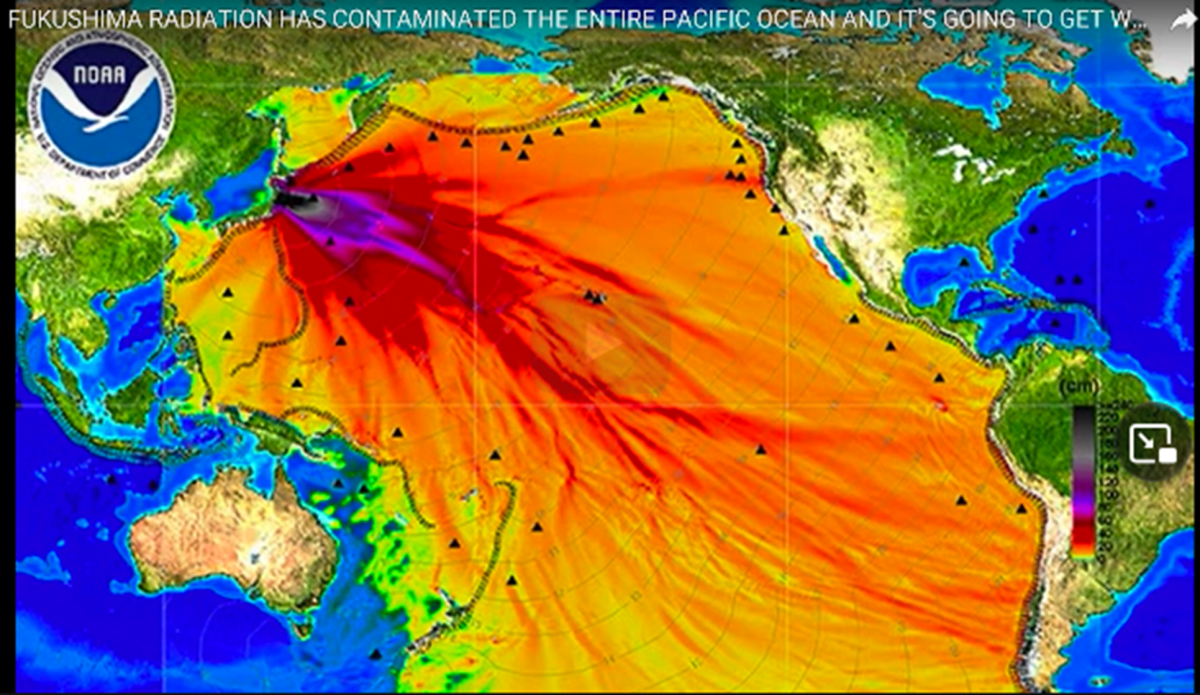
The following figure, with the added title “FUKISHIMA RADIATION HAS CONTAMINATED THE ENTIRE PACIFIC OCEAN AND ITS ONLY GOING TO GET WORSE!” was repeated over and over again on the web by various “green” groups.

Yes, the figure was produced by NOAA (National Oceanic and Atmospheric Administration of the US Government). BUT it is a graph of WAVE HEIGHTS after the tsunami. NOAA does not measure radiation levels.
A similar graph has been used for years by Helen Caldicott including during a presentation to Teals before the last election. Helen’s graph had a logo from a company in Australia that does undertake radiological measurements. The company stated on their website that it was not their work and that their logo was falsely included. She must have known for nearly ten years that the graph was false. I am also horrified by nuclear war and nuclear bombs and admire her work in this area but not at the cost of truth about low dose radiation.
Nuclear power plants and nuclear bombs are very different. I hate nuclear weapons. However, the use of falsified information when advocating for the banning of nuclear weapons or nuclear power is not OK. It is particularly abhorrent when scientific data is used in a way that the author knows to be untrue. I was told to use this technique in an environmental campaigning course by a famous international “Green” organisation.
These types of fear peddling are totally unethical, particularly when they pretend to be scientific in nature.
Why Do the Media call the Tsunami, the Fukushima Nuclear Disaster?
How many deaths could have been avoided if suggestions for evacuation or shelter in place standards suggested by the IAEA had been used. But Fear and Panicked Evacuation of about 100,000 people was responsible for 2313 disaster-related deaths among evacuees from Fukushima prefecture.
An old nuclear power plant overdue for decommissioning was damaged at Fukushima Daiichi by a wave 13-15m high. The placing and tsunami protection of the Daiichi plant assumed a 3m wave.
Eleven reactors at four nuclear power plants in the region were operating at the time and all shut down automatically when the earthquake hit. Subsequent inspection showed no significant damage to any from the earthquake itself.
The residual heat cooling systems worked for 8 out of the 11 power plants. At Fukushima Daiichi, electrical power from all 6 external sources stopped and the generators turned on until the tsunami flooding disabled 12 0f 13 backup generators running the cooling systems. Switching gear was also damaged.
Heat built up causing steam in the cooling systems. Hydrogen was produced by the steam reacting with exposed Zircaloy cladding. The containments were filled with inert nitrogen, which prevented hydrogen from burning in the containment. However, the hydrogen leaked from the containment into the reactor buildings, where it mixed with air and exploded. 3 of the 4 reactor buildings were damaged by hydrogen explosions. This was not a nuclear explosion. It was simple chemistry. To prevent further explosions, vent holes were opened in the top of the remaining reactor buildings. All reactors were stable within 2 weeks.
Three Tepco employees at the Daiichi and Daini plants were killed directly by the earthquake and tsunami. There have been no deaths or cases of radiation sickness from the nuclear power plant incident. One man from the plant died of cancer died soon afterwards but it is thought to be unrelated.
But in contrast there were 2,300 deaths caused by fear of radiation that triggered the evacuation.
Government nervousness to this day has delayed the return of many evacuees to their homes. Concerns about radiation in the sea caused panic even in the USA and some people made themselves sick with overdoses of iodine.
Tritium.
About 18 months ago, South Korea and China advised their citizens to stop eating seafood. Water used to cool the Fukushima reactors had been decontaminated and stored in large tanks and was finally to be released to the sea by Japan. The IAEA carefully monitored the releases. Korean fishermen were suffering loss of income as a result of the bans. After Korea monitored the sea water, they reversed their advice. China has only recently lifted their ban as they could not detect any contaminants. I followed the data for a while. Sometimes the tritium levels were so low in the discharge, the discharge water was diluting the tritium levels in the the sea water.
Tritium is created every day in our atmosphere and comes down in the rain, ending up in the sea. This natural process is the overwhelming source of tritium in the ocean.
For more of my blogs about tritium, see https://onewomanjourney.com.au/2023/08/25/tritium-trivia/
https://onewomanjourney.com.au/2023/08/31/its-raining-i-might-get-tritium-in-my-hair/
https://onewomanjourney.com.au/2023/09/06/the-iaea-and-fukushima-water-release/
https://onewomanjourney.com.au/2023/09/09/south-korea-monitors-fukushima-release/
 My Blog has become My Nuclear Journey