Why Do We Fear Radiation 6

Ref: Wade Allison Emeritus Prof of Physics lecture 2018, Dun School of Pathology, Oxford
There are many articles on the web that link cancer treatment with heart disease. An example from the Cleveland Clinic states “Radiation heart disease is a side effect of radiation therapy for cancers in the chest and includes a wide range of heart conditions. Because it can occur many years after exposure, close monitoring is essential.“
There is no doubt that high doses of radiation can cause cancer. This has been well known since the Second World War when two nuclear bombs were dropped on Japan. Medical journal articles linking radiation treatment for cancer to later heart conditions have been around for at least 4 decades. It is important to read the full papers as the term “low dose” radiation often actually refers to quite high radiation doses well above 100mSv.
But How Much Radiation Causes Cancer and Heart Disease?
By the early 1980s, it was becoming widely known that radiation treatment for cancers of the chest increased a wide range of heart problems. Medical studies of the period described how patients receiving more than 30 grays during treatment had a high risk of developing heart issues in coming years. Just how much is 30 grays? 30 grays is 30 sieverts that is 30,000 mSv. This is an enormous amount of radiation! These 1980 studies have been quoted over and over again in medical review documents. Unfortunately, the radiation dose levels are not often discussed leaving some readers in doubt that very high doses of radiation are the cause. Personally I am still astonished at the amount of radiation used for cancer treatment.
Modern radiotherapy for cancer treatment has taken giant strides. Many cancers are treated with radiopharmaceuticals. These agents combine relatively short-lived radioisotopes with biological compounds that target the radiation much more precisely to the cancer cells avoiding as much radiation to nearby healthy cells as possible. Doses need to be high enough to kill the cancer cells. The doses are much lower than they used to be but they are still levels like 3 gray or 3,000 mSv. Chemotherapy is often used to make the cancer cells more sensitive to ionizing radiation.
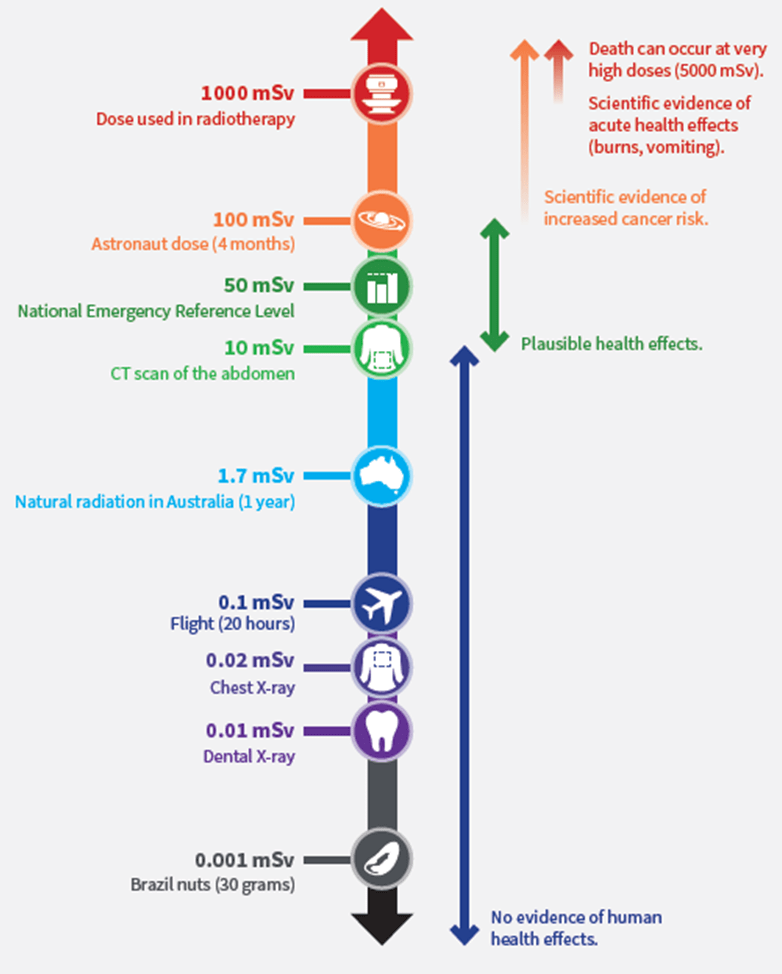
Ref: https://www.arpansa.gov.au/sites/default/files/2021_ionising_radiation_and_health.pdf
“There have been many large studies on people developing cancer from radiation exposure. Scientific evidence shows that the increased risk of developing cancer occurs at exposure levels of 100 mSv or higher. However, it is worth noting that outside of radiotherapy treatments, which is the targeted use of radiation to destroy cancer cells, the risk of being exposed to radiation doses at 100 mSv or higher is extremely low.“
“For radiation exposures less than 100 mSv, the scientific evidence for increased health risk is more limited. This is because the risk of developing cancer from low radiation dose is very small compared to the overall cancer rates, which makes it very difficult to measure, even with a very large study. It is plausible that health effects could occur at levels below 100 mSv.“
These statements from ARPANSA mirror a very wide range of scientific literature I have read over many years.

The only way to pick up health effects at levels under 100mSv has been to use epidemiological approaches. Unfortunately, these studies do not always agree with each other. I have seen two camps undertake complex calculations on the same data and come to totally opposite conclusions.
The amount of radiation used in medical diagnoses is also rather high but only exceeds 100mSv when used over and over again on large area scans such as whole body CT scans. Again the amount of radiation used has dropped considerably over time with new techniques as the use of targeted radiopharmaceuticals such as Technetium-99m compounds.
Since some of the earliest life appeared on Earth, living things have had the ability to repair radiation damage. More on this topic in future blogs.
ANSTO highlights that some members of the public fear that external radiation can build up in the body until it gets to a point where it kills you. This is not the case. Ionising radiation does not build up in your body any more than light which falls on you builds up. The radiation that reaches you is gone a fraction of a second later. https://www.ansto.gov.au/sites/default/files/2019-01/What%20is%20radiation%20brochure%202018%20final%20eVersion.pdf
This raises the question of how radiation does cause any harm. I plan to address this issue in a later blog.
 My Blog has become My Nuclear Journey