It was the Number Four RBMK reactor at the nuclear power plant at Chernobyl, Ukraine that caught on fire on April 26, 1986 demolishing the reactor building and then releasing large amounts of radiation into the atmosphere. The other 3 reactors kept operating, the last of them closing on December 15, 2000, and finally the decommissioning phase began.
Construction of the new city of Slavutych started in 1986, and the first inhabitants settled in October 1988. This new city was intended to replace the ghost city of Pripyat. Slavutych is sited on the left bank of the Dnieper River about 30 miles east of the Nuclear Power Plants (NPP). It is mostly home to survivors of the disaster who had to be relocated from Pripyat, among them about 8,000 people who were children when the disaster occurred. Many inhabitants still work at the site of the former plant for monitoring, maintenance, or scientific purposes. They commute to the zone on a regular basis. A rail line (twice crossing the international border with Belarus) runs directly from the city to the site of the NPP.
In 2021, of the approximately 7,000 people who came in and out of the CEZ to work, more than 4,000 had shifts of either 15 days a month or four days a week—schedules devised to minimize exposure to ionizing radiation. They are security guards, firefighters, scientists, decommissioning workers or those who maintain the infrastructure of this unique community. Many lived part-time in the ancient city of Chernobyl occupying some of the rooms and apartments that were evacuated in 1986. A few even lived in Pripyat.
About 70,00 tourists visited the inner zone of the CEZ prior to the war.
https://www.nationalgeographic.com/culture/article/life-goes-on-chernobyl-35-years-after-worlds-worst-nuclear-accident has some great pictures.
https://www.bbc.co.uk/news/resources/idt-sh/moving_to_Chernobyl This is a very moving story.https://www.nationalgeographic.com/culture/article/life-goes-on-chernobyl-35-years-after-worlds-worst-nuclear-accident
What Has Happened During the War?
On 24 February, 2022 Russia invaded Ukraine and took over the CEZ. Ukrainians were allowed to keep doing work essential to the safety of the site under Energoatom but the rotation system broke down. On March 20 roughly half of the staff who were on shift when the Russians took over, were allowed to return home to Slavutych for the first time. The second rotation was allowed on 11th April. The Russian military controlled the CEZ for five weeks until they withdrew on 31 March. But roads had been made impassable and workers had to be brought via boat down the Dnieper River. The CEZ has remained in Ukrainian control since.
It has been reported that the Russians looted and destroyed a lot of equipment including 1000 computers and firefighting equipment. They laid mines but I have just read that the Ukrainians say they have cleared these.
Tanks and Russian Armed Forces caused a lot of harm to infrastructure and to the Red Forest area. It was claimed that an enormous spike in radiation (even in Chernobyl city) measured at the time by the gamma dose rate
monitoring network in the CEZ was caused by tank movements disturbing the soil.
Beresford et al think that the effect was temporary and the high readings may have been due to military electro-magnetic frequency interference causing reporting anomalies from the detectors. https://pubmed.ncbi.nlm.nih.gov/37352719/ .
They have also published https://pubmed.ncbi.nlm.nih.gov/35196340/ Current ionising radiation doses in the Chernobyl Exclusion Zone do not directly impact on soil biological activity.
What is Happening to Slavutych and the City of Chernobyl?
Slavutych is often cut off from the rest of Ukraine, and Belarus is hostile now. Bombing occurs and many people have fled. Even so, civilians with children have settled in Chernobyl as the housing is cheap. Slavutych was seen as a wonderful place to live but the population is dropping, noting that parts of Eastern Ukraine have lost half their population due to the war. With time the well paid work at the NPP is becoming less.
Decommissioning the NPP
The work is being funded by the Ukrainian Government, the European Bank for Reconstruction and Development and Other International Private Donors. (I ask why aren’t the Russians paying?)
The stages and actions are:
• Shut down: The last reactor at the plant was shut down in 2000.
• Remove fuel: Nuclear fuel was moved to a storage facility in the first stage of the decommissioning process.
• Deactivate reactors: All reactors will be deactivated in the second stage.
• Maintain reactors: The reactors will be maintained until radiation levels drop to an acceptable level.
• Dismantle reactors: The reactors will be dismantled and the site cleared.
• Decontaminate: The plant and surrounding area will be decontaminated, including any radioactive soil and water.
• Restore environment: The site will be restored to an environmentally safe state.
The first waste canister containing highly radioactive spent nuclear fuel from the Chernobyl nuclear power plant in Ukraine has been successfully processed.
There was a sarcophagus rapidly put in place on Reactor 4 as an emergency solution. It was starting to disintegrate. Better containment has always been needed.
Chernobyl’s New Safe Confinement
Chernobyl’s New Safe Confinement (NSC) is a design and construction project unprecedented in the history of engineering. Never before has such a huge structure been constructed at a heavily contaminated site.
It was started at the site in late 2010 and the structure was moved into position on Reactor 4 in November 2016. Following systems installation, testing and commissioning the New Safe Confinement has now been handed over to the Ukrainian authorities and the Chernobyl Shelter Fund was closed in late 2020. https://www.ebrd.com/what-we-do/sectors/nuclear-safety/chernobyl-new-safe-confinement.html
The Health of Workers of Slavutych
City authorities for Slavutych have stated that there is less cancer and heart problems than in other cities in Ukraine. This is interesting as many of the “Liquidators” still live in Slavutych. There are also claims that fertility levels in Slavutych are higher than in similar cities in Eastern Europe. Unfortunately references I saved from a few years ago, even if they are still on the web, have become impossible to translate. I would love more data. The effects of the war will probably confuse health data. People are fleeing due to bombing and isolation from the rest of Ukraine.
Current Radiation levels in the CEZ
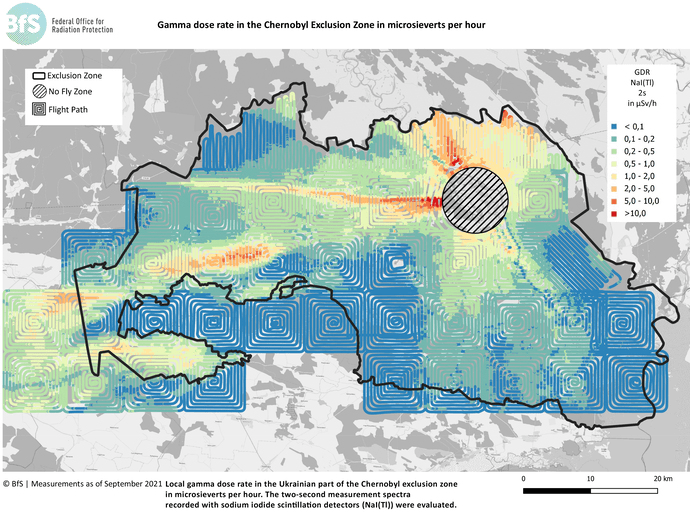
In 2022, the German entity, the Federal Office for Radiation Protection (BfS) published the first area-wide radiological mapping of the exclusion zone in over 30 years at the request of the Ukrainian Government. BfS works for the safety and protection of man and the environment against damage due to ionising and non-ionising radiation.
The data were collected in 2021, using extensive aerial surveys as well as ground truthing for the cesium 137 in the soil. The elevated local dose rate values measured in the exclusion zone today are almost exclusively due to cesium 137, which has a half-life of 30 years. Short-lived radioactive substances such as iodine-131 have not been detected for years. https://www.bfs.de/SharedDocs/Pressemitteilungen/BfS/EN/2022/006.html
Local gamma dose rate in the exclusion zone of Chernobyl in microsieverts per hour
A conversion table to help aid understanding of the radiation levels is given below.

Spatial distribution of cesium-137 in the exclusion zone in kilobecquerels per square metre

In my next blog I will write about the Liquidators of Chernobyl. Where are they now? How are they now?
 My Blog has become My Nuclear Journey