The Chernobyl Liquidators: Where Are They Now? How Are They Now?

The Chernobyl liquidators are the people who were called in to deal with the immediate aftermath of the Chernobyl nuclear disaster in 1986. They lived in tents close to Reactor 4 and did so much work to keep the site safer and cleaner than it would have been. They are the firefighters, the men who cleaned off the burnt material on the roof of the reactor building. They built the sarcophagus, worked in the power stations, buried parts of the red forest and buried topsoil and nearby villages.

An estimated 350 000 clean-up workers or “liquidators” from the army, power plant staff, local police and fire services were initially involved in containing and cleaning up the radioactive debris during 1986-1987. About 240 000 liquidators received the highest radiation doses while conducting major
mitigation activities within the 30 km zone around the reactor. Later, the number of registered liquidators rose to 600 000, although only a small fraction of these were exposed to high levels of radiation.
https://www.who.int/docs/default-source/documents/publications/health-effects-of-the-chernobyl-accident.pdf

The full WHO 167 page report can be found on https://iris.who.int/bitstream/handle/10665/43447/9241594179_eng.pdf

Where Do the Liquidators of Chernobyl Live Now?

The majority still live in Russia, a few thousand still live in Estonia, many live in Slavutych and about 1500 moved to Israel. Chernobyl has been a Jewish enclave down through the centuries. The original liquidators were given little protection in very highly radioactive situations. My surprise is that some staff from Reactor 4 and some of the firefighters that crucial night are still alive. Depending on their country of residence, some of the liquidators receive pensions and/or have received compensation payments.

In the years before and after the Chernobyl Accident, the people of the USSR and later the independent states went through a period of poor nutrition and absent or very inadequate medical facilities. The average life span of men in these countries has increased dramatically as living conditions have improved. For example, people in Russia only had an average life span of 65 in 1993 and a life span of 73 in 2022. I saw one figure of only 53 years in the 1980s. In 2022, Ukrainians still only had a life span of 69 years. Smoking and drinking vodka were frequent pastimes during the hard years.

In 2006, Opinion was Divided over Chernobyl’s True Toll

The World Health Organisation and UNSCEAR (The United Nations Scientific Committee on the Effects of Atomic Radiation) both published reports in 2005. A fierce debate broke out fueled by scientists in Ukraine, Belarus and Russia as well as entities like Greenpeace that felt that the health impacts of Chernobyl were badly underestimated by WHO and UNSCEAR. The WHO and UNSCEAR reports claimed that fewer than 50 people died as a result of radiation from the Chernobyl Accident. Other estimates of the number of deaths so far in the former Soviet countries range as high as 50,000, reflecting deep splits in opinion over the appropriate way to evaluate the long-term effects of the tragedy. https://www.thelancet.com/action/showPdf?pii=S0140-6736%2806%2968559-0

There is no doubt that evacuation, dislocation and treatment of the liquidators led to severe mental illness in many people. Fear and stress can cause many illnesses. Claims by a Russian scientist of genomic instability is concerning. Genomic instability is only one of the many factors needed for cancer to manifest.

Unfortunately, many of the higher estimates from epidemiological modelling are based on the LNT Model formulated after WW2. It is now known to overestimate the potential impacts of low dose radiation.

Experts talk About the Health Effects of Chernobyl

https://www.unscear.org/docs/reports/2008/11-80076_Report_2008_Annex_D.pdf

Being exposed to the sort of doses that come out of nuclear power plant accidents is far less dangerous than going sitting on a beach in Australia.” – Jerry Thomas

1f Nuclear Accidents

The first nuclear power plants were built during a period when safety was not considered as it is now.

When I did my undergraduate degree in chemistry in the 1960s, most of the organic chemistry department personnel were missing an eye. We were not considered true organic chemists until we had at least one labelled mark on the ceiling from an accidental explosion. We used Bunsen burners, naked gas flames, to distill off flammable and often carcinogenic solvents. I knew just what to do when my hair, lab coat and books erupted in flame from burning ether. Big drums were used for the storage of solvents and when the lab finally burnt down, the explosions from each of the solvent drums sent up spectacular columns of black smoke. The Research Laboratory of ICIANZ where I had a holiday job burnt down a year or so after I was there despite the training we received to prevent and extinguish solvent fires.

When I went to the dentist as a child, the dentist gave me mercury to take home for play. I first held a big bar of uranium metal in my bare hands in 1962.

The first safety features for nuclear power plants were just tacked on as an afterthought. I will describe current safety features for nuclear power plants later in my series of blogs. Safety is now designed and built in, made triply redundant and checked and cross-checked by regulators.

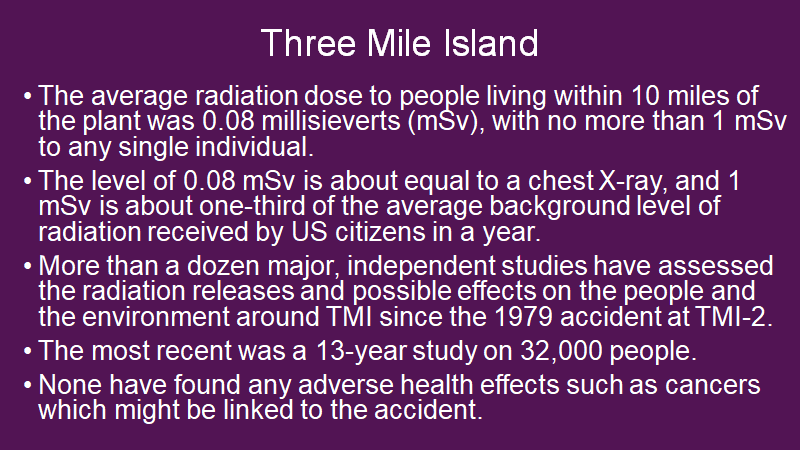
Three nuclear power plant accidents are well known. Using some of my slides from my presentations, the basic facts as best I can ascertain them are given below.

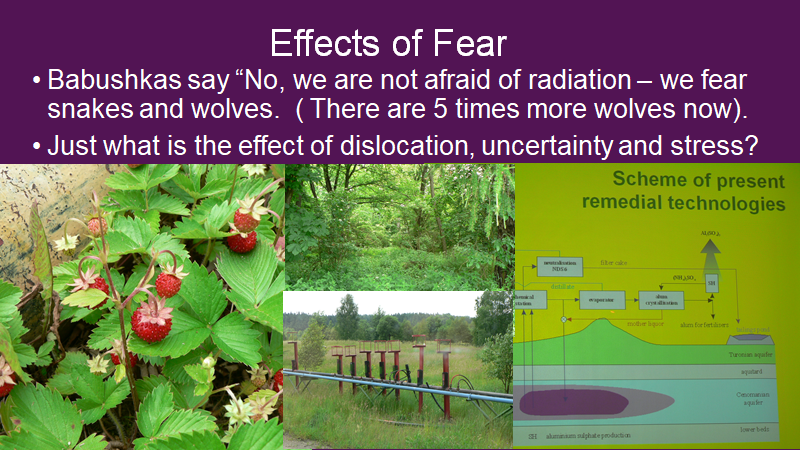
Fear caused all the health effects.

Chernobyl was a terrible happening. So many things were wrong including dreadful design with just a thin concrete cover and international coverup following the explosion. Documents are still being written about the details.

Recorded interviews with Babushkas are enlightening. “My friends who stayed away are all dead now and we are still alive.” 

Ukraine, the site of the Chernobyl disaster obtained almost half of its electricity from nuclear power plants in 2021. It was planning to build more. I have been presenting detailed updates about the happenings and safety of nuclear facilities in Ukraine during each presentation I do.

In 2008, My husband and I attended an International Mining Water Association conference in Karlovy Vary within the Czech Republic. The U.S.S.R. had pillaged its surrounding countries leaving massive legacies. One of the remediation projects we visited was a uranium mine with contaminated ground water. The rehabilitation scientists presented the chemical data and then took us out to view the works which were in their last stages. In one area there were beautiful, ripe, wild strawberries. I picked a strawberry and illogical fear erupted around me. I said, “You have seen the data, these are perfectly healthy to eat, and I am not worried.”  Suddenly, the men around me were trying the strawberries too and they were wonderful.

A friend who worked at the UN International Atomic Energy Agency (IAEA) in Vienna, told me in 2005 that the IAEA had learnt many lessons about how to manage a disaster at Chernobyl. A whole generation of rural farming children grew up without sufficient protein in their diets, eggs and milk being their traditional sources. Fear caused a lot of unnecessary damage. However, these lessons were forgotten or not learnt by Government authorities when a tsunami hit Japan.

Many studies have been published about the incidence of thyroid cancer in children following Chernobyl. A very large collection of thyroid tissue samples was collected from thyroid cancer sufferers. A very recent genetic study has shown that children receiving high doses of Iodine 131 soon after the disaster do have quite distinct genetic damage from that of children diagnosed with thyroid cancer since that time. (References:

  1. Yeager M, Machiela MJ, Kothiyal P, et al. Lack of transgenerational effects of ionizing radiation exposure from the Chernobyl accident. April 22, 2021. Science. DOI: 10.1126/science.abg2365.
  2. Morton LM, Karyadi DM, Stewart C, et al. Radiation-related genomic profile of papillary thyroid cancer after the Chernobyl accident. April 22, 2021. Science. DOI: 10.1126/science.abg2538.)

Iodine 131 breaks down very quickly. The following graph shows its decay curve. Half of it has decayed in 8 days and 99.9% in 80days.

Japan shut down many of its nuclear power plants. After very extensive safety testing and refurbishment, many of these power plants are now back in operation.

Antinuclear campaigners used the following picture with the heading shown on it to frighten people around the world. Yes, it is a graph produced by the National Oceanic and Atmospheric Association of the US (NOAA), but it is not a graph of radiation but of wave heights. It had no relation to radiation levels in sea water.

There is a tendency when people become sick, particularly with cancer, to blame nuclear radiation as the culprit. When I was head of the technical division for environmental regulation in mining in the Northern Territory the outcome of an investigation near Ranger Uranium Mine illustrated this point. Members of the Jawoyn people were becoming sick. They gathered food in a billabong downstream of the mine. The Jawoyn blamed the mine. Extensive monitoring of the food and water showed only very low background levels of radioactivity.  The investigations detected dangerous levels of raw sewage contamination. Bacteria were causing the sickness and the situation was soon rectified.

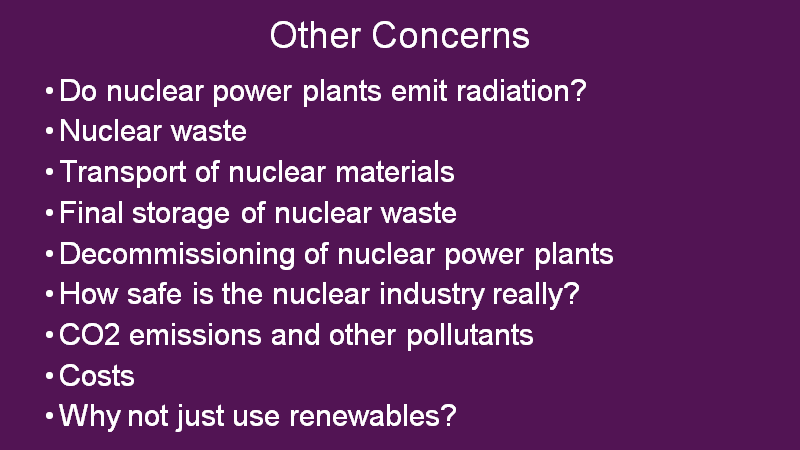
There are other concerns voiced about nuclear energy, and these will be discussed in later blogs.