


And since March 2022, more reactors have been shut down prematurely and more countries have started considering or ordering more nuclear power.
In Australia, it is not possible to have nuclear power without legislative changes. We do have a reactor at Lucas Heights in Sydney used to manufacture radioactive isotopes for medical purposes.
Some polls suggest there are more Australians that would consider or like nuclear power than are anti-nuclear. I have heard that some of the previous Government politicians considered putting nuclear power in their policies for the May 22 Federal elections but were told that the Coalition would lose if they did. I, for one, would have considered voting for them if they had done so. South Australia has recently enacted legislation that allows waste technologies.
Stephen Wilson of Queensland University has a very detailed report that can be downloaded from https://energy.uq.edu.au/research/social-economic-environmental-research under the nuclear subheading called What would be required for nuclear energy plants to be operating in Australia from the 2030s

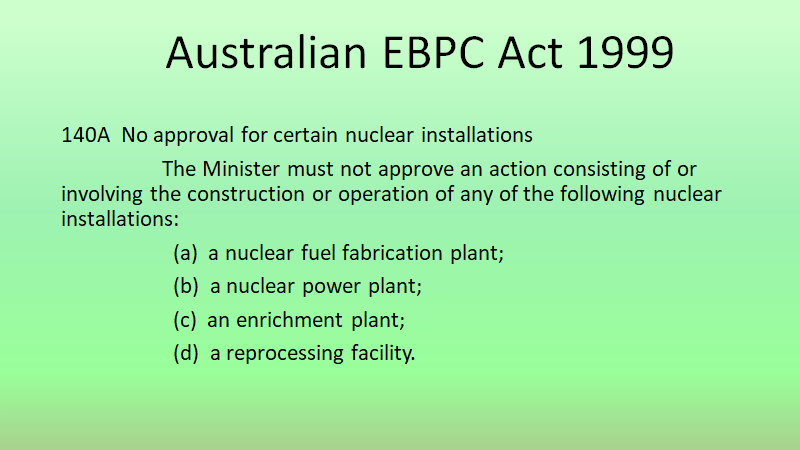
This is only one of many pieces of legislation that would need to be changed. Several States have legislation also banning nuclear power. The Queensland Act evens tries to push its wishes on other states and the Commonwealth.

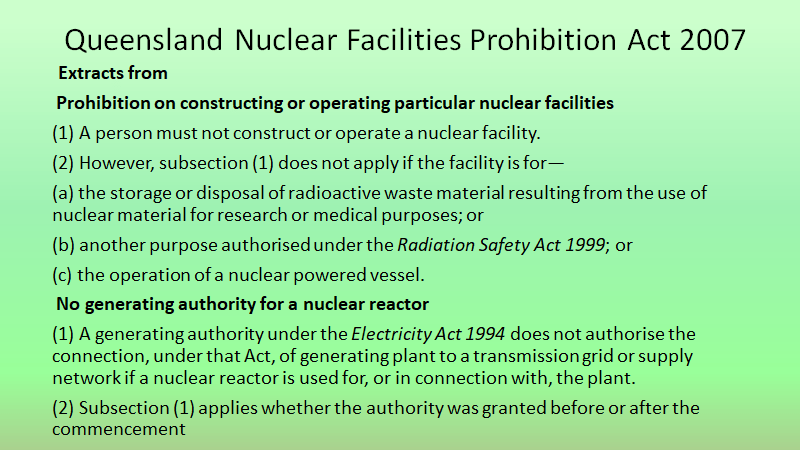
Even a small plug and play nuclear reactor would be banned in Qld even if the EBPC Act was changed.
Interestingly, The Commonwealth Parliament has a committee of MPs called “Friends of Nuclear”.
We export a lot of uranium and also have great stores of thorium. It all seems third world to me, we are happy to be a giant quarry for other countries. In some ways, we are making ourselves very energy vulnerable as we don’t have the facilities to manufacture the power plants needed for our own electricity needs. We have to import all the value added parts. I note that the US has decided to upgrade its manufacturing sector to make both nuclear requirements and renewable equipment and is even looking at more mining or at least forming commercial partnerships with other countries that don’t lessen their energy security.
We need MPs, both state and federal, prepared to champion nuclear power and work towards changing our legislation.
HOT OF THE PRESS: David Littleproud, has been elected as new leader of the National Party in Australia. The National Party kept all its seats at the recent election but is part of the coalition that just lost the election to the Labour Party.
David Littleproud has called on Prime Minister Anthony Albanese to “come with the National Party” to lead a conversation on nuclear power. The Prime Minister has vowed to rebuild Australian politics and focus on consensus and bipartisanship.
Later in this last week the new liberal leader, Peter Dutton said he’s ‘not afraid’ of nuclear debate.
In an April, the Institute of Public Affairs asked over 1,000 Australians whether they agree or disagree with the following statement: “Australia should build nuclear power plants to supply electricity and reduce carbon emissions”:it seems 53% agreed with 23% against.
The poll also identified widespread support across party lines for nuclear power:
- 70% of Coalition voters support building nuclear plants (13% oppose).
- 52% of Labor voters support building nuclear plants (27% oppose).
- 44% of Greens voters support building nuclear plants (30% oppose).
“Even more Greens voters support than oppose nuclear power in Australia.”
The poll also identified that more Australians across every age group support nuclear than oppose it:
- 52% of those aged 18-24 and under support building nuclear plants (19% oppose).
- 47% of those aged 25-54 support building nuclear plants (25% oppose).
- 62% of those aged 55 and over support building nuclear plants (23% oppose).
Support for nuclear power generation also crosses income groups:
- 71% of Australians earning $100,000 and over support building nuclear plants (16% oppose).
- 55% of Australians earning between $45,000 and $99,999 support building nuclear plants (22% oppose).
- 49% of Australians earning less than $45,000 support building nuclear plants (25% oppose).

Well after all this, it seems our politicians should be working hard to change our anti nuclear power legislation. Perhaps we need to give them a shove by writing to our local members.

This is the end of the nuclear talks on my blog. I will be writing about the desecration thoughtless implementation of wind power is doing to Australia’s precious biodiversity, agricultural lands and aboriginal heritage in future blogs.
Clearing forests on our Great Dividing Range will worsen climate change through a number of mechanisms, lead to more droughts and floods and destroy our special unique biodiversity.
 My Blog has become My Nuclear Journey