How Much Radiation Causes Cancer and Heart Disease?

Why Do We Fear Radiation 6

Ref: Wade Allison Emeritus Prof of Physics lecture 2018, Dun School of Pathology, Oxford

There are many articles on the web that link cancer treatment with heart disease. An example from the Cleveland Clinic states “Radiation heart disease is a side effect of radiation therapy for cancers in the chest and includes a wide range of heart conditions. Because it can occur many years after exposure, close monitoring is essential.

There is no doubt that high doses of radiation can cause cancer. This has been well known since the Second World War when two nuclear bombs were dropped on Japan. Medical journal articles linking radiation treatment for cancer to later heart conditions have been around for at least 4 decades. It is important to read the full papers as the term “low dose” radiation often actually refers to quite high radiation doses well above 100mSv.

But How Much Radiation Causes Cancer and Heart Disease?

By the early 1980s, it was becoming widely known that radiation treatment for cancers of the chest increased a wide range of heart problems. Medical studies of the period described how patients receiving more than 30 grays during treatment had a high risk of developing heart issues in coming years. Just how much is 30 grays? 30 grays is 30 sieverts that is 30,000 mSv. This is an enormous amount of radiation! These 1980 studies have been quoted over and over again in medical review documents. Unfortunately, the radiation dose levels are not often discussed leaving some readers in doubt that very high doses of radiation are the cause. Personally I am still astonished at the amount of radiation used for cancer treatment.

Modern radiotherapy for cancer treatment has taken giant strides. Many cancers are treated with radiopharmaceuticals. These agents combine relatively short-lived radioisotopes with biological compounds that target the radiation much more precisely to the cancer cells avoiding as much radiation to nearby healthy cells as possible. Doses need to be high enough to kill the cancer cells. The doses are much lower than they used to be but they are still levels like 3 gray or 3,000 mSv. Chemotherapy is often used to make the cancer cells more sensitive to ionizing radiation.
Ref: https://www.arpansa.gov.au/sites/default/files/2021_ionising_radiation_and_health.pdf

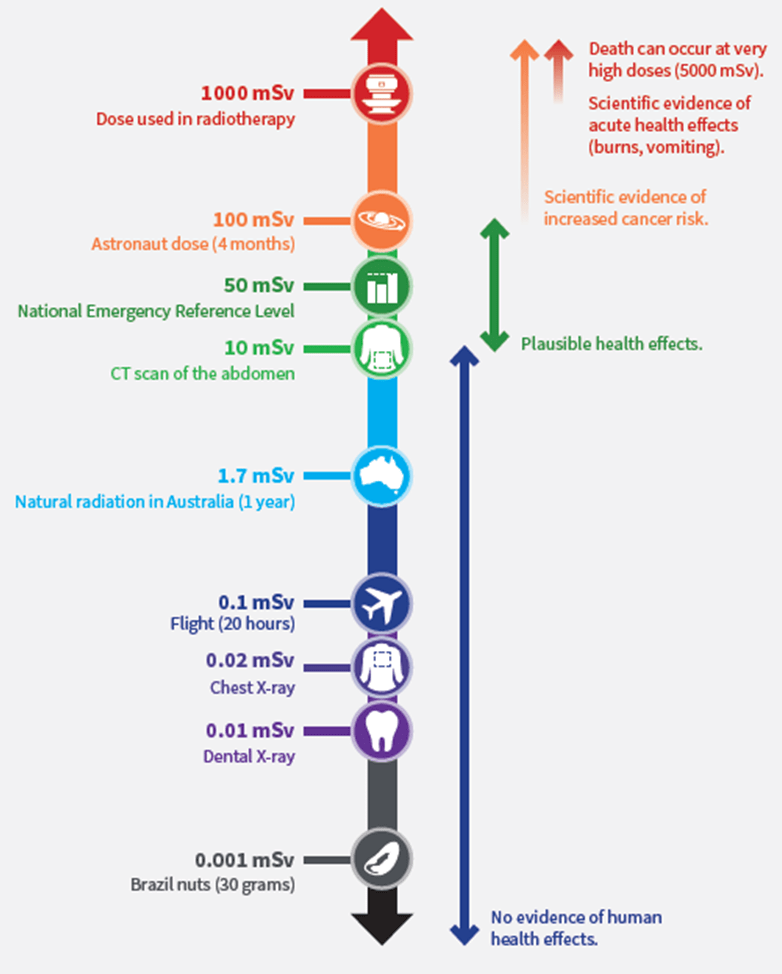
There have been many large studies on people developing cancer from radiation exposure. Scientific evidence shows that the increased risk of developing cancer occurs at exposure levels of 100 mSv or higher. However, it is worth noting that outside of radiotherapy treatments, which is the targeted use of radiation to destroy cancer cells, the risk of being exposed to radiation doses at 100 mSv or higher is extremely low.

For radiation exposures less than 100 mSv, the scientific evidence for increased health risk is more limited. This is because the risk of developing cancer from low radiation dose is very small compared to the overall cancer rates, which makes it very difficult to measure, even with a very large study. It is plausible that health effects could occur at levels below 100 mSv.

These statements from ARPANSA mirror a very wide range of scientific literature I have read over many years.

The only way to pick up health effects at levels under 100mSv has been to use epidemiological approaches. Unfortunately, these studies do not always agree with each other. I have seen two camps undertake complex calculations on the same data and come to totally opposite conclusions.

The amount of radiation used in medical diagnoses is also rather high but only exceeds 100mSv when used over and over again on large area scans such as whole body CT scans. Again the amount of radiation used has dropped considerably over time with new techniques as the use of targeted radiopharmaceuticals such as Technetium-99m compounds.

Since some of the earliest life appeared on Earth, living things have had the ability to repair radiation damage. More on this topic in future blogs.

ANSTO highlights that some members of the public fear that external radiation can build up in the body until it gets to a point where it kills you. This is not the case. Ionising radiation does not build up in your body any more than light which falls on you builds up. The radiation that reaches you is gone a fraction of a second later. https://www.ansto.gov.au/sites/default/files/2019-01/What%20is%20radiation%20brochure%202018%20final%20eVersion.pdf

This raises the question of how radiation does cause any harm. I plan to address this issue in a later blog.

Why Nuclear Should Be Part of Australia’s Energy Mix

Here are 8 good reasons. Most of this post comes from a simple pamphlet I recently put together.

  1. Nuclear Saves Habitat, Jobs and Farming Land

We could be replacing coal-fired power stations with Nuclear Power on the dirty old coal sites. A high proportion of the skilled workforce could be retained with decent salaries. Current transmission infrastructure would replace the need to build new transmission lines, saving money, resources such as copper while saving even more habitat and our best food producing soils. It is our land and its habitat that is sequestering most of the carbon dioxide that Australia produces. See my 2 previous blogs for more information.

2. Nuclear Power is a Low Carbon Energy Source

3. Nuclear Power is Safe

Nuclear activity and its ionising radiation are part of the natural world and were there when life began. Biology had to learn how to live safely with low and moderate levels of radiation. Otherwise, it would not have survived. The problem is with neither the physics nor the biology but with ourselves. While like all animals we are naturally protected and have no need to worry about immersion in moderate radiation, we have learned how to build instruments and make measurements that scare us. We put regulations in place that are designed to protect us from risks that nature has already covered.- Wade Allison Nov 2023

The Cellular Changes Needed To Initiate Cancer Have Not Been Observed  at Low Dose Rates. At least 6 to 8 of specific cellular changes must occur for cancer to result. The “Hit Theory” of DNA mutation as a cause of cancer is way out of date and not applicable.

4. Nuclear Waste is the Power Source of the Future

We do know how to bury it safely for ever – Nature has shown us how and some countries are doing so now.  BUT, what a waste!

5. Materials Needed to Manufacture Power Systems

The metals used in solar and wind power and transmission lines are becoming scarcer.  It takes more than a decade to open up a new mine but we do not even have enough mineral resources to build the first generation of renewables. Recycling is very energy inefficient.  

Recent evaluations of all the materials needed for the Energy Transition indicate a shortage of many materials. We do not even have sufficient minerals in the ground- Simon Michaux.  We must be careful with all the resources we have whether minerals, money, or biodiversity. We must never forget how much nature is doing to look after us.

6. We Need to Decarbonise More Sectors Than Just Electricity

7. The Energy Produced from a Power System Compared to the Energy Used to Produce that Power System

Until a solar farm can produce enough energy to make itself again, it shouldn’t be called renewable. If it takes too much energy to make and use a power source, it is not a viable long-term solution. Most calculations of money or energy costs do not include all of the  system costs.

Why does Nuclear Power have such a high EROI? ANSWER: Because of the orders of magnitude higher energy density of the fuels it can use such as uranium and thorium.

8. The Future

When should Australia introduce nuclear energy? Are we Australians ready yet? The false fear of radiation has even slowed our ability to even look after our low dose waste from research facilities and hospitals to a ridiculous extent. Most of the cost and time delays that effect the building of nuclear power plants around the world do not arise from the reactor itself but from ordinary engineering works. Australia’s recent history with big infrastructure projects including Snowy 2.0 is not impressive. It seems many big projects have very big cost and time overruns.

However, the first stage of the process will take time that we shouldn’t waste. Stage One involves removing the current bans both nationally and state by state. By the time we finish this first stage, we will be in a better position to judge what to build and purchase.

Wish to learn more? See early posts and become a subscriber.

South Korea Monitors Fukushima Release

Decades ago, I worked as an environmental scientist based in Hong Kong. I still stay in touch with some of my staff, who now are very experienced in their careers. I had heard that Hong Kong people were being warned about buying seafood, particularly seafood from Japan due to the release of water from Fukushima. I received an interesting article yesterday and quote from a section of it in the original Chinese together with the translation. I have omitted the first paragraphs. The references vary in their language but Note 2 is in English.

I jump to the last paragraphs examining the above 7:30 report.

當然,你依然可以反駁,日方的數據是假的。那麼你也可以看看韓國新聞。根據昨日韓聯社的消息,上周四日本排放核廢水後,韓國政府已在該海域30個點位進行緊急輻射測試,所有樣本均符合安全標準,而截至目前為止,韓國內的海鮮或進口海產尚未測到輻射。 (注2)

事實上,韓國從來不信日本,甚至不信國際原子能總署,所以7月以來,韓國已在200個海洋點位自己做水質監測,日本也無任歡迎。但奇怪的是,中国居然沒有像韓國般,實事求是加入監測行列,只堅持嚇鬼不動搖地在大陸、香港做「大內宣」,讓「財經作家」那種寫手散播假資訊,唯恐天下不亂地製造恐慌

因此我們可以假定」,中央政府正在下一盤很大的棋,旨在「給中国人民上一課科普」,引導民眾搶購可測試核輻射的蓋格計數器,之後驀然回首,才發現自己家的輻射原來比東京強900多倍(注3)——也許是中国建材問題——背後的理由實在太令人暖心了。

“Of course, you can still argue that the Japanese figures are fake. Then you can also check out Korean news. According to Yonhap news yesterday, the South Korean government has conducted emergency radiation tests at 30 points in the sea after Japan discharged nuclear waste water last Thursday, all samples met safety standards, and so far no radiation has been detected in seafood or imported seafood in South Korea. (Note 2)

In fact, South Korea has never believed in Japan, or even the International Atomic Energy Agency, so since July, South Korea has done its own water quality monitoring at 200 ocean points, and Japan is not welcome. But strangely enough, China has not joined the monitoring ranks like South Korea, just insist on scaring ghosts and doing “big internal propaganda” in mainland China and Hong Kong, letting writers like “financial writers” spread false information, lest the world will cause panic.

“So we can assume” that the central government is playing a big game of chess, aimed at “teaching the Chinese people a lesson in popular science”, guiding the public to snatch up Geiger counters that test nuclear radiation, and then looking back to discover that their own home’s radiation is more than 900 times stronger than Tokyo (note 3) – perhaps China’s building materials problem – the reason behind it is too heartening.”

Notes (References):

1 https://t.ly/Vdvih

2 https://t.ly/BjuD4

3 https://t .ly/g7arY

As expected, the South Koreans have not been able to find fault with seafood or seawater. One has to question the motives of countries who spread fear about radiation when these same countries build and sell nuclear power plants. Is it a question answered as it so often is “Just follow the money trail”?

Fear of Low Dose Radiation

We have nothing to fear but fear itself.

Low dose radiation has harmed few people, but the fear of radiation has killed thousands. I will back up this statement in future blogs.

Why do we fear radiation? Is it because we can’t see it, we can’t smell it, we can’t hear it? Yet many types of radiation are all around us and have been since the beginning of life on earth.

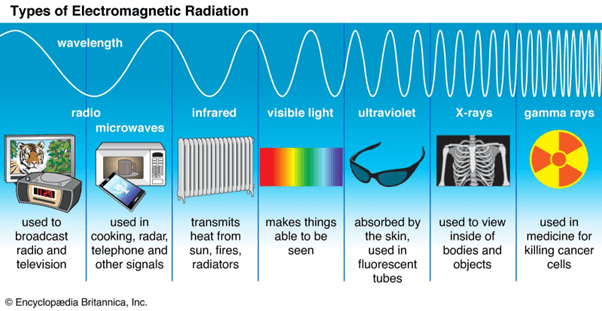
There are most types of radiation form a spectrum, yet evolution has only provided a very narrow window for our senses. We often call this window the visible spectrum, the colours of the rainbow, the light our eyes can see. Yet, if it was so important for our health that we needed to avoid all forms of radiation, why hasn’t evolution given us the tools to measure its intensity?

Advances in man’s technology have now provided the tools to measure the smallest amounts of low dose ionising radiation, tools such as Geiger counters and scintillation counters. I used scintillation counting extensively when I worked in biochemical and medical research.

We now know that our planet is bombarded from space by cosmic rays every day. The core of our planet is radioactive, and this helped to make life on earth possible by making the planet a little warmer. No matter where we live, radiation comes from the rocks below us. It is in the food we eat and the water we drink. The background levels in some places on earth are much higher than those in Australia.

Potassium is very important for the health of our bodies. All of this potassium contains a proportion of the radioactive  form of potassium, potassium 40. So, every time we eat a banana or a potato or indeed get enough veggies or protein in our diet, we take in potassium 40.

Uranium, a word that puts fear in many people’s hearts, is absolutely ubiquitous in our world. It is everywhere. At one stage of my career, I had a team of people and a laboratory truck that travelled all over the Northern Territory sampling streams and ground water. The lowest concentrations of uranium we ever saw were in waters downstream of Ranger and Jabiluka mine sites. Our radiological standards in Australia are pretty tough but even so the drinking water standards are tougher still. Uranium is far more dangerous as a heavy metal then as a source of radiation. Heavy metals do damage to our kidneys.

Instead of protecting us by making ionising radiation visible to us, evolution has protected us with biochemical mechanisms that prevent, and repair damage created by low dose radiation. When life began on earth, the radiation levels were at least four times greater than they are now and may have even been even 10 times greater.

We now know far more about the effects of low dose radiation on people and other forms of life than we do about most chemicals in our environment. I will share some of that information in future blogs.