As described by the UN, Land “plays a key role in the climate system” as an essential carbon sink because its surfaces, such as forests, regulate the planet’s temperature and help to store carbon. In the last decade alone, land-based ecosystems absorbed around 30 per cent of the carbon emissions generated by human activities, such as the burning of fossil fuel. https://www.un.org/en/climatechange/science/climate-issues/land
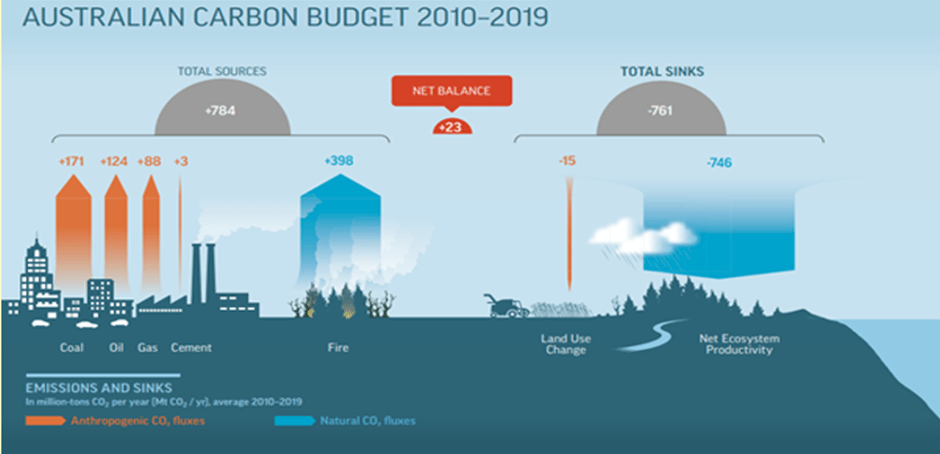
This approach does not match the UN Net Zero approach as only direct anthropogenic activities to ease Climate Change can be counted.
Checking the Meaning of Net Zero
A deeper look at the wording of Net Zero statements puts little emphasis on Nature’s role in lowering GHG. For example, note the following Australian wording, with emphasis on “we”.
Net zero means balancing the amount of emissions WE produce with those WE remove from the atmosphere.
The UN says:
Put simply, net zero means cutting carbon emissions to a small amount of residual emissions that can be absorbed and durably stored by nature and other carbon dioxide removal measures, leaving zero in the atmosphere.
However, the UN reports use the following explanations:
Carbon dioxide removal (CDR): Refers to anthropogenic activities removing CO2 from the atmosphere and durably storing it in geological, terrestrial or ocean reservoirs, or in products. It includes existing and potential anthropogenic enhancement of biological or geochemical sinks and direct air capture and storage but EXCLUDES natural CO2 uptake NOT directly caused by HUMAN activities.
Land use, land-use change and forestry (LULUCF): A GHG inventory sector that covers emissions and removals of GHGs resulting from direct human-induced land use, land use change and forestry activities.
Ref: https://www.unep.org/resources/emissions-gap-report-2024#:~:text=As%20climate%20impacts%20intensify
What is the Effect of Using this Anthropocentric Approach?
Only 3% of the world’s budget for climate change mitigation is spent on forest protection, even though vegetated land surface is removing 30% of the emissions we produce. As CO2 levels have risen, nature has kept taking CO2 out of the atmosphere, but the system is starting to show real strain for 2 reasons.
- We have undervalued natural ecosystems already in existence by not giving their conservation and protection a strong enough voice and role in the definitions of Net Zero. Thus, it becomes OK to knock down parts of a forest to build wind turbines or palm plantations or build a 4- lane highway for COP 30. Net Zero accounting only measures the actual land area cleared but forgets the edge effects that can dry out forest and soil lessening the ability of far greater areas of forest to continue sequestering carbon. Disturbed forest is more susceptible to wildfire and damage from storms leading to yet further degradation.
- As temperatures climb, the ability to photosynthesise can become weaker in a wide range of plants. Unfortunately, almost all tree species have a C3 type metabolism that is not well adapted to hotter and drier conditions. Australia is lucky to have many C4 plants such as saltbush, spinifex and indeed almost all of our Australian grasses. C4 crops include sugarcane, pearl millet, corn and sorghum. In some wetter years our savannah lands do a lot of sequestration. They need protection too.
C4 photosynthesis was an adaptation to less water and lower CO2. It is far more efficient in drought and high sunlight and dominates in tropical savanna areas. When grown in the same environment, at 30°C, C3 grasses evaporate approximately 833 molecules of water per CO2 molecule that is fixed, whereas C4 grasses lose only 277. This means that soil moisture is conserved, allowing them to grow for longer in arid environments.
It is possible that if we keep on our current pathway, Australia will turn our forests from net sinks for CO2 to net sources and then we could progress to losing them completely. What a tragedy that would be! Imagine losing our moist Eastern Australia lands. Forests are a very important part of the water cycle and do a massive job of cooling the Earth and keeping it from drying out. Forests bring rain. Loss of biodiversity within forests degrades and ultimately kills forests. They are complex ecosystems where every living thing plays a role. I will expand the topic of forests as net sinks or sources in a future blog.
Reaching net zero is impossible without nature. In the absence of proven technology that can remove atmospheric carbon on a large scale, the Earth’s vast forests, grasslands, peat bogs and oceans are the only option for absorbing human carbon pollution, which reached 37.4 bn tonnes in 2023. https://www.iea.org/reports/co2-emissions-in-2023/executive-summary)
So far Nature has been doing much more to lower CO2 levels than all our anthropogenic efforts.
Why are we wasting money and other resources to build temporary structures by destroying the resource we already have that is busily working to moderate our climate ? How about we save our land from further degradation by using nuclear power in the longer term and gas now as part of a meticulously planned energy transition that includes carefully sited renewables?
The use of nuclear power and gas would help to preserve the land. Gas is a much lower carbon emitter than coal. By using more gas for industrial purposes for tasks that require high heat, a job that renewables cannot do, carbon emissions can be reduced without losing strategic industries we need to build our homes, produce food and export mining products. The Australian Government recognises a role for gas but seems to have done little to ensure a reasonably priced, adequate supply to industry. https://www.industry.gov.au/publications/industry-sector-plan/pathway-2050
Watch Mark Vassella, BlueScope Managing Director and CEO, address The National Press Club of Australia on “Australian gas prices are costing us our manufacturing, jobs, energy transition, and a future made in Australia.” https://youtu.be/HJoVbF1rtGI?si=LdTxvpatAGY-PDjO
We have already done so much damage, because Net Zero policies just don’t address the issues. Theoretically, Australia now has the Nature Repair Scheme which officially began with the Nature Repair Act 2023 which came into effect on December 15, 2023. Implementation finally started in 2025 with the first project improving land by replanting. The scheme is designed to” restore and protect” our natural environment, and participants can earn carbon credits. This scheme does not protect forests. It demands similar actions to Net Zero and still leaves our best remaining forests vulnerable. Our Environmental laws need strengthening not weakening to prevent building renewables in the wrong places and destroy the existing carbon sequestration capacity.
Next time – Are Our Forests Becoming Net Carbon Emitters or Sinks?

 My Blog has become My Nuclear Journey