Why Do We Fear Radiation? 5

Australia experiences low background levels of nuclear radiation.
The most variation in background levels in Australia results from higher levels of radon due to the geology of an area. ARPANSA has produced a map that can be easily accessed for those wanting to know more. https://www.arpansa.gov.au/understanding-radiation/radiation-sources/more-radiation-sources/radon-map
Some areas of the world have much higher background levels, some patches being one hundred times higher than the world average. In general terms, multiple studies have suggested that long term residents of these higher background areas do not suffer from higher rates of cancer or heart disease. They may even develop extra protective measures. I will provide more information on this topic some of which can be controversial, in later blogs.
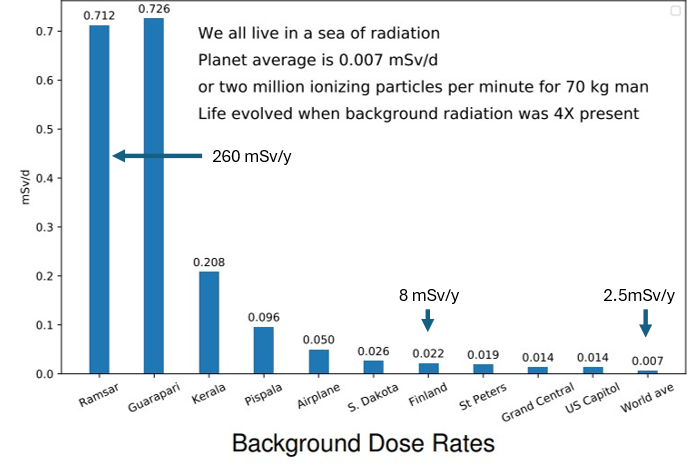
Background Radiation Dose Rate in mSv/day. Graph by Jack Devaney
Not all background data is easily available in mSv. Some interesting facts may be shown in other units such as grays. For X-rays, gamma rays and beta emitters, the gray is numerically the same value when expressed in sieverts, but for alpha particles one gray is equivalent to 20 sieverts, as a radiation weighting factor is applied accordingly. Alpha particles are easy to stop but once in the body, they inflict more damage.
When radiation is measured using instruments like a geiger counter, the unit is becquerels (Bq). One becquerel is equal to one nuclear decay per second. Conversions from becquerels to mSv can be done accurately for a single radionuclide but mixtures are very complex. For reference to the figure below, there are one thousand trillion becquerels in a Petabequerel, an almost unimaginable number. The overall message is clear. Human influence on background levels is small. As large as the effect of the dreadful nuclear bomb testing was, it is relatively tiny fraction of the total and diminishes every year.
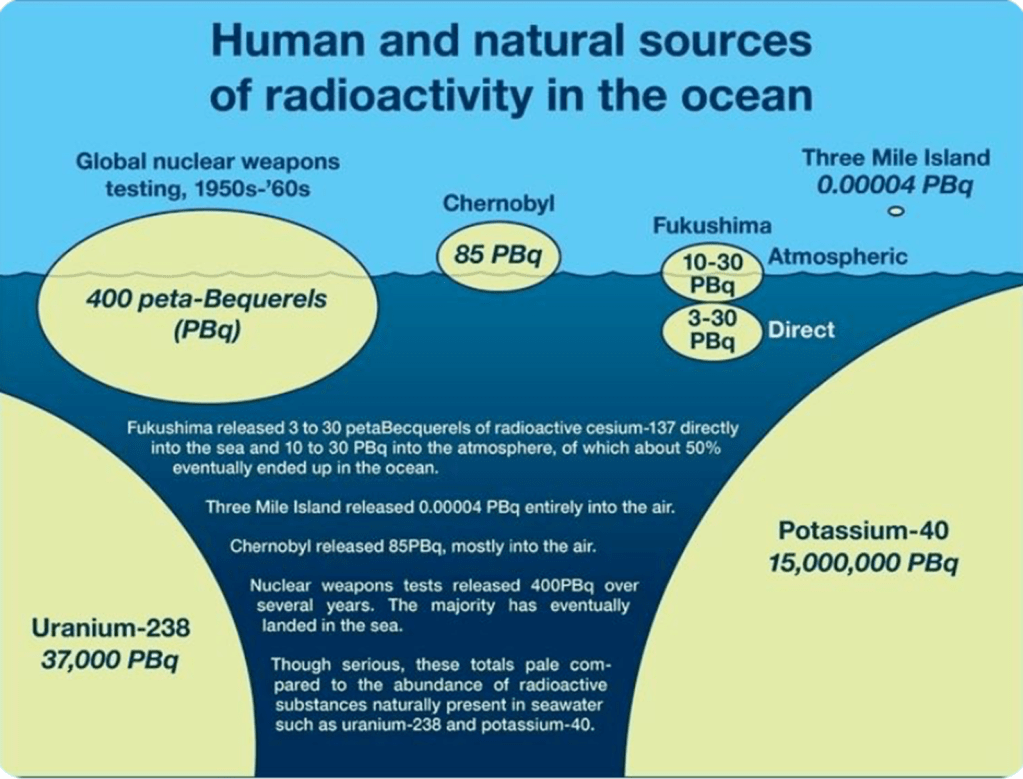
I first saw this posted by Robert Hargraves and again recently on a post by Oscar L Martin on LinkedIn.
 My Blog has become My Nuclear Journey