The Effect of False Fear of Low-Dose Radiation – Fake Graph of Fukushima

Japanese Tsunami March 2011

A magnitude 9.0 earthquake, centred to the east of Sendai caused  a wave 10m high travelling at 800 kph .  The highest wave hitting the coast of Japan was 23m. It travelled inland for 10 km in some places. The Hawaiian Islands had waves over 3 metres high. As many as 19,500 lives were lost from both the earthquake and tsunami.

Misinformation

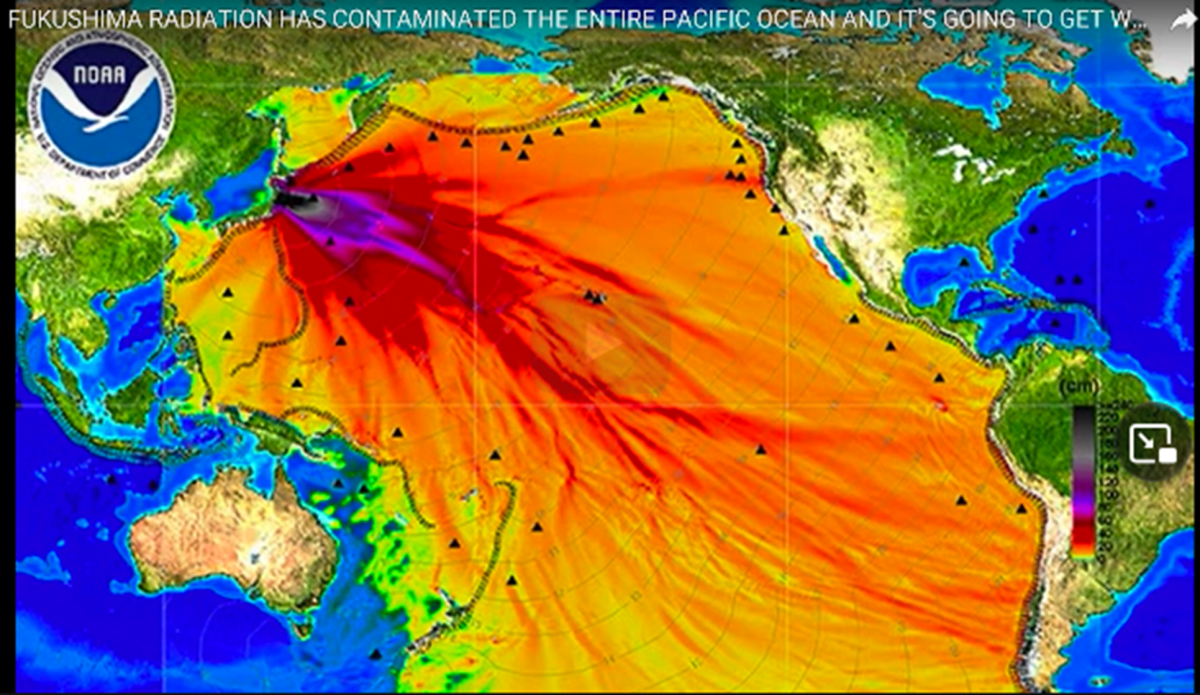
The following figure, with the added title “FUKISHIMA RADIATION HAS CONTAMINATED THE ENTIRE PACIFIC OCEAN AND ITS ONLY GOING TO GET WORSE!” was repeated over and over again on the web by various “green” groups.

Yes, the figure was produced by NOAA (National Oceanic and Atmospheric Administration of the US Government). BUT it is a graph of WAVE HEIGHTS after the tsunami. NOAA does not measure radiation levels.

A similar graph has been used for years by Helen Caldicott including during a presentation to Teals before the last election. Helen’s graph had a logo from a company in Australia that does undertake radiological measurements. The company stated on their website that it was not their work and that their logo was falsely included. She must have known for nearly ten years that the graph was false. I am also horrified by nuclear war and nuclear bombs and admire her work in this area but not at the cost of truth about low dose radiation.

Nuclear power plants and nuclear bombs are very different. I hate nuclear weapons. However, the use of falsified information when advocating for the banning of nuclear weapons or nuclear power is not OK. It is particularly abhorrent when scientific data is used in a way that the author knows to be untrue. I was told to use this technique in an environmental campaigning course by a famous international “Green” organisation.

These types of fear peddling are totally unethical, particularly when they pretend to be scientific in nature.

Why Do the Media call the Tsunami, the Fukushima Nuclear Disaster?

How many deaths could have been avoided if suggestions for evacuation or shelter in place standards suggested by the IAEA had been used. But Fear and Panicked Evacuation of about 100,000 people was responsible for 2313 disaster-related deaths among evacuees from Fukushima prefecture.

An old nuclear power plant overdue for decommissioning was damaged at Fukushima Daiichi by a wave 13-15m high. The placing and tsunami protection of the Daiichi plant assumed a 3m wave.

Eleven reactors at four nuclear power plants in the region were operating at the time and all shut down automatically when the earthquake hit. Subsequent inspection showed no significant damage to any from the earthquake itself.

The residual heat cooling systems worked for 8 out of the 11 power plants. At Fukushima Daiichi, electrical power from all 6 external sources stopped and the generators turned on until the tsunami flooding disabled 12 0f 13 backup generators running the cooling systems. Switching gear was also damaged.

Heat built up causing steam in the cooling systems. Hydrogen was produced by the steam reacting with exposed Zircaloy cladding. The containments were filled with inert nitrogen, which prevented hydrogen from burning in the containment. However, the hydrogen leaked from the containment into the reactor buildings, where it mixed with air and exploded. 3 of the 4 reactor buildings were damaged by hydrogen explosions. This was not a nuclear explosion. It was simple chemistry. To prevent further explosions, vent holes were opened in the top of the remaining reactor buildings. All reactors were stable within 2 weeks.

Three Tepco employees at the Daiichi and Daini plants were killed directly by the earthquake and tsunami. There have been no deaths or cases of radiation sickness from the nuclear power plant incident. One man from the plant died of cancer died soon afterwards but it is thought to be unrelated.

But in contrast there were 2,300 deaths caused by fear of radiation that triggered the evacuation.

Government nervousness to this day has delayed the return of many evacuees to their homes. Concerns about radiation in the sea caused panic even in the USA and some people made themselves sick with overdoses of iodine.

Tritium.

About 18 months ago, South Korea and China advised their citizens to stop eating seafood. Water used to cool the Fukushima reactors had been decontaminated and stored in large tanks and was finally to be released to the sea by Japan. The IAEA carefully monitored the releases. Korean fishermen were suffering loss of income as a result of the bans. After Korea monitored the sea water, they reversed their advice. China has only recently lifted their ban as they could not detect any contaminants. I followed the data for a while. Sometimes the tritium levels were so low in the discharge, the discharge water was diluting the tritium levels in the the sea water.

Tritium is created every day in our atmosphere and comes down in the rain, ending up in the sea. This natural process is the overwhelming source of tritium in the ocean.

For more of my blogs about tritium, see https://onewomanjourney.com.au/2023/08/25/tritium-trivia/

https://onewomanjourney.com.au/2023/08/31/its-raining-i-might-get-tritium-in-my-hair/

https://onewomanjourney.com.au/2023/09/06/the-iaea-and-fukushima-water-release/

https://onewomanjourney.com.au/2023/09/09/south-korea-monitors-fukushima-release/

1f Nuclear Accidents

The first nuclear power plants were built during a period when safety was not considered as it is now.

When I did my undergraduate degree in chemistry in the 1960s, most of the organic chemistry department personnel were missing an eye. We were not considered true organic chemists until we had at least one labelled mark on the ceiling from an accidental explosion. We used Bunsen burners, naked gas flames, to distill off flammable and often carcinogenic solvents. I knew just what to do when my hair, lab coat and books erupted in flame from burning ether. Big drums were used for the storage of solvents and when the lab finally burnt down, the explosions from each of the solvent drums sent up spectacular columns of black smoke. The Research Laboratory of ICIANZ where I had a holiday job burnt down a year or so after I was there despite the training we received to prevent and extinguish solvent fires.

When I went to the dentist as a child, the dentist gave me mercury to take home for play. I first held a big bar of uranium metal in my bare hands in 1962.

The first safety features for nuclear power plants were just tacked on as an afterthought. I will describe current safety features for nuclear power plants later in my series of blogs. Safety is now designed and built in, made triply redundant and checked and cross-checked by regulators.

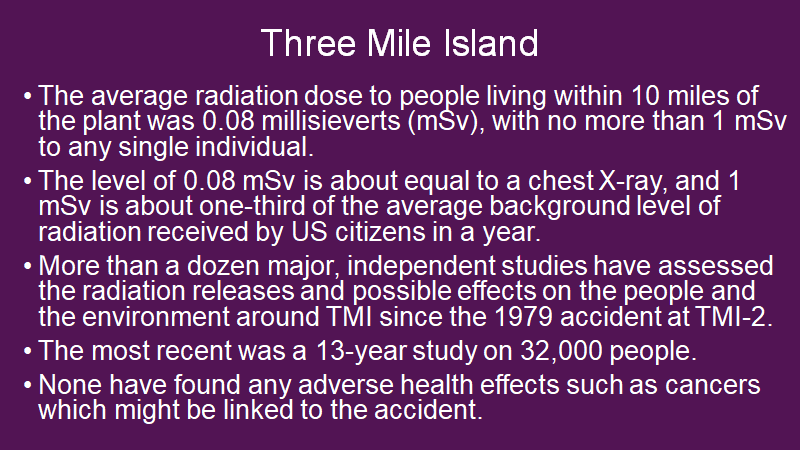
Three nuclear power plant accidents are well known. Using some of my slides from my presentations, the basic facts as best I can ascertain them are given below.

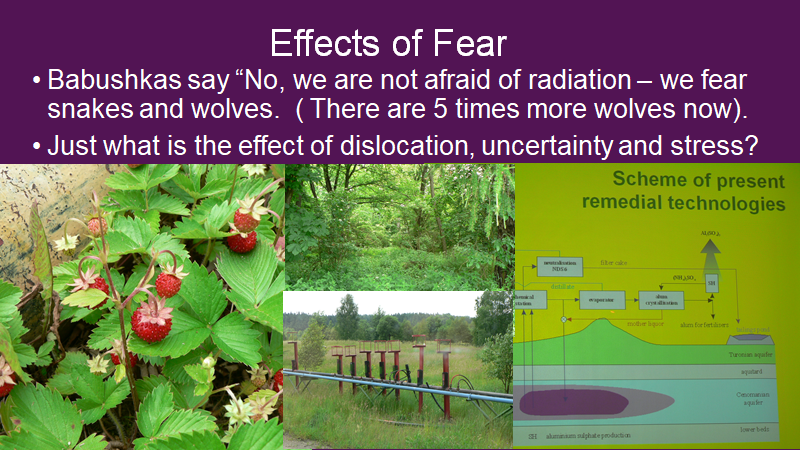
Fear caused all the health effects.

Chernobyl was a terrible happening. So many things were wrong including dreadful design with just a thin concrete cover and international coverup following the explosion. Documents are still being written about the details.

Recorded interviews with Babushkas are enlightening. “My friends who stayed away are all dead now and we are still alive.” 

Ukraine, the site of the Chernobyl disaster obtained almost half of its electricity from nuclear power plants in 2021. It was planning to build more. I have been presenting detailed updates about the happenings and safety of nuclear facilities in Ukraine during each presentation I do.

In 2008, My husband and I attended an International Mining Water Association conference in Karlovy Vary within the Czech Republic. The U.S.S.R. had pillaged its surrounding countries leaving massive legacies. One of the remediation projects we visited was a uranium mine with contaminated ground water. The rehabilitation scientists presented the chemical data and then took us out to view the works which were in their last stages. In one area there were beautiful, ripe, wild strawberries. I picked a strawberry and illogical fear erupted around me. I said, “You have seen the data, these are perfectly healthy to eat, and I am not worried.”  Suddenly, the men around me were trying the strawberries too and they were wonderful.

A friend who worked at the UN International Atomic Energy Agency (IAEA) in Vienna, told me in 2005 that the IAEA had learnt many lessons about how to manage a disaster at Chernobyl. A whole generation of rural farming children grew up without sufficient protein in their diets, eggs and milk being their traditional sources. Fear caused a lot of unnecessary damage. However, these lessons were forgotten or not learnt by Government authorities when a tsunami hit Japan.

Many studies have been published about the incidence of thyroid cancer in children following Chernobyl. A very large collection of thyroid tissue samples was collected from thyroid cancer sufferers. A very recent genetic study has shown that children receiving high doses of Iodine 131 soon after the disaster do have quite distinct genetic damage from that of children diagnosed with thyroid cancer since that time. (References:

  1. Yeager M, Machiela MJ, Kothiyal P, et al. Lack of transgenerational effects of ionizing radiation exposure from the Chernobyl accident. April 22, 2021. Science. DOI: 10.1126/science.abg2365.
  2. Morton LM, Karyadi DM, Stewart C, et al. Radiation-related genomic profile of papillary thyroid cancer after the Chernobyl accident. April 22, 2021. Science. DOI: 10.1126/science.abg2538.)

Iodine 131 breaks down very quickly. The following graph shows its decay curve. Half of it has decayed in 8 days and 99.9% in 80days.

Japan shut down many of its nuclear power plants. After very extensive safety testing and refurbishment, many of these power plants are now back in operation.

Antinuclear campaigners used the following picture with the heading shown on it to frighten people around the world. Yes, it is a graph produced by the National Oceanic and Atmospheric Association of the US (NOAA), but it is not a graph of radiation but of wave heights. It had no relation to radiation levels in sea water.

There is a tendency when people become sick, particularly with cancer, to blame nuclear radiation as the culprit. When I was head of the technical division for environmental regulation in mining in the Northern Territory the outcome of an investigation near Ranger Uranium Mine illustrated this point. Members of the Jawoyn people were becoming sick. They gathered food in a billabong downstream of the mine. The Jawoyn blamed the mine. Extensive monitoring of the food and water showed only very low background levels of radioactivity.  The investigations detected dangerous levels of raw sewage contamination. Bacteria were causing the sickness and the situation was soon rectified.

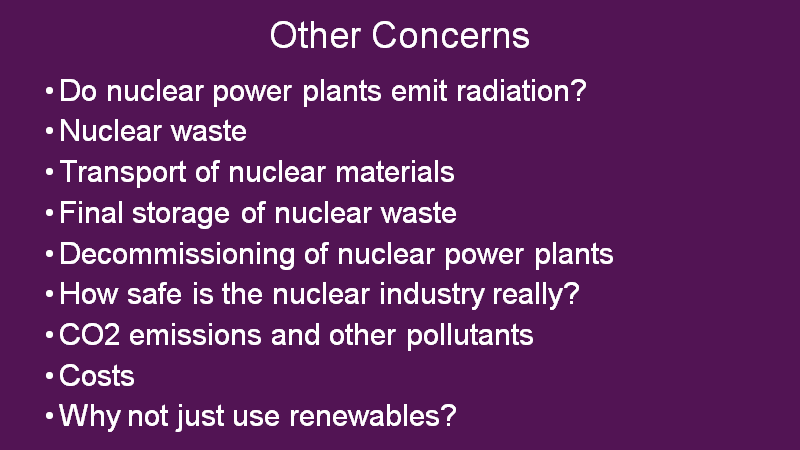
There are other concerns voiced about nuclear energy, and these will be discussed in later blogs.