Nuclear Power Radiation is Benign! Part 1

This is a copy of a Substack article by Robert Hargraves on April 6.  The full essay will be posted in several parts. https://substack.com/@roberthargraves1

Abstract

The root cause of nuclear power cost and opposition is excessive fear of radiation. This essay explores true observed radiation, effects, harm, and benefits, summarized here, proven later.

Doesn’t radiation from nuclear power plants causes cancer?

No, its radiation damage rates are slower than biological repair rates.

Isn’t the nuclear waste harmful to future generations?

No, we can store used fuel in ground-level casks as penetrating radiation decays away. You’d then have to eat the waste to get sick.

Don’t nuclear power plants cost too much?

Yes, because regulators’ rules were written using the precautionary principle, not today’s scientific observations.

Full Essay

Radiation is a weak carcinogen. After the WW II atomic bombings of Japan we all feared globally destructive nuclear war. To intensify that fear NGOs and nations exaggerated geneticists’ idea that even trivial amounts of radiation constantly degraded human genes through generations, even to birthing three-eyed monsters. When that fiction was disproven, the radiation fear of choice became cancer.

Governments and regulators strove to protect voters from the vague harm of invisible radiation, creating rules and procedures to keep people away from any radiation from nuclear power. These rules constantly became more strict and cumbersome.

These radiation exposure rules from worldwide regulators such as the US Environmental Protection Agency and Nuclear Regulatory Commission created the problem of high cost and long build times, making new nuclear power too expensive. In reality, nuclear power can be the least expensive reliable energy source, at $0.03/kWh, if we educate the public, politicians, and regulators.

Fear can kill. Radiation from the triple Fukushima nuclear reactor meltdown killed no one, but Japan’s fearful government killed over 1,600 people with hasty, unnecessary evacuations.

Nuclear power optimism is on the rise. Will people return to nuclear fear after the next failure leaks some radioactive material out? Perfection is impossible. Radiation releases will happen. Airplanes do crash. People still fly. They understand authentic risks and benefits.

Two Westinghouse AP1000 nuclear power reactors has been powered up in Georgia. Will these be the last commercial US nuclear power plants?

Radiation fear

Wisdom of a woman awarded two Nobel prizes.

Ionizing radiation harms by displacing electrons, breaking molecular bonds in cells. Radiation dose is measured in Sieverts (Sv) or Grays, which are watt-seconds (joules) of energy absorbed, per kilogram of tissue. These are the effects of intensive, brief absorbed doses of radiation.

  • 10 Sv is deadly,
  • 1 Sv risks non-fatal acute radiation sickness,
  • 0.1 Sv slightly increases future cancer risk.

Regulators mistakenly claim any radiation exposure is potentially harmful, so set unreasonably low limits, hoping to calm fearful people. Media headlines frighten people about any radiation leaks, no matter how small, in order to gain attention with headlines.
Nuclear power growth, now in vogue, will end with the next radiation release unless we replace today’s regulators with institutions that balance benefits against quantified radiation doses and observed effects.

The near century of concessions lowering 1934 radiation limits from 0.002 Sv per day to 0.001 Sv per year has not reduced harm. Lowered limits have increased public fear, along with evidence-free rulings that all radiation is potentially fatal.

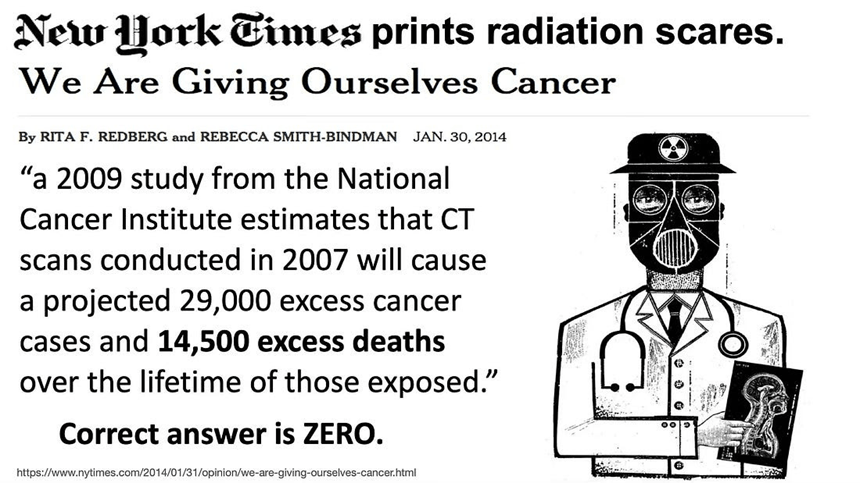
Newspapers often highlight unsubstantiated claims of radiation harm, such as this New York Times fright about CT scans, “a 2009 study from the National Cancer Institute estimates that CT scans conducted in 2007 will cause a projected 29,000 excess cancer cases and 14,500 excess deaths over the lifetime of those exposed.” The correct number is likely zero.

Atomic bomb survivors

After the 1945 atomic bombing of Hiroshima and Nagasaki, people and nations became concerned about the destruction of possible world-wide nuclear war. In 1950 began a studies of the health of the atom bomb survivors. The work was undertaken to make people more aware of the possible long term effects of radiation on genetics, and to increase fear of nuclear warfare. The Radiation Effects Research Foundation (RERF) maintains the data and publishes papers that explore linkages between cancer and radiation exposure. Radiation doses, by individual, were estimated after asking people where they were at the time of the bomb explosions, five years before.

The US National Academies used REFR data to claim that the risk of solid cancer is directly proportional to absorbed radiation dose. They promote the LNT (linear no threshold) model of health effects of radiation, which maintains the chance of cancer is directly proportionate to radiation exposure, and thus there is no safe dose of radiation. They published this following chart of cancer risk for bomb survivors.
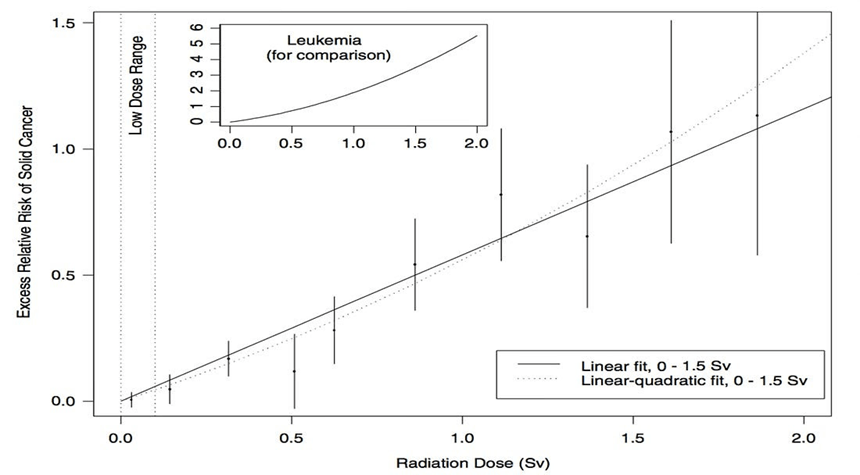
Excess cancer risk for people irradiated by the atomic bomb

However, the data point in the low dose range of exposures less than 0.1 Sv does not show evidence that such low doses case cancer. Few in the radiation science community endorse this LNT model of low dose radiation effects, but LNT remains the official policy of the US EPA, NRC, and many other organizations in the radiation protection industry.

National Council on Radiation Protection hides data refuting LNT.

A 2001 article by Jaworowski and Waligorski illustrated how many scientists were misinforming governments with information tailored to continue the simplistic LNT model. They misled people into fearing that even low level radiation was potentially deadly. The right side of their graphic shows the NCRP’s (National Council on Radiation Protection) seemingly linear relationship between leukemia mortality and radiation exposure for survivors of the atomic bombing, evidencing their support for LNT.

The left hand side shows the UNSCEAR (United Nations Scientific Committee on the Effects of Atomic Radiation) with much more detailed information about the effects of low dose radiation. There is clearly no evidence of increased leukemia mortality from radiation doses under 0.1 Sv (100 mSv). Clearly the LNT model is wrong.

A-bomb survivors’ exposures < 0.1 Sv caused no excess cancers.

The chart above uses bomb survivor cancer data to display that cancer rate increases from radiation, if any, are unobservable at doses < 0 .1 Sv. The leftmost, blue bar represents residents who happened not to be in the cities when the two atomic bombs exploded.

Part 2 will discuss regulation of nuclear facilities

Endnotes

A fully referenced version, with endnotes and URL links, is https://hargraves.s3.us-east-1.amazonaws.com/Benign!+Nuclear+power+radiation.pdf

Australia Can No Longer Manufacture Windows For Homes

It’s nuclear or nothing if we wish to be a reasonably self-sufficient country. With no merchant navy at all, we are very vulnerable from a security viewpoint if we rely on the import of all our fertilizers, most building materials and chemicals.

 The following article was written on Thursday 13 March 2025 written by Leith van Onselen for MacroBusiness daily email. https://www.macrobusiness.com.au/2025/03/australia-can-no-longer-manufacture-windows-for-homes/

“Australia’s last major plastics manufacturer, Qenos, closed last year due to high energy costs. Now, Australia is wholly reliant on imported plastics from China.

In February, Australia’s only architectural glass manufacturer, Oceania Glass, collapsed after 169 years of operation, amid soaring gas costs.

Oceania Glass was Australia’s only manufacturer of architectural flat glass, producing and distributing format glass for use in Australian homes and buildings.

According to the company’s website:

“We have a proud heritage serving Australia, having sold our very first glass in 1856 and are the only architectural glass-maker in Australasia”.

“Our glass is featured in many of Australia’s most iconic buildings, including the Australian Parliament House”.

Oceania Glass required large amounts of energy, particularly gas, to maintain the 2000-tonne furnace at the heart of its operations.

“Certainly, for us as glass manufacturers, there are no real current alternatives for glassmaking outside of natural gas or other carbon fuels”, Oceania Glass chief executive Corné Kritzinger stated in January 2022.

Oceania Glass officially shuttered on Monday 3 March, and CEO Corné Kritzinger left the following heartfelt message on LinkedIn:

On Monday, 3 March 2025, Australia lost another critical manufacturing capability—architectural float glass. The closure of the country’s last remaining float glass plant was a quiet event, attended only by employees. This stood in stark contrast to its grand opening 51 years ago, when political and business leaders gathered to celebrate a milestone in Australian manufacturing.

There was no media coverage, no public acknowledgment—most Australians remain unaware that an entire industry has disappeared from their own backyard.

For the past 11 years, Australia had just one operating float glass plant. Now, there are none. We are entirely dependent on imported glass.

The reasons behind this closure are complex, but they boil down to one fundamental issue: Australia’s economic and regulatory environment is increasingly unfavourable to manufacturing. The challenges were insurmountable.

This business had a long and proud history. It began in 1856, importing glass into Victoria. In 1931, the first manufacturing plant opened in Sydney, producing patterned glass and shortly thereafter sheet glass. A drawn sheet plant- the predecessor to float glass – commenced in Dandenong, Victoria in 1962. Then, in 1974, Australia’s first float glass line, and the first in the Southern Hemisphere, was established in Dandenong. This investment drove rapid growth, leading to a second float line in Ingleburn, Sydney, in 1988 during Australia’s Bicentenary.

Float glass production is both an art and a science. It requires precisely blending seven raw materials and melting them in a furnace at a staggering 1600°C—comparable to the belly of a dragon.

Natural gas fuels this intense heat, triggering complex chemical reactions that transform raw ingredients into perfectly smooth, crystal-clear glass.

But now, that dragon’s fire has been extinguished—permanently.

To all who have worked for and alongside this business over the past 169 years, thank you. Your contributions and dedication have shaped an industry that, though gone from our shores, will not be forgotten.

Obviously, the hyperinflation of East Coast gas costs made Oceania Glass unviable.

These costs are certain to soar even higher once LNG import terminals are built in NSW, Victoria, and South Australia, thereby locking in import parity prices at the same time as nearly three-quarters of East Coast gas is exported, mostly to China.

So, while Australia exports most of its East Coast gas to China, it will now import plastics, glass, and nearly every other manufactured good from China, thanks to expensive energy costs.

All of Labor’s fantastical 1.2 million housing construction target will now rely on imported windows. We are not a serious country.” End of article.

It is worth noting that the use of gas instead of coal reduces CO2 emissions by half. Come on Australians, we can do better than this!

The Effect of False Fear of Low-Dose Radiation – Fake Graph of Fukushima

Japanese Tsunami March 2011

A magnitude 9.0 earthquake, centred to the east of Sendai caused  a wave 10m high travelling at 800 kph .  The highest wave hitting the coast of Japan was 23m. It travelled inland for 10 km in some places. The Hawaiian Islands had waves over 3 metres high. As many as 19,500 lives were lost from both the earthquake and tsunami.

Misinformation

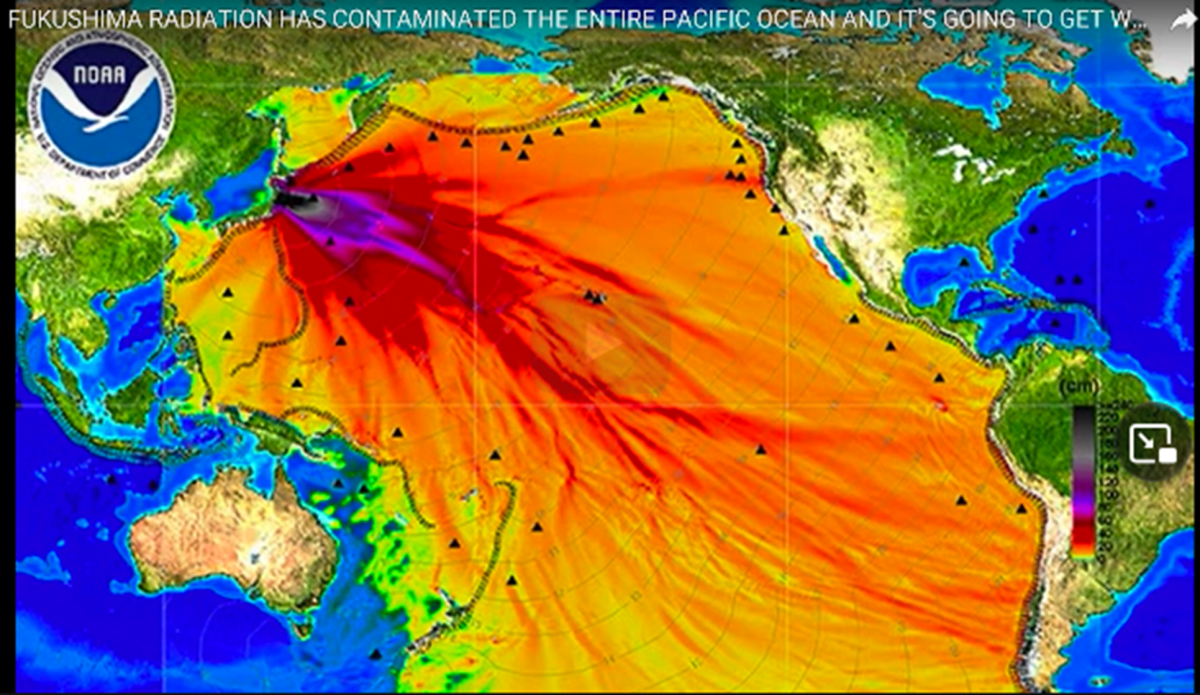
The following figure, with the added title “FUKISHIMA RADIATION HAS CONTAMINATED THE ENTIRE PACIFIC OCEAN AND ITS ONLY GOING TO GET WORSE!” was repeated over and over again on the web by various “green” groups.

Yes, the figure was produced by NOAA (National Oceanic and Atmospheric Administration of the US Government). BUT it is a graph of WAVE HEIGHTS after the tsunami. NOAA does not measure radiation levels.

A similar graph has been used for years by Helen Caldicott including during a presentation to Teals before the last election. Helen’s graph had a logo from a company in Australia that does undertake radiological measurements. The company stated on their website that it was not their work and that their logo was falsely included. She must have known for nearly ten years that the graph was false. I am also horrified by nuclear war and nuclear bombs and admire her work in this area but not at the cost of truth about low dose radiation.

Nuclear power plants and nuclear bombs are very different. I hate nuclear weapons. However, the use of falsified information when advocating for the banning of nuclear weapons or nuclear power is not OK. It is particularly abhorrent when scientific data is used in a way that the author knows to be untrue. I was told to use this technique in an environmental campaigning course by a famous international “Green” organisation.

These types of fear peddling are totally unethical, particularly when they pretend to be scientific in nature.

Why Do the Media call the Tsunami, the Fukushima Nuclear Disaster?

How many deaths could have been avoided if suggestions for evacuation or shelter in place standards suggested by the IAEA had been used. But Fear and Panicked Evacuation of about 100,000 people was responsible for 2313 disaster-related deaths among evacuees from Fukushima prefecture.

An old nuclear power plant overdue for decommissioning was damaged at Fukushima Daiichi by a wave 13-15m high. The placing and tsunami protection of the Daiichi plant assumed a 3m wave.

Eleven reactors at four nuclear power plants in the region were operating at the time and all shut down automatically when the earthquake hit. Subsequent inspection showed no significant damage to any from the earthquake itself.

The residual heat cooling systems worked for 8 out of the 11 power plants. At Fukushima Daiichi, electrical power from all 6 external sources stopped and the generators turned on until the tsunami flooding disabled 12 0f 13 backup generators running the cooling systems. Switching gear was also damaged.

Heat built up causing steam in the cooling systems. Hydrogen was produced by the steam reacting with exposed Zircaloy cladding. The containments were filled with inert nitrogen, which prevented hydrogen from burning in the containment. However, the hydrogen leaked from the containment into the reactor buildings, where it mixed with air and exploded. 3 of the 4 reactor buildings were damaged by hydrogen explosions. This was not a nuclear explosion. It was simple chemistry. To prevent further explosions, vent holes were opened in the top of the remaining reactor buildings. All reactors were stable within 2 weeks.

Three Tepco employees at the Daiichi and Daini plants were killed directly by the earthquake and tsunami. There have been no deaths or cases of radiation sickness from the nuclear power plant incident. One man from the plant died of cancer died soon afterwards but it is thought to be unrelated.

But in contrast there were 2,300 deaths caused by fear of radiation that triggered the evacuation.

Government nervousness to this day has delayed the return of many evacuees to their homes. Concerns about radiation in the sea caused panic even in the USA and some people made themselves sick with overdoses of iodine.

Tritium.

About 18 months ago, South Korea and China advised their citizens to stop eating seafood. Water used to cool the Fukushima reactors had been decontaminated and stored in large tanks and was finally to be released to the sea by Japan. The IAEA carefully monitored the releases. Korean fishermen were suffering loss of income as a result of the bans. After Korea monitored the sea water, they reversed their advice. China has only recently lifted their ban as they could not detect any contaminants. I followed the data for a while. Sometimes the tritium levels were so low in the discharge, the discharge water was diluting the tritium levels in the the sea water.

Tritium is created every day in our atmosphere and comes down in the rain, ending up in the sea. This natural process is the overwhelming source of tritium in the ocean.

For more of my blogs about tritium, see https://onewomanjourney.com.au/2023/08/25/tritium-trivia/

https://onewomanjourney.com.au/2023/08/31/its-raining-i-might-get-tritium-in-my-hair/

https://onewomanjourney.com.au/2023/09/06/the-iaea-and-fukushima-water-release/

https://onewomanjourney.com.au/2023/09/09/south-korea-monitors-fukushima-release/

The Chernobyl Liquidators: Where Are They Now? How Are They Now?

The Chernobyl liquidators are the people who were called in to deal with the immediate aftermath of the Chernobyl nuclear disaster in 1986. They lived in tents close to Reactor 4 and did so much work to keep the site safer and cleaner than it would have been. They are the firefighters, the men who cleaned off the burnt material on the roof of the reactor building. They built the sarcophagus, worked in the power stations, buried parts of the red forest and buried topsoil and nearby villages.

An estimated 350 000 clean-up workers or “liquidators” from the army, power plant staff, local police and fire services were initially involved in containing and cleaning up the radioactive debris during 1986-1987. About 240 000 liquidators received the highest radiation doses while conducting major
mitigation activities within the 30 km zone around the reactor. Later, the number of registered liquidators rose to 600 000, although only a small fraction of these were exposed to high levels of radiation.
https://www.who.int/docs/default-source/documents/publications/health-effects-of-the-chernobyl-accident.pdf

The full WHO 167 page report can be found on https://iris.who.int/bitstream/handle/10665/43447/9241594179_eng.pdf

Where Do the Liquidators of Chernobyl Live Now?

The majority still live in Russia, a few thousand still live in Estonia, many live in Slavutych and about 1500 moved to Israel. Chernobyl has been a Jewish enclave down through the centuries. The original liquidators were given little protection in very highly radioactive situations. My surprise is that some staff from Reactor 4 and some of the firefighters that crucial night are still alive. Depending on their country of residence, some of the liquidators receive pensions and/or have received compensation payments.

In the years before and after the Chernobyl Accident, the people of the USSR and later the independent states went through a period of poor nutrition and absent or very inadequate medical facilities. The average life span of men in these countries has increased dramatically as living conditions have improved. For example, people in Russia only had an average life span of 65 in 1993 and a life span of 73 in 2022. I saw one figure of only 53 years in the 1980s. In 2022, Ukrainians still only had a life span of 69 years. Smoking and drinking vodka were frequent pastimes during the hard years.

In 2006, Opinion was Divided over Chernobyl’s True Toll

The World Health Organisation and UNSCEAR (The United Nations Scientific Committee on the Effects of Atomic Radiation) both published reports in 2005. A fierce debate broke out fueled by scientists in Ukraine, Belarus and Russia as well as entities like Greenpeace that felt that the health impacts of Chernobyl were badly underestimated by WHO and UNSCEAR. The WHO and UNSCEAR reports claimed that fewer than 50 people died as a result of radiation from the Chernobyl Accident. Other estimates of the number of deaths so far in the former Soviet countries range as high as 50,000, reflecting deep splits in opinion over the appropriate way to evaluate the long-term effects of the tragedy. https://www.thelancet.com/action/showPdf?pii=S0140-6736%2806%2968559-0

There is no doubt that evacuation, dislocation and treatment of the liquidators led to severe mental illness in many people. Fear and stress can cause many illnesses. Claims by a Russian scientist of genomic instability is concerning. Genomic instability is only one of the many factors needed for cancer to manifest.

Unfortunately, many of the higher estimates from epidemiological modelling are based on the LNT Model formulated after WW2. It is now known to overestimate the potential impacts of low dose radiation.

Experts talk About the Health Effects of Chernobyl

https://www.unscear.org/docs/reports/2008/11-80076_Report_2008_Annex_D.pdf

Being exposed to the sort of doses that come out of nuclear power plant accidents is far less dangerous than going sitting on a beach in Australia.” – Jerry Thomas

South Korea Monitors Fukushima Release

Decades ago, I worked as an environmental scientist based in Hong Kong. I still stay in touch with some of my staff, who now are very experienced in their careers. I had heard that Hong Kong people were being warned about buying seafood, particularly seafood from Japan due to the release of water from Fukushima. I received an interesting article yesterday and quote from a section of it in the original Chinese together with the translation. I have omitted the first paragraphs. The references vary in their language but Note 2 is in English.

I jump to the last paragraphs examining the above 7:30 report.

當然,你依然可以反駁,日方的數據是假的。那麼你也可以看看韓國新聞。根據昨日韓聯社的消息,上周四日本排放核廢水後,韓國政府已在該海域30個點位進行緊急輻射測試,所有樣本均符合安全標準,而截至目前為止,韓國內的海鮮或進口海產尚未測到輻射。 (注2)

事實上,韓國從來不信日本,甚至不信國際原子能總署,所以7月以來,韓國已在200個海洋點位自己做水質監測,日本也無任歡迎。但奇怪的是,中国居然沒有像韓國般,實事求是加入監測行列,只堅持嚇鬼不動搖地在大陸、香港做「大內宣」,讓「財經作家」那種寫手散播假資訊,唯恐天下不亂地製造恐慌

因此我們可以假定」,中央政府正在下一盤很大的棋,旨在「給中国人民上一課科普」,引導民眾搶購可測試核輻射的蓋格計數器,之後驀然回首,才發現自己家的輻射原來比東京強900多倍(注3)——也許是中国建材問題——背後的理由實在太令人暖心了。

“Of course, you can still argue that the Japanese figures are fake. Then you can also check out Korean news. According to Yonhap news yesterday, the South Korean government has conducted emergency radiation tests at 30 points in the sea after Japan discharged nuclear waste water last Thursday, all samples met safety standards, and so far no radiation has been detected in seafood or imported seafood in South Korea. (Note 2)

In fact, South Korea has never believed in Japan, or even the International Atomic Energy Agency, so since July, South Korea has done its own water quality monitoring at 200 ocean points, and Japan is not welcome. But strangely enough, China has not joined the monitoring ranks like South Korea, just insist on scaring ghosts and doing “big internal propaganda” in mainland China and Hong Kong, letting writers like “financial writers” spread false information, lest the world will cause panic.

“So we can assume” that the central government is playing a big game of chess, aimed at “teaching the Chinese people a lesson in popular science”, guiding the public to snatch up Geiger counters that test nuclear radiation, and then looking back to discover that their own home’s radiation is more than 900 times stronger than Tokyo (note 3) – perhaps China’s building materials problem – the reason behind it is too heartening.”

Notes (References):

1 https://t.ly/Vdvih

2 https://t.ly/BjuD4

3 https://t .ly/g7arY

As expected, the South Koreans have not been able to find fault with seafood or seawater. One has to question the motives of countries who spread fear about radiation when these same countries build and sell nuclear power plants. Is it a question answered as it so often is “Just follow the money trail”?

When Quick Decisions Lead to Wrong Conclusions

The final step: making sure to put numbers in their right context. Are we looking at the whole picture? What works for some people may not work so well for others.

There is a tremendous amount of excellent technical information about radioactivity on the web, but it is often hard for anyone without that specific training to understand. There are also a lot of misleading statements and conclusions on the web. These even appear in peer-reviewed scientific journal articles such as the Chinese paper given as a link in my blog Tritium Trivia. This paper showed the results of modelling various releases of tritium water from Fukushima. Unfortunately, the last step was forgotten. Showing great expanses of red all over the Pacific Ocean would lead nearly everybody to say “How terrible! Japan is polluting the Pacific Ocean with radioactive material.” However, at the end of the document the background levels of tritium in the Pacific Ocean are quoted and this puts the release data into perspective. But nowhere in the paper was the context of the data given, that is that the levels of tritium were so low compared to normal background levels that they would be impossible to distinguish from the background variability.

I have made the decision that I will try to make my blogs as easy to read as I can so that they are suitable for most users of the web. This is not easy with technical information and my background of writing technical reports. Word has an editor function that allows you to calculate the readability of the document. Yesterday, for the very first time I managed to achieve my goal.

I was so excited that I quickly finished the blog and published it only to realize within minutes that I had forgotten a crucial step. I had jumped to the conclusion too quickly and not fully put the information into context. I rapidly edited the post and republished it. However, my subscribers received a set of comments that were not quite right. In my joy of finding a way to explain just how low tritium levels can be, I forgot just how many hydrogen atoms are in a little water. 18 g of water (one mole for the technocrats) contains 6*1023 molecules of water, 12*1023 hydrogen atoms and about a million tritium atoms.  This is still just as teeny in radiation terms but the numbers 1 and a million sound so different. 1TU is only 0.118 Bq/L. I will explain what this means in future blogs.

I apologize to my subscribers. At my age you are allowed to call it a senior moment. However, I suspect that in our current haste over climate change mitigation, we are all making similar mistakes. We do the first part of the work but then forget to really look at the big picture and put everything into context.

There Is Already So Much Good Information on the Web

I have been having so much trouble writing this blog. There are so many people out there who can communicate in a clearer fashion than I can. Why would my blog make any difference to a world that needs so much help? Both you dear reader, and I need to remember that if we even educate or influence one other person, we have helped to change the world for the better.

It is impossible to share with others everything that I have learnt on this nuclear journey of mine, but I must try. Without nuclear power, we will find ourselves going back to the dark ages which was such a cruel world.

Renewable energy technologies can only take us so far. There are three major reasons for this. The first is energy density. Wind and solar power cannot provide enough energy to both manufacture themselves, mine the materials they require, recycle some of their components and still produce electricity for other purposes.  Nuclear can. Secondly, the resources to make enough wind and solar for both the developed and the developing world don’t seem to exist. Basic physics ensures that the energy required to completely recycle components is enormous.

Finally, the land requirements for wind and solar are huge but not impossible. Unfortunately, to find enough land, we destroy or badly harm biodiversity of all types including forests, wetlands, mangroves and our precious and diminishing arable soils. Nuclear power requires less space despite the stupidity about radiation caused by fear.

Nuclear Now is a 2022 American documentary film, directed and co-written by Oliver Stone. It is a film that I would like everybody to watch. It is very long film and really has too much information for one sitting. I have provided a link to the film below. Do make use of the link while it still works.

There is also a book that I would love everybody to read. Jack Devaney makes some points that I believe should be considered by regulators in every country. The book is finally available as a paperback from a number of sources. It is a big book but even reading the beginning chapters and the final chapters is more than worthwhile.

The book is not as negative as the title “Why Nuclear Power has been a Flop”suggests. The book supplies many fascinating insights.

“Jack Devanney is the principal engineer and architect of the ThorCon molten salt reactor power plant. Since 2011 he has pursued his idea of using shipyard construction technology to mass-produce safe, inexpensive power plants that can bring the benefits of electricity to all the world, with no CO2 emissions. He married the advanced nuclear technology developed and demonstrated by Oak Ridge Laboratory with his own engineering experiences with ships, power plants, and energy.” – Amazon.com

Jack also speaks on Decouple and has lots of information and fascinating ideas on his Geordian Knot News.  http://jackdevanney.substack.com

2d Basics About Nuclear Power Plants and Waste

Source: Canadian Nuclear Association https://cna.ca/reactors-and-smrs/how-a-nuclear-reactorworks/

Canadian nuclear power reactors are CANDU reactors – heavy water reactors developed by Canadian scientists and engineers. CANDU stands for Canada deuterium uranium, because it uses deuterium oxide (heavy water) as a moderator and coolant and uses natural (not enriched) uranium as a fuel. There are 19 in operation in Canada and another 11 elsewhere in the world. India also has 16 nuclear reactors that are based on the CANDU model.

I have included this schematic because it shows other important elements of a nuclear power plant.  When used fuel rods are first taken from a reactor, they are both thermally and radioactively hot and must be cooled down.  They are placed in a special cooling pool close to the reactor, shown as “used fuel management.”

About a decade ago, my husband Dr David Jones was invited as a guest speaker on uranium mining at a conference in Sweden.  We took the opportunity to visit every nuclear facility we could and included all stages of nuclear waste management. I talked them into giving me a copy of the video below which shows some of the aspects of waste handling in Sweden. It is worth watching.

Click on the video to start it

2c How Does Nuclear Energy Work?

Ultimately, all the energy we use arises from some form of nuclear energy. The Sun’s energy reaches our planet as a result of nuclear reactions in the Sun itself. This energy is critical to our survival on Earth. The sun provides the energy for photosynthesis and hence all our food, wood, and dung. All the fossil fuels were created many millions of years ago from plants that derived their energy from the Sun. Differences in the heat from the Sun hitting Earth at different latitudes drives our climate engine. These differences in heat around the globe creates the wind that drives our wind turbines. Going back in time, it was nuclear reactions out in space that created the elements we find on Earth.

This video introduces the concepts of nuclear fission and can be found on https://www.youtube.com/watch?v=D91T-B-PVE0 if you have challenges making the embedded video work.

All the commercial nuclear power plants (NPP) operating today use nuclear fission as their source of heat energy. Optimism suggests we may be able to use nuclear fusion at some time in the future as an alternative to nuclear fission.

A great deal of energy holds the protons and neutrons of an element’s nucleus together. The heavier elements tend to degrade into lighter elements. Elements close to iron (Fe) in the periodic table are very stable. When elements come apart for whatever reason we call this nuclear fission. Because it takes less energy to hold the resulting smaller nuclei together, a lot of energy is released. Uranium and plutonium have excessively big nuclei and fall apart relatively easily depending on the number of neutrons present. Looking at the periodic table below, the heaviest elements are shaded in yellow, and they are all radioactive. The heaviest elements may only exist for minutes or seconds as they are so unstable. Some of the elements with smaller nuclei have minor isotopes that are radioactive, depending on the number of neutrons in their nuclei.

This schematic works for most types of electricity generation power plants operating today. In the case of nuclear power stations, the heat source is a nuclear fission reactor which creates hot, pressurised steam which turns a turbine. The fossil fuel power plants work in a similar manner. After use, the steam condenses back to water and recycles past the heat source again.

Cooling water is kept separate from the recycling water for many reasons. For example, condenser water, which is cooling water, can be sea water and  taken directly from the ocean and returned to it at a slightly higher temperature. Marine life, close to a variety of power stations, is slightly different to that a little further away. In most cases, the slight increase in temperature leads to a greater density of some marine species. Detrimental effects are not found. The boiler water is usually exceptionally clean water with special additives to keep pipes and pumps from eroding or clogging up.

The giant cooling stacks are part of many diverse types of power stations and only emit steam from cooling water.

Even hydroelectric and wind power work in an analogous manner to that shown on the top part of the diagram above. There is no heat source, the power to drive the turbines comes from rushing water or air. There is no need for a cooling system. However, even hydroelectric schemes can have a small impact on water temperatures both upstream and downstream of the power plants.

The energy of the spinning turbines becomes electrical energy by moving magnets within the electrical generator. This short video was  cut in my talks and was used just to remind us about electrical units. It has taken from MW vs. MWh: Do You Know Your Electric Units? https://www.enerdynamics.com

https://www.enerdynamics.com/Energy-Insider_Blog/MW-vs-MWh-Do-You-Know-Your-Electric-Units.aspx

Since the beginning of 2022, many countries in Europe are doing a U-turn away from closing down their nuclear power stations to planning new nuclear power plants.

The BWR type reactors work in exactly the same way as shown in the general schematic for a power plant.

Light-water reactors use ordinary water, also called light water, to produce steam to drive their turbines. Water also acts as a neutron moderator that slows neutrons down so more reactions can occur. Water absorbs too many neutrons to be used with unenriched natural uranium as fuel. So, the fuel used is enriched to 3-5% U238. Canada’s CANDU reactors can use natural uranium as fuel, but they are not light-water nuclear reactors. Instead, the reactor water used is heavy water.

PWRs have one more system that circulates water. Water passing through the reactors is separate to that in the circuit that drives the turbines. In order to generate steam efficiently, the “reactor water” is maintained at a high pressure and thus higher temperatures can be reached.

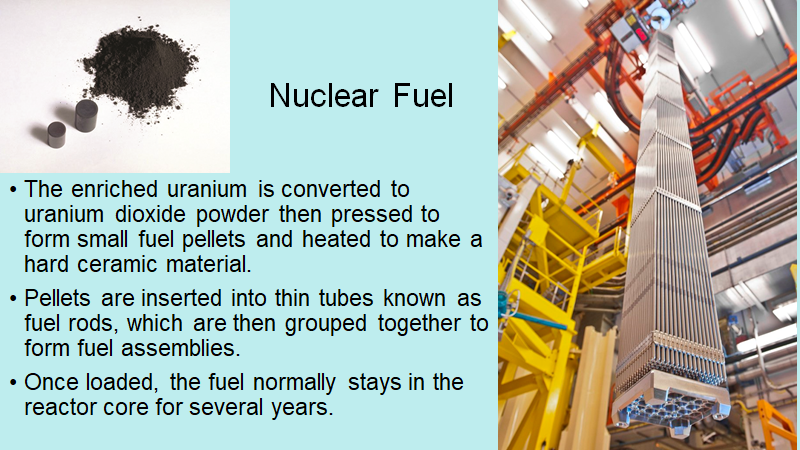
Many people visualise nuclear waste from reactors as a liquid. All highly radioactive waste is solid and contained in fuel rods within a fuel assembly and then kept within further layers of protective containment  More details about waste handling is presented in later blogs.

2a Does Nuclear Power have a Place?

Why are we planning on decarbonising our world? Well, there are lots of reasons including the chance for some entities to make lots of money. The main reason is illustrated below:

How are we doing? Well,  I am sure that I saw graphs for Australia showing that our methane and nitrous oxide levels were coming down and I put the methane reduction down to the reduction in our cattle and sheep numbers over the last decade or so. I cannot find my reference to those graphs despite my attempts at filing the information I have read in the last few months. The recent data for methane emissions show that our levels are rising (IEA Methane Tracker). I assume that this is probably due to fugitive emissions from the Queensland newly developed gas fields.

I must apologise, as I gave the wrong impression at the first presentation of this information at U3A in Atherton. I did not put this information up on the screen, it was only verbal but some of the attendees will remember my statement about Australia’s methane and nitrous oxide levels coming down.

One of the difficulties I have found when preparing my talks is a disparity in numbers between one source and another. However, it is clear that on a per capita basis, Australia emits some of the highest levels of CO2 and methane. Methane is emitted from wetlands and in quite substantial amounts. Worldwide, the fossil fuel industry seems to be working hard to control fugitive emissions and flaring as shown on the slide below. A few more years of data will clarify the level of methane emission as the flattening of the curve may be due in part to restricted travel during the COVID epidemic. Methane is emitted from wetlands and in quite substantial amounts.

The next few graphs come from the International Energy Agency (IEA) website https://www.iea.org/data-and-statistics. It is obvious that the bulk of worldwide CO2 emissions arise from the use of the fossil fuels coal, gas and oil. Gas produces about half the CO2 compared to coal for the generation of the same amount of energy. All the fossil fuels are valuable commodities in their own right for the manufacture of many goods we take for granted in our modern lives. They form the feedstock for so many chemicals, and they are a finite resource. It is such a waste when we just burn them to produce energy. Coal is still needed for the production of steel and a substantial proportion of Australia’s coal exports are used for this purpose. Recent technologies such as the use of hydrogen for steelmaking offer hope for the future.

Nuclear power plants have been producing a steady supply of electricity for over 30 years, but nuclear power has not been used to supply energy for other purposes. Despite the rapidly increasing construction of solar and wind power, again these energy sources are only used for the production of electricity. One of the obvious ways to decarbonise our energy, is to use electricity as a replacement for the production of heat and for transportation. Some public transportation systems around the world have always been electric. Electric trucks have been used in some transport sectors for nearly a century. China has been remarkably busy building high-speed, electric train networks this century.

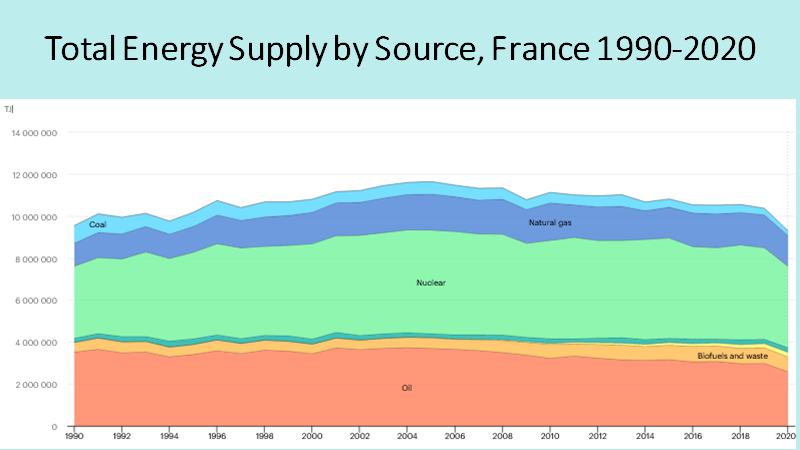
Unfortunately, some of the EU countries such as France, Sweden and Germany have been closing down some of their nuclear power plants earlier than needed. France has had some of the cleanest electricity in the world at cheap prices, but the push for replacement by wind energy has taken them in the wrong direction. In the last few months, a number of EU countries have taken a U-turn and are planning more nuclear power plants. There has also been a real push to improve efficiency of electricity use within the EU. As can assumed from the graph below, even France produces significant levels of CO2 due to the use of oil for heating and transportation.

Despite the billions of dollars and euros spent on erection of new wind farms, the percentage of electricity produced through wind power has not increased in the OECD countries. Indeed, the use of coal has increased while gas which produces half the CO2 compared to coal has gone down.

1a Why Do We Fear Nuclear Power?

When nuclear reactions occur, two main forms of energy are released: heat and radiation. Radiation is used in nuclear power plants to cause more nuclear reactions to occur to keep the power plant operating.  The heat is collected by a “cooling system” and makes steam which then drives turbines and generates electricity.  Most of a nuclear power plant runs in a very similar way to electricity generation by a coal -fired or gas power plant.  They all have turbines and cooling systems. When we burn coal, gas or wood, the energy is released in two main forms: heat and radiation.  In this case, the radiation is in the form of infra-red radiation  and light which is not so useful except perhaps psychologically sitting in front of an open fire.

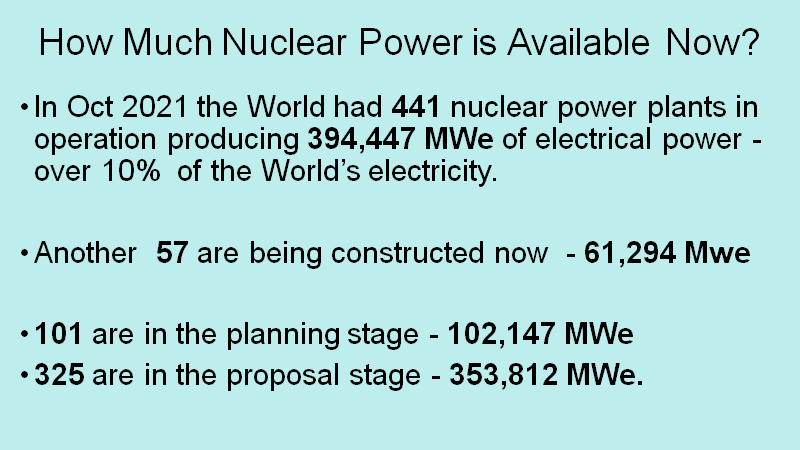
There are about 440 nuclear power plants in operation in 33 countries. Australia is not one of these. Australia is the only G20 country where nuclear power is banned by Federal law. Nuclear power production is currently not permitted under two main pieces of Commonwealth legislation—the Australian Radiation Protection and Nuclear Safety Act 1998 (the ARPANS Act), and the Environment Protection and Biodiversity Conservation Act 1999 (the EPBC Act).

Nuclear power plants provide 10% of the world’s electricity. It is one of the safest sources of power generation. It produces no CO2 or other pollutants during operation and is the only source of power where every stage of the entire life cycle is securely contained.

Civil nuclear power has more than 18,000 reactor years of experience. The first commercial power plants were built over 50 years ago in the 1960s. Many of the world’s current nuclear power plants were built decades ago and for many years, few new reactors were built due to the campaigns by antinuclear groups and community concerns following Chernobyl. This was concerning as the new technology with greatly improved safety and efficiency was not being implemented. Safety features were no longer just added on as the technology advanced but were an integral part of the designs.

A year ago, the USA and major countries in Europe were setting dates to rid themselves of nuclear. Even France that had 70% of its electricity produced by nuclear power plants was winding down the industry.  Sweden was replacing nuclear with wind power and Germany was determined to close all its nuclear power plants. However, other parts of the world, particularly Asia, had a different view and saw nuclear as an important part of the energy mix.  About 55 power reactors are currently being planned or constructed in 19 countries.

In 2022, attitudes seem to be changing. France’s president Emmanuel Macron has announced plans to relaunch the country’s commercial nuclear programme with the construction of at least six new nuclear power reactors – and the possibility of eight more for a total of 14 – if he is re-elected. He also announced he wants to extend the lifespan of older nuclear plants to 50 years or more from 40 years currently, provided it was safe to do so. Japan shut down most of its nuclear power plants following the Fukushima event but has then gradually reopened each plant following extensive safety assessment and refurbishment.

Over recent weeks, several Eastern European countries have stated they need nuclear power if they are to reach their 2050 climate goals.

The first set of blogs accompanying my PowerPoint slides provide some basic material on radioactivity and uranium, fact checks issues that worry most of us and asks the question “Why are we afraid of nuclear power?”.

Support from New Friends

(Written 18 January 2022)

The Save Chalumbin campaign has much support locally including both our local federal and state MPs. It is easy to find information about Chalumbin by just googling the name. Destroying ecology and habitat critical to the survival of endangered species, is not “green” power!

Even according to the project’s referral under the EPBC act, Epuron states: “Despite the avoidance, minimisation and mitigation measures…, the project is anticipated to have a significant residual impact on the greater glider, the red goshawk and the magnificent brood-frog.” Epuron sold the project to Korea Zinc about a month ago. Did they realise Chalumbin was one step too far?

The Red Goshawk is probably Australia’s rarest bird of prey.
This endangered raptor lives at Chalumbin.

At that first coffee meeting, I mentioned that nuclear required a lot less space on the ground than renewables. Some of the campaigners were thrilled with this idea, and even offered to develop a website for me so that I could blog about the benefits of nuclear power. This offer gave me the emotional impetus to act but I refused their offer of financial support to set up the website. I wanted to maintain my independence. Over the last couple of months, I have tried ridiculously hard to see both viewpoints on many issues. It can be hard to determine the facts and undertake your own assessment, but I have been trying to do so.

Since finishing slides for my presentations, the group has sent me some remarkably interesting documents about many topics relating to decarbonisation which have added to my already large and growing collection. I love articles that quote their sources because then I can go back and really look at what the original article said and look at actual data and assess it when I can. I am grateful for the support. There is so much out there and of such varying quality.

I do believe there is a real place for renewables, but we must not be blindfolded to the downsides. More and more, I do see a place for nuclear power and sincerely hope that many of the new designs for nuclear power plants are implemented. Some days, I have felt negative about the chances of nuclear power really taking off in time but slowly and surely, I am becoming increasingly optimistic.

There are now green groups and many individual environmentalists who once shunned the use of nuclear power generation, changing their minds. The Green Party in Finland is pro-nuclear. There are now members of the Green Party in Australia who are pro-nuclear. I have been disappointed by the Swedish Parliament who seems to be dominated by the Green Party and is planning, at huge financial cost, to shut down working nuclear power plants. This is even though most of the Swedish population are still pro-nuclear.

In the last week, I have discovered some of the pro-nuclear groups operating in Australia. Most of their information is fascinating and written by people so much more knowledgeable than me. I have gathered so much material about renewables and nuclear that I feel this blog should share some of the information or at least direct others to great sources.

I would like to say a big thank you to Helen Keough and Caroline Emms who have been working so hard to save Chalumbin. Their friendship and encouragement keep telling me to get out there and do what I can.