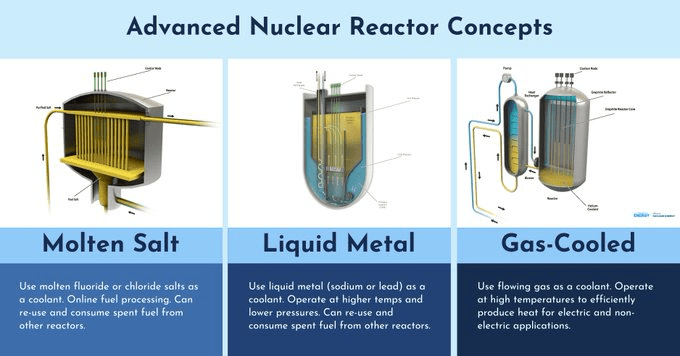

I have not been able to insert some of the videos I used in my talks but links are given. There are now dozens of new designs around the world and it will be a race to see who dominates the market in various categories. In my talks I just gave an overview to provide a picture of the range of technologies and sizes on the drawing board.
https://www.rolls-royce.com/innovation/small-modular-reactors.aspx#section-smr-build for the UK.

Nuscale SMR has been fully licensed in the US and can now start manufacturing its units. It is now listed on the US stock exchange. This is an advanced Gen 3 design. If you are interested in more detail, there is a lot of information on the web.
Some of the front running companies are multi nationals such as GE Hitachi. This is their video on the very small SMR or microreactor, Evinci.

The next slide shows another current product that is too big to be called an SMR. Most of the text in slides is taken from company literature as I am not qualified to make comments on the technology.

The next product is very innovative and known as PRISM

The next video is about the BWRX-300, a design that has been used in some of Nuclear for Climate Australia models.


Other interesting technologies include those of Terra Power.


I note that the first benefit listed above applies to many or perhaps most new designs.


Molten salt reactors
A number of companies are designing and about to build molten salt reactors such as Thorcon in Indonesia, (https://thorconpower.com/0, TerraPower, Natrium, Samsung in South Korea, and in India. Experimental testing of containment materials continues at Oak Ridge National Laboratory in the US and research even happens in Australia with ANSTO (https://www.ansto.gov.au/our-science/nuclear-technologies/reactor-systems/advanced-reactors/anstos-contribution-to). One of the issues experienced withe design of molten salt reactors related to chemical corrosion of the vessels containing the molten salt. I was not surprised that fluoride salts might be very corrosive nut the salt mixtures have evolved, chloride salts would be far less challenging. I get the impression that this issue has been resolved but of course it is under wraps now to preserve various companies’ competitive advantages.
China is producing a number of designs of many types including molten salt reactors and plans a massive building program for nuclear power. Russia’s Rosatom was also interesting but has had a number of contracts cancelled second quarter of 2022. One of China’s designs is shown below. China is currently building a molten salt reactor.
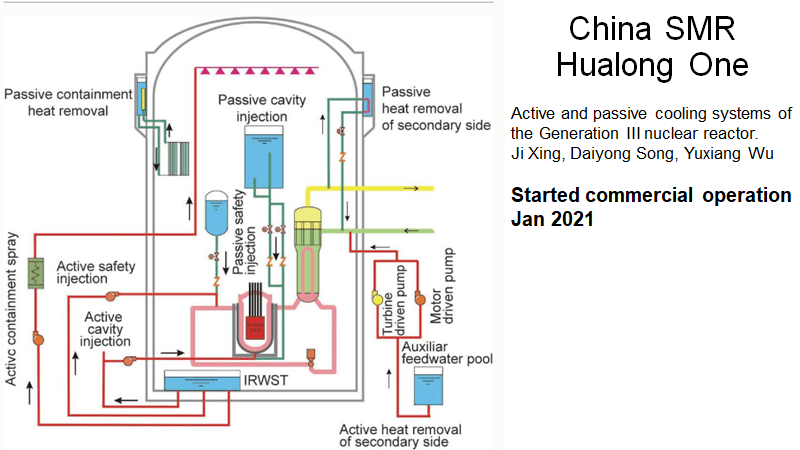
The fuels for Gen 4 reactors can be very different to current fuel pellets. Some of the newer fuels are more like those that have been used in nuclear submarines for many years. Others are completely different like Triso balls or fuels dissolved in molten salt. TRISO particles cannot melt in a reactor and can withstand extreme temperatures that are well beyond the threshold of current nuclear fuels. For more see https://www.energy.gov/ne/articles/triso-particles-most-robust-nuclear-fuel-earth. New designs can make use of so called waste fuel or thorium or a mix.
Some Gen 4 designs use HALEU fuel which has been used by the US military for decades.
In May 2022, Norway-based marine group Ulstein has launched the Ulstein Thor, its concept design for a 149-m (489-ft) replenishment, research, and rescue (3R) ship that will feature a Thorium Molten Salt Reactor (MSR) to generate large amounts of clean and safe electricity. This allows the vessel to operate as a mobile power and charging station for a new generation of battery-powered cruise ships at sea.
These are all fission based reactors but research on fusion based reactors continues and will be viable eventually but not in this decade or two. Fusion happens at extreme temperatures.


Australian Ben Heard has produced a number of detailed videos describing SMRs in more technical detail than I can such as:
Suddenly, after a long hiatus, so much is happening.
 My Blog has become My Nuclear Journey