
Earth is made of Stardust –We live on a Radioactive Planet, a Nuclear Planet
- Every element in the Universe was made by nuclear reactions in stars.
- When stars age, they break apart and form stardust.
- Gravity combined this dust to make solar systems of planets.
- The core of our planet is radioactive and provides us with a warmer planet surface and a magnetic field.
For A Planet to Generate Its Own Magnetic Field by the Geodynamo Process – It Must Have the Following Characteristics
- The planet must rotate fast enough.
- Its interior must have a fluid medium.
- The interior medium must have the ability to conduct electricity.
- The core must have an internal source of energy that propels convection currents in the liquid medium.
- On Earth where does the energy come from? Radiogenic heat comes from the radioactive elements: Uranium 238,Thorium 232 and Potassium 40. All have very long half-lives.
- Iron and Nickel conduct the electricity in the core.
Today, Mars does not have a global magnetic field. However, Mars did power an early dynamo that produced a strong magnetic field 4 billion years ago, comparable to Earth’s current surface field.

https://www.space.com/earths-magnetic-field-explained
Without a Magnetic Field Our Atmosphere Would be Stripped Away by Solar Winds. Life on Earth Would Not be Possible.
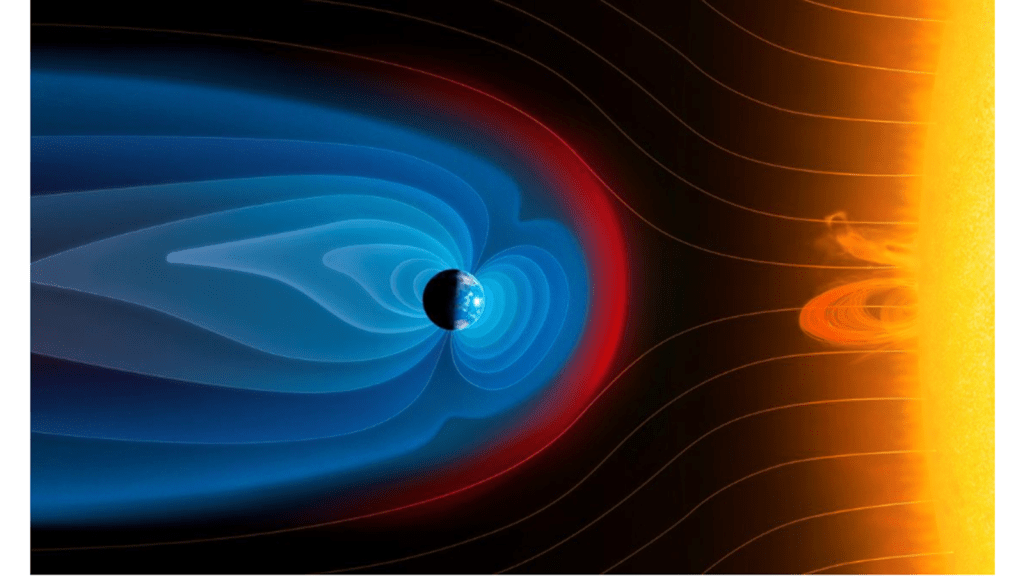
Earth’s Magnetic Field – Our Protective Blanket Helps Shield Us From Unruly Space Weather.
According to NASA, the magnetosphere also protects Earth from large quantities of particle radiation emitted during sun storms as well as cosmic rays – atom fragments – raining down on Earth from deep space. Our magnetic field repels harmful energy away from Earth and traps it in zones called Van Allen radiation belts.
But our protective shield is not completely invincible. Cosmic rays are part of the background radiation we receive every day.
Tritium is created in our upper atmosphere every day and comes down in the rain.
None of this protection would be possible if Earth was not enough of a nuclear planet with sufficient quantities of radioactive substances.
The next two blogs in the series illustrate the basics of just what radiation actually is and provides terms necessary to understand later blogs. The third blog discusses the range of background radiation found naturally on the surface of our planet. For some readers there will be surprises in store.
 My Blog has become My Nuclear Journey