Are Forests Becoming Carbon Sources Rather Than Carbon Sinks?

Currently, our land with its forests and other vegetation removes a massive 30% of our carbon emissions every year. Unless natural carbon removal processes are maintained, we have no chance of ever restoring carbon dioxide levels in our atmosphere to tolerable levels.

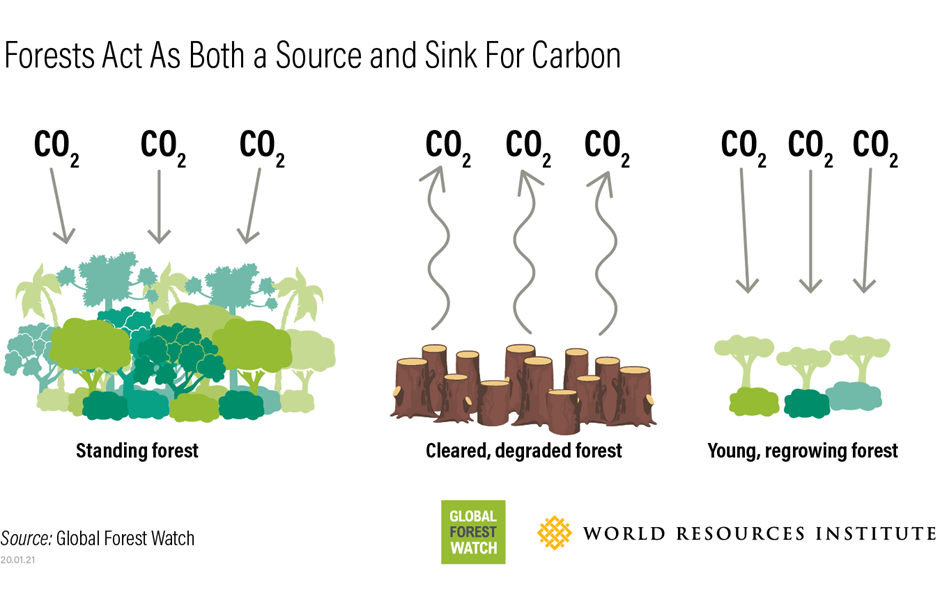
The classic diagram below is misleading in that it is too simple. The “young growing forest” in the third panel is shown as sequestering more CO2 than the “standing forest” or natural forest. This is initially true but depending on its origin and future, the young growing  forests can end up as a net carbon sources or at best carbon neutral.

There are two main groups of “young growing forests”: plantations and regrowth forest. If regrowth forest survives long enough and is ecologically diverse enough, it can take on the characteristics of older forests when it reaches an equilibrium between death and decay and natural tree replacement.
Old-Growth Forests Store Carbon Differently

When it comes to fighting climate change with forests, it’s easy to think all trees are equal. This thinking has led to simple approaches that focus on tree numbers rather than the complexity of the forest. However, science tells a different story: old-growth forests and tree plantations store carbon in distinct ways, and this matters significantly for climate action.

https://www.ecomatcher.com/why-old-growth-forests-store-carbon-differently/

Old-growth forests are sophisticated carbon storage systems that have been built over hundreds or even thousands of years. There are trees of different ages, sizes, and species, creating a complex living structure. This diversity is crucial for storing carbon. Trees do die but they are replaced, and the system reaches a wonderful equilibrium which continually sequestered carbon. The massive tree trunks in old-growth forests represent centuries of carbon buildup. A single large tree can capture as much carbon in one year as an entire medium-sized tree contains in its whole body. In some forests, large trees make up just 6% of all trees but account for 33% of the forest’s yearly growth. This shows why size matters when it comes to carbon storage.

Most importantly, old-growth forests continue to store carbon in many different ways and places. Above ground, carbon is locked in living trees, dead standing trees, and fallen logs that take decades to break down. Below ground, massive root systems and centuries of built-up soil create huge underground carbon vaults. This multi-layered storage system provides both capacity and strength.

Many of Australia’s native forests are younger remnant forests but these forests are also living ecosystems and actually work nearly as hard for us, not just by sequestering carbon and preserving our biodiversity but by helping to cool our land through evapotranspiration and shading and forming a critical part of the water cycle. Forests can store a lot of water, helping to mitigate floods, seed clouds and clean water.

Do Plantations Mitigate Climate Change?

Plantations are typically planted with a single species all at the same time. Plantation forests can remove between 4.5 and 40.7 tons of CO2 per hectare per year during their first 20 years of growth. However, they all reach maturity together and die together, throwing all that carbon back into the atmosphere if they are not logged first. Depending on the use of those forestry products a little of the carbon may be stored for a few decades. Thus, plantations end up carbon neutral at best having achieved no long-term benefits.

Unfortunately, the carbon accounting and reward systems in Australia encourage the use of plantation type forests after bush fires rather than assisting the natural but slower reforestation processes. Some of these decisions are influenced by the severity of the fires. This again emphasises the importance of doing everything we can to fight all wildfires as quickly and efficiently as possible.

What Happens If Forests Stop Absorbing Carbon? Ask Finland

Natural sinks of forests and peat were key to Finland’s ambitious target to be carbon neutral by 2035. But now, the land has started emitting more greenhouse gases than it stores. (https://www.theguardian.com/environment/2024/oct/15/finland-emissions-target-forests-peatlands-sinks-abs)

In a country of 5.6 million people with nearly 70% covered by forests and peatlands, many assumed the plan would not be a problem.

For decades, the country’s forests and peatlands had reliably removed more carbon from the atmosphere than they released. But from about 2010, the amount the land absorbed started to decline, slowly at first, then rapidly. By 2018, Finland’s land sink – the phrase scientists use to describe something that absorbs more carbon than it releases – had vanished.

Finland’s forests were mostly planted after WW2. In other words, they are mainly plantation forests. Commercial logging of forests – including rare primeval ecosystems formed since the last ice age – has increased from an already relentless pace, now making up the majority of emissions from Finland’s land sector.

Higher temperatures are causing the peat to break down and release CO2.

It has been suggested that by reducing the amount of logging and better management of their forests, the situation could be turned around. However, Finland’s Finance Ministry estimates that harvesting a third less would reduce GDP by 2.1%.

Finland is now forced to reduce its emissions by other means and won’t reach its Net Zero Target any time soon.

Are Australia’s Tropical Forests Becoming Net Carbon Sources?

An October 2025 paper published in Nature looking at Australian moist tropical forests used half a centuries’ data on above ground biomass as a measure of carbon sequestration. The above ground biomass was determined by measuring the girth and the height of every tree in each plot.

The study reported that a transition from carbon sink (0.62 ± 0.04 tonnes C /ha/ yr: 1971–2000) to carbon source (−0.93 ± 0.11 tonnes C /ha/ yr: 2010–2019) had occurred. https://doi.org/10.1038/s41586-025-09497-8

Standing carbon stored in the trees dropped almost 30% to about 200 tonnes of carbon/ha yet these Australian forests continue to be among the most carbon-dense terrestrial ecosystems on the planet as well as harbouring a very high proportion of Australia’s remaining biodiversity.

The trees are only living half as long. Death rates have doubled. Degradation has been caused by cyclones and high winds, invasive species, higher temperatures and loss of soil moisture. Canopy leaves die in hot dry weather. There has also been a change in fire regimes. Loss of pollinating species such as the spectacled flying fox means that there are less seeds to regenerate the forests. Clearing and fragmentation of the forest in earlier years left the forest more vulnerable.

Importantly, in this particular study other vegetation was excluded as was carbon stored below ground in the soil and plant roots. However, luckily this forest is still a net sink when biomass underground is considered. Could that change?

The World’s Land Sinks and Sources in 2024
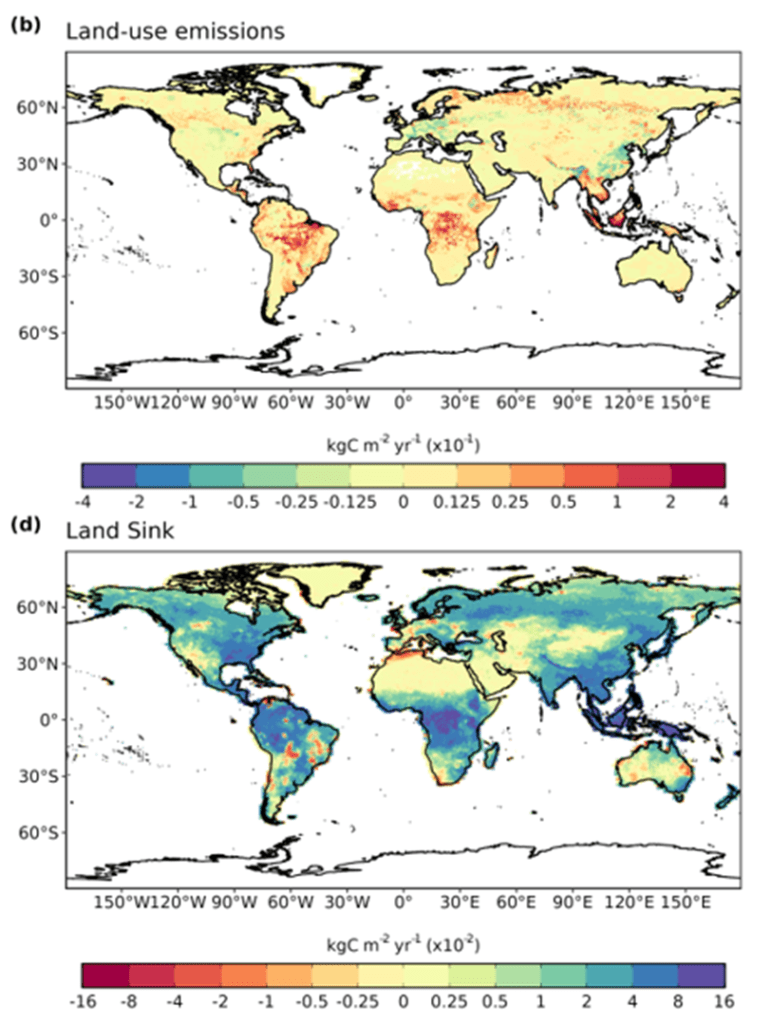
Ref: Global Carbon Project Carbon Budget 2024 slides

Note that the land of southern Queensland, despite its remaining forest, is now a carbon source.

Many areas around the world are close to a tipping point.

The Amazon basin is showing many areas of stress, the most important natural forest areas of the world.  The upper Amazon River and tributaries dried out for the first time in recent years.

A wrecked canoe lies in the dry bed of the Amazon River near San Augusto, Peru. IMAGE CREDIT: Plinio Pizango Hualinga/Rainforest Foundation US

How Much Degradation Can a Forest Take Before Becoming a Net Carbon Source?

An intact native forest will be a carbon sink.

A disturbed forest may be a carbon sink or a carbon source depending on the nature and amount of disturbance. A forest can become a net carbon source long before being totally degraded. For example, in 2025 the Amazon Basin has now been degraded to the extent that it has become a net source rather than a net sink.

A badly degraded forest is a carbon source.

As temperatures climb, and land dries out, is there a tipping point? Of course there is!

It is not necessary to clear large areas within a forest to start it along the path to its tipping point. Studies in the Amazon basin have shown that clearing a little land in the middle of forest can dry out the soil for up to 3 km away. This has an effect on the water cycle and over time the damage gradually extends further and further into the forest.

Despite man’s disruption of some of our most important forests and increasing CO2 levels, nature has continued to remove 30 % of the carbon emissions we produce. Signs of strain are now showing. The oceans are not taking up quite the same amount that they were. The major tropical forests have sink areas but increasing source areas and the balance between sink and source is changing.
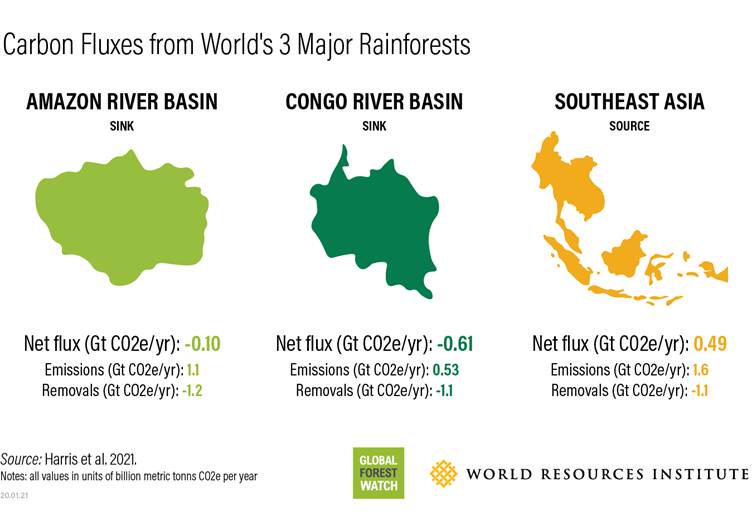
However, these forests still store hundreds of billions of tonnes of carbon.  

Unfortunately, the current Net Zero protocols reward the creation of plantation forests at the expense of ecologically diverse established native forests. There is little reward for maintaining and looking after real forests. It is seen as beneficial to degrade forest to build short term mitigation structures, not considering the long term effects. We are neglecting the natural world by concentrating too much on economic drivers. Even less-intensively managed land has been made a poorer cousin.

Adapted from Earth Syst. Sci. Data, 15, 1093–1114, 2023

What Will Happen to the World if Nature Stops Being a Net Carbon Sink?

We do need to cut emissions. It is not the basic concept of Net Zero that is the problem. It is how it is being implemented. We need a new way forward!

As temperatures climb, and land dries out, is there a tipping point? Of course there is!

Unfortunately, the current Net Zero protocols give the biggest rewards for the least effective behaviour.

How much more can we threaten our Australian forests before they crash and the eastern states become drier and drier and even hotter than necessary?

Please UN, COP and Australian Government find a way to reverse these trends. It is not too late!

Are We Forgetting the Aim of the Energy Transition?

Humans have lived through a range of temperature changes. It is recent civilization that we are trying to save with people living all over the earth in great numbers needing a lot of energy not least in the form of food. We tend to forget how hard life was trying to have enough energy to survive even after we discovered fire.  For most of our existence, the only way for a few individuals to get ahead a little was to use slaves or beasts of burden or warriors. These living energy sources were fed as little as possible or used as canon fodder.  They rarely lived very long.

Then, only a few centuries ago, we discovered much more energy dense fossil fuels.  Suddenly, we could abhor slave labour, care about animal welfare and we could all have good shelter and food.  Poverty has been slowly disappearing in many parts of the world.

Our modern food production is very dependent on a stable climate. It is also very energy intensive.  A few degrees of extra heat or a little less rain has devastating effects on production levels. 

How do we balance energy needs with maintaining a stable climate?  The critical action at this time is lowering greenhouse gas emissions. To do this, the biggest tasks are the electrification of many processes as possible, decarbonization of electricity generation and carbon capture and storage. What is the only energy efficient and cost-effective method of carbon capture and storage? As discussed in my previous blog natural systems are wonderful at carbon capture and storage. Let nature do its work!

Hydro, wind, solar, nuclear, and geothermal power plants all use up energy and produce relatively small amounts of carbon dioxide in their manufacture, construction, demolition, and recycling. Energy is used in the mining for their manufacture.  Some require lots of backup storage or have other firming or conversion requirements. All require transmission lines.

What are Queensland’s Plans?

Queensland Government plans to deliver:

  • 50% renewable energy target by 2030
  • 30% emissions reduction below 2005 levels by 2030
  • 70% renewable energy by 2032
  • 80% renewable energy by 2035
  • zero net emissions by 2050.

Far North Queensland has two wind farms, Mt Emerald (180MW) and Windy Hill(24MW), with a third, the Kaban Green Power Hub under construction. Under Phase 1, the government has invested $40 million to upgrade the coastal 157 KV transmission infrastructure between Cairns and Townsville to 275KV. This investment will provide up to 500 MW of renewable energy connection potential in Far North Queensland. Several investors have shown interest in the area, with the $400 million 157 MW Kaban Wind Farm now under construction and expected to be operational this year. At Kaban there are 28 wind turbines which are 226m in height to the tip of the blade.

A photograph of Kaban Wind Farm taken Dec 2022. More roads and turbines can be seen in the distance.

Windy Hill has been running just over 20 years and has already needed to replace the wind turbine blades.

During the second half of last year, the Draft Public Environment Report was issued for the proposed Chalumbin Wind Farm on two grazing properties in Far North Queensland. These properties border the World Heritage Wet Tropics on the East and extend westward to the scattered woodland of the Einasleigh Uplands on the West.  Early pictures of the site by Epuron showed cattle grazing in scattered woodland but in reality, most of the wind turbines were to be sited on mountain ridges close to the eastern boundary in dense eucalypt and transitional forest. The potential impacts from the project are substantial and wide-ranging including threats to endangered species and aboriginal cultural heritage.

The site of the proposed Chalumbin Wind farm.

Photos used in publicity about Chalumbin Wind Farm

Under the current Australian system, comments on a draft PER can only be submitted to the Project Proponent. The proponent then revises the document and sends the document plus the comments to The Federal Minister for the Environment.  A decision on the Chalumbin project under the EPBC Act is yet to be issued and has already been postponed a few times. At one stage during the comment period, the Proponent put a full-page ad in the Cairns Post stating that they would welcome positive comments thus inferring that they would not accept negative comments.

A few locals have calculated the implications of the project from a carbon dioxide viewpoint. There were a number of omissions and critical mistakes in the Chalumbin PER about this topic such as equating carbon loads with carbon dioxide loads. This is a factor of 44 to 12.

Figures for the loss of forest carbon storage following clearance vary depending on the type of forest. The Chalumbin site is mostly pretty dense forest with good canopy cover for much of the areas where turbines are to be located. There are many trees with diameters of a metre or more. The carbon stored in these trees would be lost immediately if the trees are piled up and burnt or more slowly if the biomass is just allowed to rot.

Other losses following clearing include soil carbon, carbon from the roots and from soil biota. Estimates made on eucalypt plantations of soil carbon and root carbon loss suggest this can be double or more the above ground loss depending on the eucalypt species, the age of the trees and the rainfall. 

Many studies suggest that natural forests are better at carbon sequestration than plantation eucalypts and that tropical wetter eucalypt forests are better still.

At Chalumbin, I have conservatively calculated that loss of carbon dioxide to the atmosphere during clearing will be about 2 million tonnes. Loss of sequestration over 20 years by this lost forest is 1.1 million tonnes or more. The carbon dioxide footprint of the wind turbines during their manufacture and transport to the site is about 300,000 tonnes. This is a total of 3.4 million tonnes.

The maximum savings in carbon dioxide made by replacing current power production with wind power  at Chalumbin is 12 million tonnes of carbon dioxide over a period of 20 years assuming a capacity factor of 30%.  The currently operating Mt Emerald Wind Farm has not achieved this capacity. So, this estimate should be dropped to 10 million tonnes or less.

This means that at least a third of the lowering of greenhouse gas emissions are lost by building a wind farm in this precious forest.

The losses don’t stop with Chalumbin.

Wind farm projects being proposed in the Wet Tropics Catchment Area are numerous and in areas of high biodiversity value, close to World Heritage areas and on the mountain ridges. This is death by a thousand cuts. The cumulative impacts from wind farm projects in the Wet Tropics Area will be unacceptability large and not usually considered.

Fragmentation of Forest and Edge Effects Destroy Biodiversity and Carbon Sequestration

Edge effects strongly affect forest microclimate, tree mortality, carbon storage and a diversity of fauna.

The hydrological regimes of fragmented landscapes differ markedly from those of intact forest. Desiccating conditions may penetrate up to 100m into areas near the roads. Streams in fragmented landscapes experience greater temporal variation in flow rate than do those in intact forests. Cleared areas have less evapotranspiration and rainfall interception and absorption by vegetation. Rapid runoff promotes localized flooding in the wet season and stream failure in the dry season, with potentially important impacts on aquatic animals.

Even narrow forest roads (20–30m) result in increased tree mortality and damage with wide-ranging alterations in the community composition of trees and undergrowth. Some insects and other fauna will not cross even narrow roads, yet hundreds of km of 70m or wider roads are being proposed.

If our forests are themselves at risk from Climate Change, forest fragmentation will accelerate the process.

Proposed Wind Farms Could Add Pollution to the Great Barrier Reef

Projects like Chalumbin lie on the head waters of the river catchments of the Wet Tropics Area. Hundreds of kms of unsealed 70-metre-wide roads that cross waterways have the potential to dump turbid water and other pollutants down rivers through areas of World Heritage Rain Forest out to the Great Barrier Reef. Farmers fear they will be blamed for the impacts.

We should remember that pollution accidents do happen. Wind turbines need lubricating and “oil changes” every 3 to 7 years. Over 200 litres of oil or synthetic lubricant is needed per turbine.

Building Wind Farms in Forests is a Terrible Waste

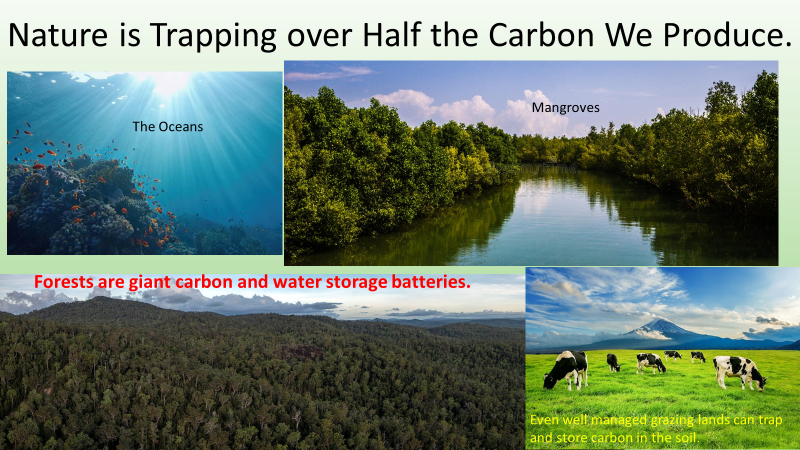
Forests are giant carbon and water storage batteries. Why discharge greenhouse gases to the atmosphere by land clearing and lose all the benefits forests provide in the mitigation of climate change? When they are gone, we lose all the carbon sequestration and cooling they do every day. Natural forests do this better than plantation forests.

By clearing forest to build wind farms, we lose a very substantial proportion of the carbon savings we would make by siting them elsewhere. A substantial proportion of what we gain in lower carbon emissions from wind power, we lose by destroying forests.

Even worse, we contribute to climate change through the loss of a range of mechanisms forests provide, long before any of the benefits of wind energy mitigate carbon emissions. This is needlessly making climate change worse in the short term which is the opposite to why we are setting 2030 targets.

We are also desecrating our irreplaceable biodiversity, Aboriginal cultural heritage, and tourist jobs in areas of high importance. High quality patches of remnant forest are rare and precious, and one proposed windfarm project area was being planned for inclusion in National Parks in the future. What a waste! We can fight climate change and protect our natural diversity at the same time. When our natural assets are gone, they are gone!

Loss of Forest Affects Cloud Formation and Alters the Hydrological Cycles 

Loss of forest on mountain tops will lessen rainfall and lead to more droughts and flooding. While one project may have almost negligible impact on weather, many more wind farms are proposed. The wind farm projects change the land use from forest to major industrial, with major extensions to each project being possible with much less assessment. This will impact on both our World Heritage listed Wet Tropical Forests and Great Barrier Reef while drying our inland agricultural lands to the west. Good agricultural land is critical to our future.

In Conclusion

 A substantial portion of the savings in carbon dioxide emissions made by using wind power are lost by building them in our precious forests. What a waste!

What worth do we put on the loss of biodiversity and ecosystems, stunning landscapes, natural carbon sequestration and storage. Forests cool the earth and make it rain. Forests soak up runoff like giant sponges and help prevent flooding, while recharging aquifers. They clean the water of pollutants so that most of the water going to the Great Barrier Reef is clean. Forest stabilises the soil so that turbid water does not kill frogs, fish, or corals.

We are putting so much at risk by building wind farms where they should not be.

I thought the goal was to fight climate change, not make it worse.

The photos in this blog are courtesy of Michael Seebeck and Steven Nowakowski

In my next blog I will provide more information about Queensland’s Energy and Jobs Plan, the Queensland SuperGrid.

How Important are Queensland’s Forests?

Worldwide, fossil fuel use spews about 37 billion tonnes of carbon dioxide into the atmosphere each year. Recent technologies have been used to determine just how much work forests do when storing carbon.  Between 2001 and 2019, forests emitted an average of 8.1 billion metric tonnes of carbon dioxide per year from deforestation and other disturbances. At the same time, forests absorbed 16 billion metric tonnes of carbon dioxide per year. 

Just imagine how much more efficient and cheaper it would be if existing forests were allowed to do their work in Queensland without disturbance. Denser forests and rapidly growing forests are particularly important. We should not forget that Queensland has nearly 40 % of Australia’s forests.

Hopefully, no one would argue that forests alone can save us from climate change, but they have a major role to play. If we do not protect forests as much as we can, we will suffer far worse climate change impacts.

The Climate Council states on https://www.climatecouncil.org.au/deforestation/

It is not effective to “offset” greenhouse gas pollution from burning fossil fuels by storing carbon in forests. This is because fossil fuels are pumping much more carbon dioxide into the atmosphere than existing forests can absorb. At the same time, carbon stores in forests and other natural carbon sinks will become increasingly unstable as climate change progresses. Droughts, tropical storms, heatwaves and fire weather are increasing in severity and frequency because of climate change. This will continue to result in increases in forest losses, contributing to more and more carbon dioxide being released into the atmosphere. Risks are significantly reduced but not avoided by keeping the rise in global temperature well below 2°C.

The future

Protecting natural ecosystems and sustainably managing and re-establishing forests are important ways to reduce greenhouse gas emissions and slow down temperature rise in the short term by drawing down carbon dioxide from the atmosphere. At the same time, we must deeply and rapidly reduce global greenhouse gas emissions levels from fossil fuels – coal, oil and gas. If we do only the former and not the latter, we risk transforming more and more of our carbon sinks into carbon sources as climate change progresses.

Oh Dear! Yes, there is a risk that we could lose all our forests to Climate Change and that really would be Armageddon. Should we just stay on our current path and let it happen? Man has a tendency to picture the worst.  It is an emotional response from our primitive brains.  This type of thinking makes excuses and leads to a lack of appropriate action.  Let’s just run around in circles instead, wasting money and time. /sarcasm

Why are forests vital?

  1. Even now Earth’s forests are still capable of pulling nearly half the carbon dioxide produced by fossil fuels out of the atmosphere despite the clearing that has already happened. We must stop destroying our forests so that they can do this task to the greatest extent possible.
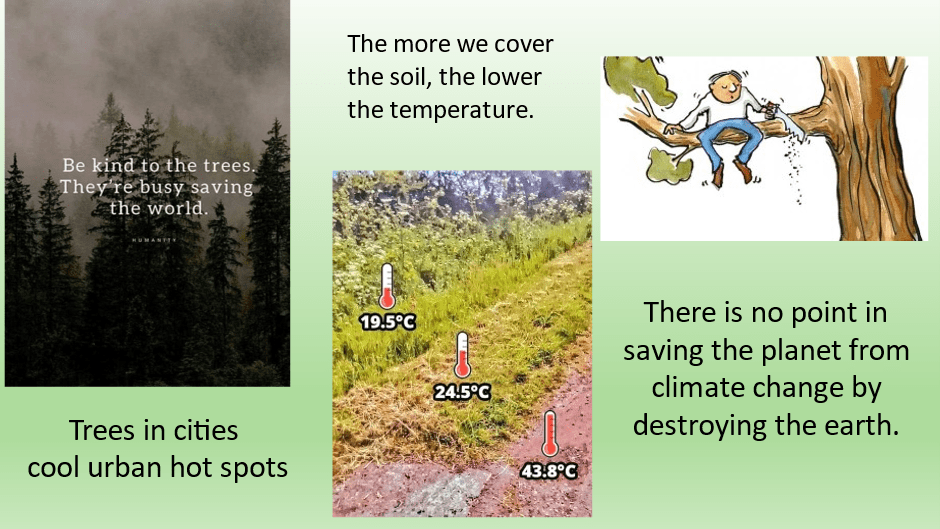
  2. Forests keep the earth’s temperature down by 1°C or more. This happens in a number of ways. They shade the ground. They pull heat out of the atmosphere by using the sun’s rays for photosynthesis, they manufacture many products some of which they pass to the organisms in the soil in addition to wood formation. They also cool their surroundings using evapotranspiration, a technique similar to our evaporative coolers.
  3. Forests are a very important part of the hydrological cycle and help to stabilise our climate in a number of ways. The soils below forests can be giant water sponges. This is particularly important on mountain ranges such as Australia’s Great Dividing Range. The water for rainfall passes down the mountain slopes much more slowly, preventing erosion and keeping our water clean and safe. The forest on mountain tops is important in cloud formation. It has been shown time and time again that rainfall is diminished if mountain tops are disturbed.  In Australia this can lead to increased drought and flooding when it does rain.
  4. As well as being a stabilising force for the climate, forests regulate ecosystems, protect biodiversity, play an integral part in the carbon cycle, and supply goods and services including shelter and food.

In order to maximise the climate benefits of forests, we must keep more forest landscapes intact, manage them more sustainably, and restore more of those landscapes which we have lost (from a recent IUCN statement).

What is Australia’s record? Nearly 50% of our forest cover has been cleared in the last two centuries, making Australia one of the worst developed countries for deforestation.

In Queensland about half of our recent clearing activity has been in catchment areas of the Great Barrier Reef particularly south of Townsville. WWF was not wrong when in December 2022 it stated that Queensland  remains the land clearing capital of Australia.

Have we learnt any lessons? No, now we are threatening the densest eucalyptus forests clustering around our wet tropical rainforests near Cairns.

Australia’s best winds to drive wind turbines are found in the south-west. Places like Tasmania lie in the path of the Roaring 40s. Because the wind doesn’t always blow, a myth was set up that the wind would blow in these periods somewhere else and where better than the  far north-east of Australia. The performance of existing wind farms in Far North Queensland is low at best and abysmal frequently. When the strong winds of the North come, we call them cyclones and the turbines will be shut down and are likely to suffer damage.

So, the current plan is to desecrate hard-working tropical forests to build poorly performing wind turbines. This is neither effective or efficient in money terms or in climate change mitigation terms.

The forest areas threatened by all the wind energy projects on the books or already being constructed are some of the most valuable in the world.

Here is just another of my slides.

There are alternatives to this rampant stupidity.

In my next blogs I discuss some of these projects in more detail. In the meantime, you might like to look at this brochure from Rainforest Reserves.

https://drive.google.com/file/d/11JoRdwId1ChhBbIivPOCj5oEAMHKhdfd/view?usp=drive_link

Is Queensland on the wrong energy path?

We have so much to do to meet the challenges of climate change. We only have limited time, money and resources. So, it becomes critical that we don’t act like headless chooks running around in circles wasting energy.  Whatever we do needs to be efficient and well planned and evaluated.

Our public electricity production generates more carbon dioxide per unit of electricity than most of the developed world. On the positive side, our households generate and use a very high level of solar energy outside of the public system.

The Queensland Government reports that our greenhouse emissions have already fallen by 29% since 2005.  Our target for 2030 is 30% below our emission levels in 2005. This suggests that we have almost reached our target. What is responsible for this decrease?  It is all about clearing land.

The forests in Queensland are doing a great job of capturing and storing the carbon dioxide we produce. Perversely the decrease in the emission data is entirely due to the slowdown in the rate of forest clearing.  When forests are cleared two changes occur.  Firstly, there is less forest working hard on our behalf. Secondly, the felled trees and the soil beneath release their stored carbon back into the atmosphere.

Let’s look at some of the data.

How is Queensland going? Queensland’s carbon intensity of electricity consumption is currently almost 700 gCO2eq/kWh. Only a couple of areas in the world produce more carbon dioxide from the production of electricity per unit of electricity. Grant Chalmers presents this data on a regular basis.

For comparison, Tasmania only produces about 25 g of carbon dioxide per kilowatt-hour of electricity produced while South Australia manages an average of slightly more than 100 g per kilowatt-hour of electricity. However, during the night, South Australia hits 400 after the sun goes down when it still relies on the dirtiest form of electricity produced – Victoria’s brown coal.

Unfortunately, most data available from Government sources are a year older than Grant’s data. Grant’s data does not take into account electricity used directly from rooftop solar.

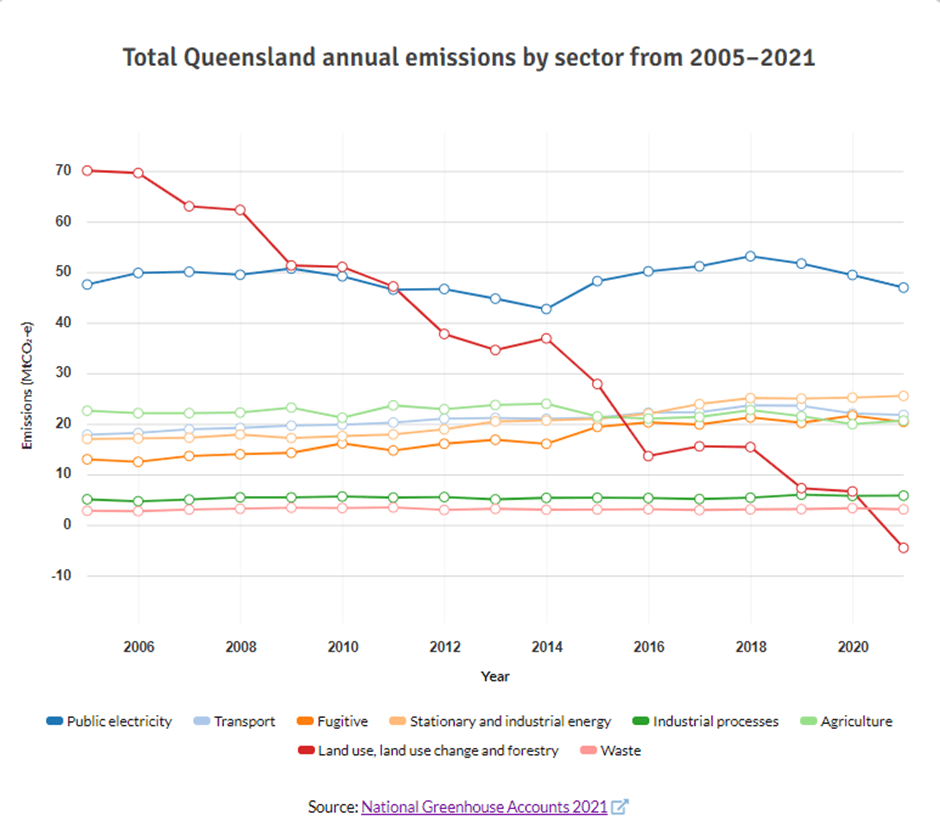
The graph below provides an overview of Queensland’s production of greenhouse gases.

Two sectors stand out: Land use, land-use change and forestry at -3.2% and public electricity producing nearly a third of the greenhouse gases. The graph below shows how the various sectors have changed over time.

Even the quickest of glances at the graph above shows that greenhouse gas emissions from most sectors have not changed much or even risen since 2005. But look at the fall from the land use, land use change and forestry sector: 70 to below zero. In 2005 about one third of Queensland’s greenhouse gas emissions came from the land use change. Our forests and well managed soils are now just counteracting the damage we are still doing by removing trees in forests but also on grasslands.

This data comes from https://www.des.qld.gov.au/climateaction/emissions-targets if you would like to dig a lot deeper.

The slide below comes from one of my talks and was prepared using information published by the UN.

In my next blog I provide a little more information about the forests in Queensland.