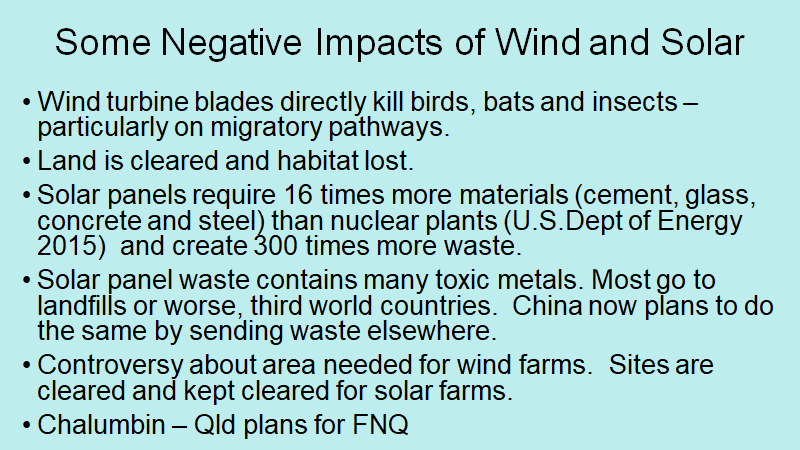
I will discuss some of the points in the slide above in later blogs.
Queensland has a plan to encourage the construction of many wind farms in Far North Queensland in the area where I live. These wind farms are in the water catchments for the World Heritage Great Barrier Reef and in some instances, the streams and rivers run through our World Heritage Rain Forest. Some are planned right next to our World Heritage Rain Forest. I will be writing a lot more about the dreadful loss of biodiversity, aboriginal heritage areas and sacred sites, and tourist jobs in future blogs. Our first wind farm, Mt Emerald, only provides 10-15% of its nameplate capacity. A reason given for siting wind farms up here was the likelihood that the wind will blow when it is not blowing down south. There is no evidence of this so far.
In order to speed up the process, Queensland has chosen to circumvent its environmental processes apart from those of the Federal EBPC Act. There is no requirement to consider the cumulative impacts of all of these projects. Quick calculations of the loss of carbon dioxide to the atmosphere by clearing dense forest compared to the gains of using wind power over conventional power indicate that a considerable proportion of the gains are lost through inappropriate placement. How inefficient and costly!
Renewables need to be sited on already disturbed land but not on precious agricultural land or forest.
Enormous areas of land are, or will be soon, having their planning status converted to heavy industrial use, making it easier for further land clearance to occur in the future. Bare soils are hotter and reflect more heat, they lose soil carbon not sequester it. They no longer retain water. Sounds like desertification.

I am currently trying to understand just how many Australian taxpayer dollars and electricity user dollars are being expended on renewables in my backyard.
Are we getting our money’s worth? All the talk about cheap power from renewables seems to be a myth. The wind farm proponents up in far north Queensland are companies based in other countries. Are we just easy, safe profits? Then there are the costs of battery storage and all the costs of upgrading our transmission system. We import the solar panels and the wind turbines.
In 2020, Australia invested $7.7 billion or $299 per person in renewable energy. The Clean Energy Regulator estimated that a record 7.0 gigawatts (GW) of new renewable capacity was installed in the same period. (media release by The Hon Angus Taylor MP: Minister for Industry, Energy and Emissions Reduction on2 February 2021)
On Sky News in 2020, Nationals MP Barnaby Joyce said it is important to remember each wind turbine costs the taxpayer $660,000 per year, per tower, due to the government subsidy scheme for renewable energy developments. He was commenting on a $600 million, 77-turbine wind farm proposed just outside of Tamworth.
 My Blog has become My Nuclear Journey