Help, It Rained, and I Have Millions of Tritium Atoms in My Hair!

In my last couple of posts, when trying to picture what enormous numbers mean, it was shown that 3 big teaspoons of natural rain falling on my head in Australia would contain about a million tritium atoms. This sounds really scary but as I will gradually show, it is of no concern. Washing our hair would increase the amount.

Tritium forms in our atmosphere every day when cosmic rays hit gases in the air, mostly nitrogen. It is washed down into rivers and streams to the ocean as well as falling directly into the ocean. Tritium forms a minute part of the background radiation that surrounds us always. Life evolved on Earth at a time when background radiation levels were 5, maybe even 10 times higher than today. All life with its complex biochemistry deals with low radiation levels so well, that there was never a need to be able to sense radiation and hence avoid it.

Tritium is even less dangerous than most sources of ionizing radiation. It gently sends out low energy beta rays. Too much of anything can kill us. High dose radiation is dangerous, and we need protection from it.  The bigger the ray particle and/or the energy involved, determines just how harmful various forms of radiation are. Tritium’s beta rays are low energy electrons. It has a half life of about twelve and a half years. The rays are so weak, they cannot penetrate the skin. If swallowed most of it leaves as water in our urine within a day or so. If tritium water vapour is breathed in the World Health Organisation standard for drinking water is 10,00, it leaves again within minutes.

This is an ironic look at statements made out to be scientific fact. Most of the fear about radiation is not true and certainly not scientific fact.

I am still scared! A million sounds such a lot!

If you read my earlier posts on tritium, you may recall that 1 TU (Tritium Unit) is one tritium atom in 1018 hydrogen atoms. This is far smaller than one person among all the people on earth. You need to visualize one person only on as many planets as there are people on earth all with similar populations as Earth. Three big teaspoons of water contain 12*1023 hydrogen atoms. One million in 12*1023 is equivalent to 1 in 1018. It is mind boggling small.

Australia receives between 2 and 3 TU in rain falling on our land. 1TU is equivalent to 0.118 Bq /L of water.  One becquerel (Bq)is defined as the activity of a quantity of radioactive material in which one nucleus decays per second. The World Health Organization standard for drinking water is 10,000 Bq/L. To reach the same levels of radioactivity in 3 big teaspoons of our rainwater you would need to drink about a quarter of a million litres of water in one day.  Whoops! A small fraction of that amount of water as just H2O would kill you.

The human body has 30 to 700*1012 cells. Another enormous number.

So single strand DNA breaks occur naturally in the whole human body over 1016 times a day. This is another enormous number. Our bodies repair this damage.

These slides have been taken from a talk I gave to a group of CSIRO alumni.

The message is that the radioactivity associated with the Fukushima discharge will not harm anything physically. Fear may cause damage to many livelihoods.

When Quick Decisions Lead to Wrong Conclusions

The final step: making sure to put numbers in their right context. Are we looking at the whole picture? What works for some people may not work so well for others.

There is a tremendous amount of excellent technical information about radioactivity on the web, but it is often hard for anyone without that specific training to understand. There are also a lot of misleading statements and conclusions on the web. These even appear in peer-reviewed scientific journal articles such as the Chinese paper given as a link in my blog Tritium Trivia. This paper showed the results of modelling various releases of tritium water from Fukushima. Unfortunately, the last step was forgotten. Showing great expanses of red all over the Pacific Ocean would lead nearly everybody to say “How terrible! Japan is polluting the Pacific Ocean with radioactive material.” However, at the end of the document the background levels of tritium in the Pacific Ocean are quoted and this puts the release data into perspective. But nowhere in the paper was the context of the data given, that is that the levels of tritium were so low compared to normal background levels that they would be impossible to distinguish from the background variability.

I have made the decision that I will try to make my blogs as easy to read as I can so that they are suitable for most users of the web. This is not easy with technical information and my background of writing technical reports. Word has an editor function that allows you to calculate the readability of the document. Yesterday, for the very first time I managed to achieve my goal.

I was so excited that I quickly finished the blog and published it only to realize within minutes that I had forgotten a crucial step. I had jumped to the conclusion too quickly and not fully put the information into context. I rapidly edited the post and republished it. However, my subscribers received a set of comments that were not quite right. In my joy of finding a way to explain just how low tritium levels can be, I forgot just how many hydrogen atoms are in a little water. 18 g of water (one mole for the technocrats) contains 6*1023 molecules of water, 12*1023 hydrogen atoms and about a million tritium atoms.  This is still just as teeny in radiation terms but the numbers 1 and a million sound so different. 1TU is only 0.118 Bq/L. I will explain what this means in future blogs.

I apologize to my subscribers. At my age you are allowed to call it a senior moment. However, I suspect that in our current haste over climate change mitigation, we are all making similar mistakes. We do the first part of the work but then forget to really look at the big picture and put everything into context.

It’s Raining! I Might Get Tritium in My Hair?

True or false?

True, and this blog will tell you why it happens.

We all have trouble looking at very big or small numbers and understanding their size and importance. I am one of those lucky people who have less trouble than most. This has had its downsides too.  As a child I loved mathematics and algebra. I saw the patterns in numbers easily and it was all a big game to me until I was bullied at a small country school for being different. I was tied to a post, day after day, mocked at, spat at, and even pummeled with food scraps.

Now I am a senior, maths is not so easy, but I will try and make some numbers about radiation levels easier to understand.

Tritium is a natural substance.

Tritium is formed in minute quantities every day in our atmosphere. Cosmic rays from space hit the gases in the air, mainly nitrogen, forming tritium. Tritium is a type of hydrogen atom with 2 extra neutrons in its nucleus. Tritium quickly becomes part of a water molecule.  Instead of a water molecule with 2 atoms of ordinary common hydrogen with one atom of oxygen (H2O), a few molecules of water are HTO. The chemistry of both is virtually identical.  The mixture comes down as rain.

Just how many water molecules have tritium in them? Well, this is where the big and little numbers come in, making the situation hard to visualize. A new unit was created to help scientists assess the meaning of various concentrations.  1 TU or tritium unit equals 1 tritium atom in 1018 atoms of hydrogen. 1018 is 1 followed by 18 zeros. I find that hard to visualize. Let’s try. There are 8 billion people on Earth, that is 8,000,000,000 people. That is only 8 with 9 zeros. So, we have to imagine the same number of planets as there are people on the earth, with populations similar to earth to be in the right ballpark.  So TUs are like one tritium or one person out of all those people on all those planets put together.  I still find that hard to visualize, but it does tell me that finding 1 tritium atom in all those ordinary hydrogen atoms looks impossible.  Yet scientists around the world can and do measure tritium levels in rain, river and ocean water and ground water. In Australia, ANSTO publishes some of this data.

So how high are tritium levels in rain? It is seasonal and dependent on rainfall patterns. In Australia it is 2 to 3 TU. Most numbers vary from 1 to 10 TU.  Nuclear bomb testing increased tritium levels in rain for a time but still at levels in the same sort of range, definitely measurable but extremely small.

So, what does this actually mean? What are the chances of one tritiated water molecule falling on your head? 18 g of water (3 big teaspoons) contain 6 *1023 molecules of water. There would be a million tritium atoms in this rainwater.

Yes, if it rains on your hair, you will get natural tritium in your hair.

So the answer is TRUE.

Tritium Trivia

Before I write about the mechanisms all life on Earth uses to repair itself from any harm caused by low dose radiation, I feel I must present some information about tritium and the current political uproar about release of water at Fukushima in Japan.

Japan’s biggest seafood customer, China, has decided to ban seafood from Japan, followed by South Korea. New Caledonia has decided to ban swimming in the ocean.

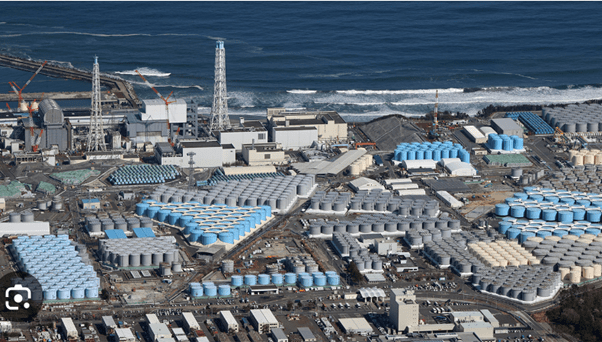
Japan has been storing treated water from the damaged Fukushima nuclear power plants in large tanks. There are about a thousand tanks containing 1.2 million tonnes of water.

Japan has begun releasing treated wastewater used to cool down the nuclear reactors damaged by the tsunami in March 2011.  The water has been treated to remove radioactive material, but small quantities remain. Tritium is hard to remove as it forms part of a few of the water molecules.  There are very small quantities of carbon 14 and there may be even smaller quantities of strontium and iodine isotopes.  Most of the latter were dispersed by May 2011.

Tritium is formed naturally every day in our atmosphere and added to the oceans and land as rainwater. Any taken into our bodies comes out fairly quickly in our urine. Radiation from tritium is weak beta rays. These rays do not travel far and are stopped by skin. Unless the dosage is extremely high, our bodies quickly repair any damage caused.

The release from Japan into the Pacific Ocean can be made to sound bad and scary. “But it actually isn’t. Similar releases have occurred around the world for six decades, and nothing bad has ever happened.

“The radioactivity in the Fukushima water is almost entirely tritium, a type of hydrogen. For scale, the Pacific Ocean contains 8,400 grams of pure tritium, while Japan will release 0.06 grams of tritium every year. The minuscule amount of extra radiation won’t make the tiniest jot of difference. A lifetime’s worth of seafood caught a few kilometres from the ocean outlet has the tritium radiation equivalent of one bite of a banana.” according to Nigel Marks is a Professor in Physics at Curtin University

Tony Hooker, Director of the Centre for Radiation Research, Education and Innovation at The University of Adelaide says: “I would like to reiterate that the release of tritium from nuclear facilities into waterways has and is undertaken world-wide with no evidence of environmental or human health implications. “

Tony Irwin, an Honorary Associate Professor at the Australian National University is also Technical Director of SMR Nuclear Technology Pty Ltd and Chair of Engineers Australia Sydney Division Nuclear Engineering Panel: “There is an understandable perception that all radioactive materials are always and everywhere dangerous, particularly liquid waste, but not all radioactive materials are dangerous. The Fukushima water discharge will contain only harmless tritium and is not a unique event. Nuclear power plants worldwide have routinely discharged water containing tritium for over 60 years without harm to people or the environment, most at higher levels than the 22 TBq per year planned for Fukushima.

“For comparison the Kori nuclear plant in South Korea discharged 91 TBq in 2019, more than four times the planned Fukushima discharge and the French reprocessing plant at La Hague discharged 11,400 TBq in 2018 into the English Channel, more than twelve times the total contents of all the tanks at Fukushima, again without harm to people or the environment.

“It is important that the International Atomic Energy Agency (IAEA) has carried out an independent and transparent review of the procedures and equipment for discharges and its comprehensive report issued in July 2023 confirms that the release will have a negligible radiological effect on people and the environment. The IAEA will maintain a continuous on-site presence on site to independently monitor discharges.

“More tritium is created in the atmosphere than is produced by nuclear power reactors, and it then falls as rain. Ten times more tritium falls as rain on Japan every year than will be discharged. The discharge limit for release of radioactive water at Fukushima is 1/7th of the World Health Organisation standard for drinking water. The discharge is ultra-conservative.”

Thanks to https://www.sciencemediacentre.org/expert-comment-on-release-of-waste-water-from-fukushima-into-the-pacific/ 

A paper was published in August 2021 by seven Chinese authors with assistance from authors in the Netherlands, Ukraine, South Korea, and Spain with scary looking figures of their modelling of potential release scenarios by Japan. https://www.sciencedirect.com/science/article/pii/S0025326X2100549X

On closer examination problematic zones were about 0.1 Becquerel(Bq)/m3 of sea water. These scenarios were all assuming much faster dumping of the water than Japan actually plans. The paper itself gives the background concentration of tritium in the surface water of the North Pacific Ocean as around 50 Bq/m3 (0.2% increase, less than natural variation). Good luck monitoring any difference during the release except at the actual release point.

Japan plans to dilute the water in the tanks before release  with a maximum concentration of tritium in the release of 1,500 Bq/l. The WHO drinking water standard is 10,000 Bq/l.

The IAEA will monitor the release at various points in the dilution and release system. The data is available at

https://www.iaea.org/topics/response/fukushima-daiichi-nuclear-accident/fukushima-daiichi-alps-treated-water-discharge/tepco-data

To understand the monitoring system watch https://twitter.com/iaeaorg/status/1694605862621380652

As I write, the tritium concentration of the discharge is 207 Bq/l. This is way less than the tough standard Japan set itself of 1,500Bq/l. The gamma ray monitoring ensures the water does not contain other radioactive contaminants.