Judgement Made: Whoops! He Bought Plutonium Online

Australian Associated Press Fri 11 Apr 2025 19.53 AEST https://www.theguardian.com/australia-news/2025/apr/11/science-nerd-ordered-radioactive-materials-parents-sydney-home-spared-conviction-ntwnfb

‘Science nerd’ who ordered radioactive materials to his parents’ Sydney home spared conviction.

A “science nerd” who ordered uranium and plutonium to his parents’ apartment has escaped conviction and been given a two-year good behaviour bond.

Emmanuel Lidden, 24, admitted breaching nuclear non-proliferation laws by ordering various radioactive samples through the internet.

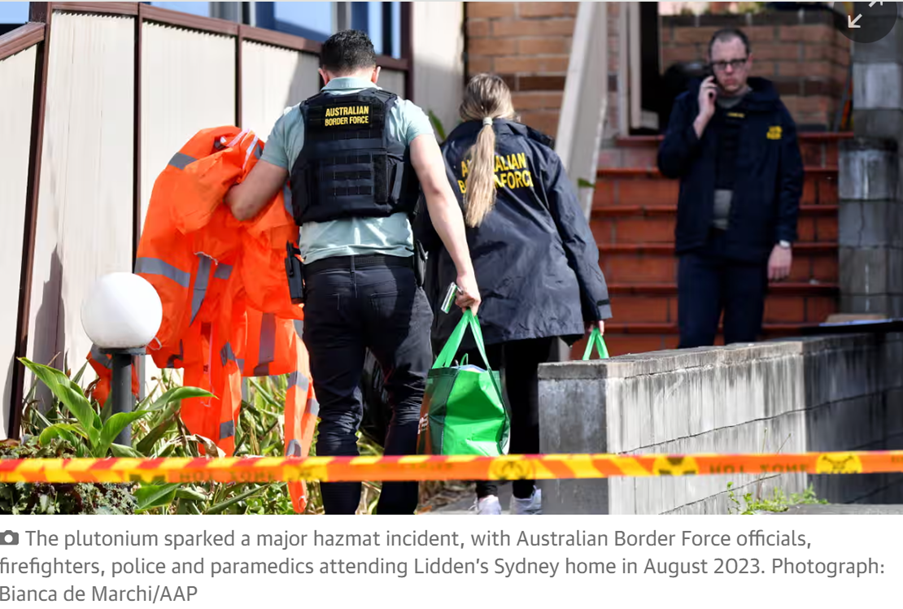
The package’s delivery sparked a major hazmat incident as Australian Border Force officials, firefighters, police and paramedics all combed the scene in August 2023.

But almost two years on, a judge on Friday spared Lidden a conviction and allowed him to walk from Sydney’s Downing Centre district court on a two-year good behaviour bond.

While his actions were criminal, judge Leonie Flannery found that the 24-year-old had mental health issues and displayed no malicious intent.

Speaking outside court after the sentencing, defence lawyer John Sutton said his client was relieved.

But the solicitor criticised border force for the way it had gone after the young man.

“It was an awful investigation for a whole range of reasons,” Sutton said.

Officers overreacted by storming Lidden’s Sydney home in hazmat suits when the amounts ordered were minuscule and harmless, he said.

“We could eat [them] and we’d still be perfectly fine,” he said.

“I’ve been contacted from scientists all around the world saying this is ridiculous.”

Prosecutors should have also questioned whether pursuing the case against Lidden in court was really in the public interest, Sutton said.

In a statement, border force Supt James Ryan called the multi-agency investigation against Lidden “extremely complex and sensitive”.

“The ABF remains committed to protecting the Australian community from all threats which can cross the border,” he said.

“I hope this example can be used as an education tool for people to be aware of the regulatory frameworks around what can and cannot be imported into Australia.”

Lidden is the first person prosecuted under Australia’s non-proliferation laws, aimed at preventing weapons of mass destruction and terrorism.

He ordered the items from a US-based science website and they were delivered to his parents’ home.

He pleaded guilty to two charges – sending nuclear material into Australia and possessing nuclear material.

At a sentence hearing in March, the lawyer described Lidden as a “science nerd” who committed the offences out of pure naivety.

“It was a manifestation of self-soothing retreating into collection; it could have been anything but in this case he latched on to the collection of the periodic table,” Sutton said at the time.

Nuclear materials can be imported legally by contacting the Australian Safeguards and Non-Proliferation Office for a permit first.

Natural Uranium is More Hazardous as a Heavy Metal Than as a Radioactive Substance

Natural Uranium is More Hazardous as a Heavy Metal Than as a Radioactive Substance. This blog has had its titles rearranged to make the content clearer. It was posted over the Christmas period and deserves more scrutiny.

Why Do We Fear Radiation? 4

Based on health considerations, the concentration of uranium in drinking water should not exceed the health-based guideline value of 0.02 mg/L. This health-based guideline value is based on chemical toxicity. The chemical toxicity of uranium is more restrictive than its radiological toxicity. – Australian Drinking Water Guidelines (ADWG).

Uranium in the Environment

Uranium is naturally present in the environment as a result of leaching from soils, rocks and natural deposits. It can also be released from mining and mill tailings, from the combustion of coal and other fuels, and from the production or use of phosphate fertilizers (which can contain as much as 150 mg/kg uranium).

Food is the major source of uranium intake and the highest concentrations are typically found in shellfish (UNSCEAR 2000). Dietary intake of uranium through food is estimated between 0.001 and 0.004 mg/day (WHO 2004). Intake through drinking water is normally low; however, drinking water can contribute the majority of daily intake in circumstances where uranium is present at higher concentrations in drinking water (WHO 2004).

In most Australian drinking water supplies uranium concentrations are well below 0.02 mg /L. However, concentrations up to 0.12 mg/L have been measured in some groundwater supplies in remote areas. In humans and experimental animals, the main toxic effect of short-term exposure to high concentrations of uranium is inflammation of the kidney. Little information is available on the effects of long-term exposure to low concentrations. (AWQG).

Comparison of the Chemical and Radiological Standards for Uranium

The Radiological drinking water standard for uranium in Australia is incredibly conservative. It is calculated using a maximum addition of radiation of 0.1mSv/year. This is one tenth of the already very conservative allowable extra exposure limit of 1mSv/year.

The radiological standard is incredibly low at 3 Bq/L based on consuming 2 litres of water every day for a year. https://www.waterquality.gov.au/guidelines

The health-based guideline value of 0.02 mg/L is equivalent to an activity concentration of 0.2Bq/L. This indicates that the health-based guideline value based on chemical toxicity is considerably more restrictive than one based on radiological data. -(AWGL)

The chemical toxicity of uranium at least 15 times more hazardous than the radiation from uranium.

The Pine Creek Geosycline

Australia is rich in uranium deposits in a number of geological formations. The Pine Creek Geosyncline covers a large part of the Northern Territory and has many major uranium deposits. In the early part of this millenium, I managed a travelling monitoring team as a regulator for mining in the NT. Consequently, I saw data from rivers and streams all over the Pine Creek Geosyncline. Often the lowest levels of uranium measured were downstream of Ranger and Jabiluka uranium mines.

It is too easy to blame radiation from substances that do emit radiation for any “sickness”. I remember one instance when Aboriginals that lived not far downstream of Ranger mine were all becoming ill. Investigation showed the illness to result from faecal bacteria in the billabong. Work undertaken to prevent raw sewage entering the billabong led to a rapid cure.

Remote Community Sues NT Government for Compensation

In 2018, the government-owned utility company Power and Water Corporation (PWC) found that the drinking water in Laramba contained 0.046 milligrams of uranium per litre (mg/L), which was more than twice the recommended level. The community had known about problems with the water supply since at least 2008, but the scale of the issue was not revealed until 2018. A new water treatment plant using ion-exchange technology was opened in 2023, making the uranium almost undetectable. https://www.abc.net.au/news/2023-04-30/water-treatment-plant-opens-in-remote-laramba

The Laramba community celebrates their new water supply which ensures uranium levels are extremely low. (ABC Alice Springs: Charmayne Allison)

The Northern Territory’s Court of Appeal on Friday 29 November heard arguments from lawyers representing the Territory government and the residents of Laramba, a town of just more than 200 people 205km northwest of Alice Springs. It was the latest instalment in a five-year legal battle, which could continue beyond this court’s eventual decision.
The court case centres on whether the NT government, as landlord to the Laramba residents, should be responsible for the quality of the drinking water.

The NT Supreme Court last year found the Territory government was responsible, with judge Peter Barr ruling the quality of the water went to the habitability of the housing. The NT government subsequently appealed the decision. https://www.theaustralian.com.au/nation/indigenous/call-for-feds-to-sort-out-remote-community-drinking-water-issues/news-story/75bc23a800352ee822123a5b170c30ac

“The case continues, because we say our clients were forced to drink that water for over 10 years so they should be entitled to some compensation,”

“But more importantly, we want to establish the point that the government in remote communities has an obligation to provide people with safe water.”

Nowhere in the press reports I read, was it clarified that the uranium level was a chemical toxicity issue and not a radiological one. This builds unnecessary fear of radiation in both Aboriginal communities and the general public.

Pamela Jones

1c Nuclear 101

The source of all our energy production is nuclear in nature.  The energy of the sun comes from nuclear reactions.  Earth heats itself through nuclear reactions which occur deep underground but not enough to sustain life, we need the heat of the sun too.

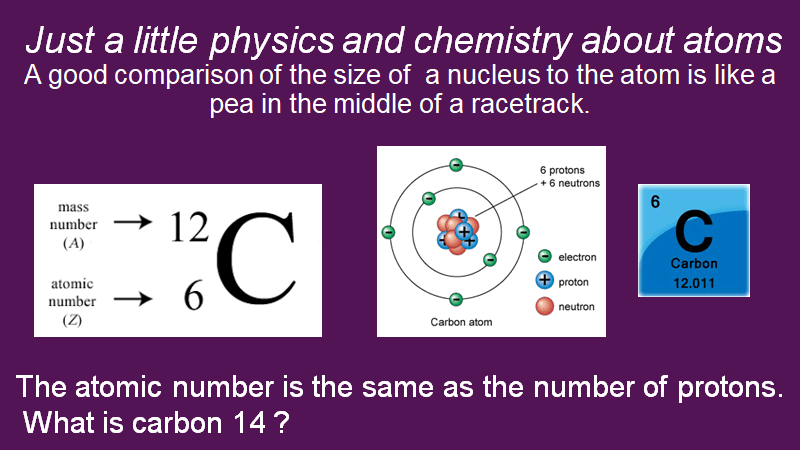
Every element has a unique atomic number, and this number corresponds to the number of protons in its nucleus. Protons are positively charged entities and would push away from each other very quickly if they were not buffered by neutrons. The mass number of an element is simply the sum of its protons and neutrons. Most of the carbon on earth has six protons and six neutrons to a total of twelve.

Carbon 12 is the common isotope of carbon. Carbon-14 still has an atomic number of six, six protons in its nucleus but eight neutrons for a total of 14. Carbon-14 is a radioactive isotope of carbon.

Hydrogen (H) is the lightest element and only has one proton. Deuterium and tritium are isotopes of hydrogen and contain one proton and either one or two neutrons. Thus, tritium has a mass number of three, one proton and two neutrons. The next element with 2 protons is Helium (He).

If, when an atom emits nuclear radiation, the number of protons in the nucleus changes, the atom changes to another element – the element that has the new number of protons.

Uranium is a metal and one of the heaviest, naturally occurring elements on earth. It is ubiquitous in our environment. It is in our drinking water, in our food, in our soils and in ourselves. When any element is much more concentrated in rocks than normal, we refer to it as an ore.

Uranium has 92 protons. Uranium 238 is the most common isotope and makes up 99.3% with 146 neutrons. It is very mildly radioactive with a half-life similar to the age of the earth itself. Uranium 235 only makes up about 0.7% and is much more radioactive. Even rarer, is the uranium 234 isotope with 142 neutrons.

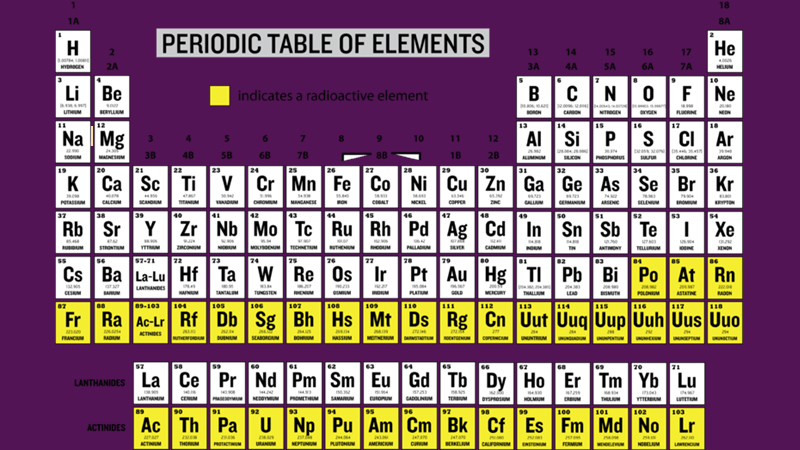
The slide above shows a version of all the known elements. It is hard to see, but hydrogen (H) is right up in the left-hand corner. Uranium (U) is fourth from the left in the bottom row. All the elements on a yellow background are radioactive. Some of the minor isotopes of the elements on the white background are also radioactive such as iodine 131, potassium 40, and carbon-14.

The video below is an excellent presentation on radioactivity. Please watch it! It leads into the next blog. If you have trouble from this site watch it on YouTube:

https://www.youtube.com/watch?v=iTb_KRG6LXo