It is very difficult to obtain reliable costings for either renewables or nuclear power. There have not been many nuclear power stations built in recent times. Finland’s new reactor is often given as an example of major cost over-runs and delays. However, even at a cost of over 11 billion Euros, it is starting to look like cheap, reliable energy at a time when Germany is paying Russia a billion Euros a day for Russian gas supplies that could be cut off at any time. It also looks cheap compared to Australia’s Snowy 2.0 pumped hydro scheme which looks like blowing out to a similar figure in AUD. The cost of construction for the new Finnish nuclear power plant, 1,650 megawatt Olkiluoto-3, could be 19 Euros/MWhr if the plant runs for 40 years or double that for 20 years.
Worldwide, with the possible exceptions in Asia such as China, very large infrastructure projects are costing much more than estimated. The large concrete pours have been blamed, together with falls in productivity. In the nuclear sector, much of the cost increases have arisen in the administrative sphere, court cases between contractors or even anti-nuclear lobbies, as well as increasing safety regulations during the construction phase which mean design changes and reconstruction. Anyone who has been involved with large construction projects, as I have, knows that the best way to blow out costs is to change designs in the middle which leads to contractor squabbles and works having to be redone.
The companies pushing SMRs, which can be factory built, have worked hard to overcome some of these hurdles. By the time Australia changes its legislation, if we do so, we will know the situation. We may also be in a better situation to know the real, total costs of renewables so that costs can be compared on a true basis. There are many comparisons made of costs on the internet. I will include a few of these. Nuscale states that its 12-module VOYGR-12, 924 MWe plant design has a levelized cost estimate (LCOE) is in the range of approximately $40/MWh to $65/MWh in the southern states of the US. Levelized Cost of Electricity (LCOE) is an economic measure used to compare the lifetime costs of generating electricity across various generation technologies.
The Nuclear Energy Agency have a fascinating site listing LCOEs calculated on data from various forms of power generation already in operation around the world. (https://www.oecd-nea.org/lcoe/ ) The calculator enables the reader to change some parameters such as discount rate and gas price. At the central case for discount rate, nuclear power is cheaper than wind and solar. At low discount rates, hydro, wind and solar become cheaper. This raises lots of questions in my mind about comparative costs and all the various cost comparison tables I have seen.
The nuclear for climate group (www.nuclearforclimate.com.au) have a great website. Robert Parker and Dr Robert Barr have carefully worked out a scenario for Australia which on their modelling provides stable, reliable electricity for Australia based on the use of BWRX-300 nuclear power stations. These would replace retiring coal plants on the same locations and retain jobs for some of existing workers while creating lots of other highly paid jobs. https://www.youtube.com/watch?v=vQC5ijEieXE
James Fleay has produced a cartoon that illustrates some of the issues associated with balancing the grid. Australia has an enormous grid connecting all states bar Western Australia and the Northern Territory under AEMO. There is currently some discussion that suggests the grid should be split up again on a state by state basis.

The CSIRO has had a draft report out on costings of various sources of electricity production out for a while. The final is yet to be made public. Some of the costings are controversial and may be too conservative for some power sources and too lenient for others. A very difficult task. GenCost 2020-21 https://www.csiro.au › media › renewables-cheapest pdf
Robert Parker uses their data in his evaluation of costs. One of his graphs is shown below. The recent rises in wholesale power prices make all these Australian numbers out of date.

It is often claimed that the more you build something, the more proficient you become and that this brings down costs. There were very few nuclear power stations built for a few decades, so as in Finland few contractors were experienced. Prices should come down – time will tell.


I read many claims that renewables have come way down in cost but are now leveling out. Unfortunately, the cost of using renewables does not include all the ancillary costs – the essential externals such as the extra grid infrastructure costs, battery storage and converters. The CSIRO has tried to take these into account but I found it confusing. The reality is that electricity prices in Australia are rapidly increasing. Wholesale prices rose almost 300% year on year in Queensland by the end of March 2022 as reported in the Australian Financial Review. Yet, by 1 May prices had skyrocketed as shown in the column on the right hand side of the slide below. Queensland had jumped from $175/MWh to $315.
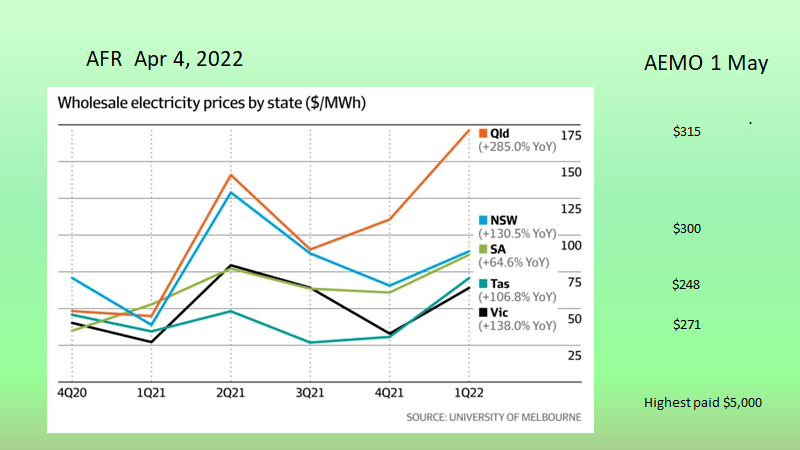
According to an AEMO media release on 29 April 2022 :
“Wholesale electricity prices in the National Electricity Market (NEM) averaged $87 per megawatt-hour (MWh) for the first quarter of 2022, up 67% from Q4 2021 and 141% on Q1 2021, driven by increased demand, coal generator outages and higher electricity-generating fuel costs.” This information is now way out of date and prices in Australia are far too high.
AEMO’s Quarterly Energy Dynamics (QED) report shows that wind and grid-scale solar output increased 743 megawatts (MW) from Q1 2021 levels to a new quarterly record of 4,190 MW, along with increases in small-scale solar (460 MW), gas (271 MW) and hydro (42 MW). Declines were seen in brown coal (304 MW) and also black coal generation (374 MW), which hit its lowest Q1 average in two decades.”
“The average Balancing Price increased by 14% from Q4 2021 to $61/MWh, while the number of negatively priced intervals was down from Q1 2021 and the WEM saw no intervals with a Balancing Price lower than -$100/MWh.”
I have to admit I find the pricing of Australian electricity very complicated. The carbon credit system, RET, auctions, order of purchase etc. make it all very complicated. However there is no doubt that our electricity prices are going up, our coal fired power stations find it hard to mesh in with renewable energy as they are not designed to ramp up and down quickly. This wears out equipment and intermittent use causes the costs of generating power to rise. Coal fired power is base load power. The newest stations are in Queensland and their construction is still in the pay-back period and knowing they are likely to be shut down earlier than originally planned mean they have to increase their prices. Because they are not operating continuously as originally planned this also increases their costs and hence prices.
Gas fired power produces about half of the carbon dioxide produced by coal but because we have contracted our gas overseas, gas prices are high. Gas power stations can ramp up and down rapidly. Combined cycle gas plants are very efficient and score well as compared to most other forms of power generation apart from their green-house gas emissions.
Traditional nuclear power is also a form of base load power and better left operating continuously. It can be ramped up and down 10-20% without problems. The new SMRs are being designed to match with renewables by ramping up and down as required.
Let us not forget grid system costs. These are added after we build the transmission infrastructure itself. Our new Labour Government in Australia has a huge budget to upgrade our grid to match the needs of renewables.

The next few slides provide a few views of LCOEs.
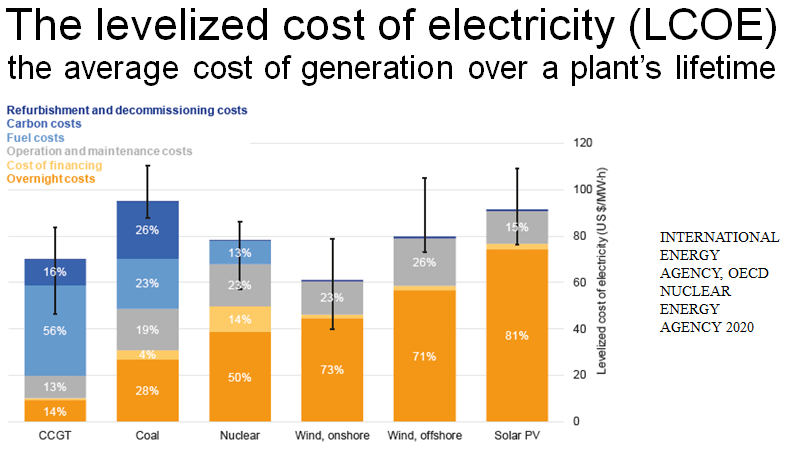
https://www.iea.org/reports/projected-costs-of-generating-electricity-2020
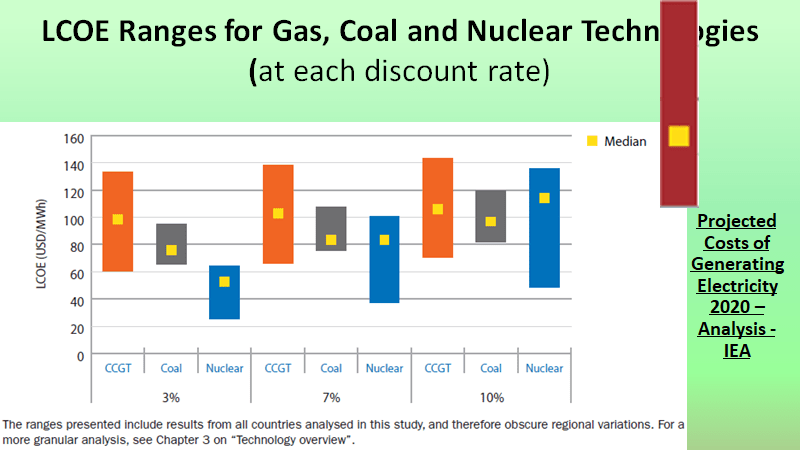
This report looks closely at how LCOEs are calculated. The couple of graphs below summarise the complexity of decision making for power generation.

The next slide is hard to read. Unfortunately costings for renewables rarely take into account the extras required to use them effectively. Lazards are known for their costings. The bottom graph shows the LCOEs of various storage systems. The top graph on the slide has been sized to match the bottom scale and shows LCOEs of the power sources themselves. Some of the costs in the bottom graph have to be added to the cost of renewables to make any comparisons valid.

Storage is expensive and requires lots of mining and manufacture. The green house gas production depends on the energy source used. There is already a supply chain issue for materials and this will worsen with the current situation with Russia.
It is often forgotten that we lose energy with each conversion. Battery storage technology is typically around 80% to more than 90% efficient for newer lithium-ion devices. Battery systems connected to large solid-state converters are being used to stabilize power distribution networks. These systems do not store power for use but are used to stop grid blackouts and brownouts. Converting electricity to hydrogen and then back to electricity again is very inefficient. 60% of the energy is lost. Hydrogen needs to be used to decarbonise other processes such as steel manufacture and fertilizer production not used to regenerate electricity.
It is of interest to note how long it takes to start up a mine or build a big coal-fired power station. China is managing to build nuclear power stations in three years. Nuscale Power claims they can do the same.
Both Russia and Kazahkstan are important sources of nuclear fuel. If you wish to look deeper, a great summary published in March 2022, is provided by https://theconversation.com/russias-energy-clout-doesnt-just-come-from-oil-and-gas-its-also-a-key-nuclear-supplier-179444
Another cost to energy production which is even harder to ascertain are subsidies.

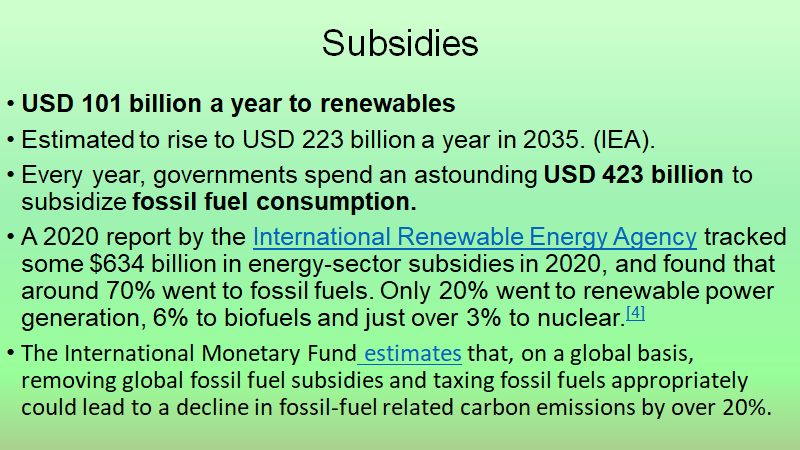

On Sky News in 2020, Nationals MP Barnaby Joyce said it is important to remember each wind turbine costs the taxpayer $660,000 per year, per tower, due to the government subsidy scheme for renewable energy developments. He was commenting on a $600 million, 77-turbine wind farm proposed just outside of Tamworth.
One of the most confounding issues with wind and solar costings is how to include the intermittancy, seasonality etc. Data for wind suggests that most onshore wind farms only produce somewhere between 10% to 30% of their nameplate capacity each year. In very ideal locations, they may reach 40% as can some offshore wind farms. The latter are more expensive to build and maintain.
This means that the capacity needed to replace fossil fuels with renewables is many times their nameplate capacity and again there seems to be disagreement on just how many times. In every country there are days when the power generated from renewables dives to very little. This means some form of backup power or an enormous, currently not available, battery backup is needed. In reality, the amount of power stored in the big batteries only lasts for a short time, enough time for operators to turn on other sources of power to prevent blackouts or worse, brownouts which are exceedingly costly.
So for every MW of wind or solar there has to be a MW of coal or gas or nuclear or hydro ready, willing and able to pick up the slack, whenever the sun sets and/or calm weather sets in. This requires unnecessary duplication of capital costs.
In every place that has large reliance on so-called cheap renewable power, electricity prices have soared and destruction of the natural environment occurred. Germany is currently clear felling ancient forest to mine more coal. We are starting to do the same silliness in Queensland, clearing highly diverse forest with endangered flora and fauna to build wind farms – releasing carbon dioxide stored in trees and soil into the atmosphere and losing all the other climate change mitigation benefits that forests provide.

The following table and its assumptions can be found at https://stopthesethings.com/2022/06/05/renewable-energy-delusion-counting-staggering-cost-of-wind-solar-obsession/.

Just look at the power generated compared to name plate capacity! 22% for onshore wind, 34% for offshore wind wind, 11% for solar (Australia is a great place for solar but not Europe). This is only 18% for all renewables in Europe in 2021, yet so often all we hear about are the nameplate capacities. This means to really reach the capacity needed to replace fossil fuel power plants with 100% renewables , 5 times the capacity has to be built before taking into account seasonality or peak times and it still may not cover really bad weather
Imagine how many nuclear power stations could be build for 2038 billion Euros. Even at the same cost as Finland’s expensive new power station, nearly 200 Olkiluoto-3 plants could be built producing over 300 GW of reliable power for 40 to 60 years. That equates to over 2,600 TWhr each year or 10% of the world’s electricity while those renewables only produced 69 GW, a fifth of what nuclear would do and that doesn’t take into account the cost of building the renewables and extra transmission lines in the first place.
The Hornsdale battery in South Australia has a storage capacity of 194 MWhr. This provides just enough time for coal fired plants to ramp up if renewable power dips too much. It has paid for itself by charging enormous prices to the wholesale market such as A$14,000/MWhr in Jan 2018, 2 million AUD for a service nuclear does not need. South Australia now has more Big Batteries. South Australia produces about 13,ooo GWhr of electricity each year. Assuming this amount is averaged over the year and the day/night cycle, Hornsdale can provide the equivalent amount of power made in South Australia for about 7 minutes. Of course, this level of electricity would not normally be needed as only parts of the system would drop production suddenly in most instances giving the poor operators more balancing time.
Until recently, I had not questioned the mantra that renewables provided cheap, clean, green electricity. I am not so sure anymore.
 My Blog has become My Nuclear Journey