
Ultimately, all the energy we use arises from some form of nuclear energy. The Sun’s energy reaches our planet as a result of nuclear reactions in the Sun itself. This energy is critical to our survival on Earth. The sun provides the energy for photosynthesis and hence all our food, wood, and dung. All the fossil fuels were created many millions of years ago from plants that derived their energy from the Sun. Differences in the heat from the Sun hitting Earth at different latitudes drives our climate engine. These differences in heat around the globe creates the wind that drives our wind turbines. Going back in time, it was nuclear reactions out in space that created the elements we find on Earth.
This video introduces the concepts of nuclear fission and can be found on https://www.youtube.com/watch?v=D91T-B-PVE0 if you have challenges making the embedded video work.
All the commercial nuclear power plants (NPP) operating today use nuclear fission as their source of heat energy. Optimism suggests we may be able to use nuclear fusion at some time in the future as an alternative to nuclear fission.

A great deal of energy holds the protons and neutrons of an element’s nucleus together. The heavier elements tend to degrade into lighter elements. Elements close to iron (Fe) in the periodic table are very stable. When elements come apart for whatever reason we call this nuclear fission. Because it takes less energy to hold the resulting smaller nuclei together, a lot of energy is released. Uranium and plutonium have excessively big nuclei and fall apart relatively easily depending on the number of neutrons present. Looking at the periodic table below, the heaviest elements are shaded in yellow, and they are all radioactive. The heaviest elements may only exist for minutes or seconds as they are so unstable. Some of the elements with smaller nuclei have minor isotopes that are radioactive, depending on the number of neutrons in their nuclei.


This schematic works for most types of electricity generation power plants operating today. In the case of nuclear power stations, the heat source is a nuclear fission reactor which creates hot, pressurised steam which turns a turbine. The fossil fuel power plants work in a similar manner. After use, the steam condenses back to water and recycles past the heat source again.
Cooling water is kept separate from the recycling water for many reasons. For example, condenser water, which is cooling water, can be sea water and taken directly from the ocean and returned to it at a slightly higher temperature. Marine life, close to a variety of power stations, is slightly different to that a little further away. In most cases, the slight increase in temperature leads to a greater density of some marine species. Detrimental effects are not found. The boiler water is usually exceptionally clean water with special additives to keep pipes and pumps from eroding or clogging up.
The giant cooling stacks are part of many diverse types of power stations and only emit steam from cooling water.
Even hydroelectric and wind power work in an analogous manner to that shown on the top part of the diagram above. There is no heat source, the power to drive the turbines comes from rushing water or air. There is no need for a cooling system. However, even hydroelectric schemes can have a small impact on water temperatures both upstream and downstream of the power plants.
The energy of the spinning turbines becomes electrical energy by moving magnets within the electrical generator. This short video was cut in my talks and was used just to remind us about electrical units. It has taken from MW vs. MWh: Do You Know Your Electric Units? https://www.enerdynamics.com
https://www.enerdynamics.com/Energy-Insider_Blog/MW-vs-MWh-Do-You-Know-Your-Electric-Units.aspx
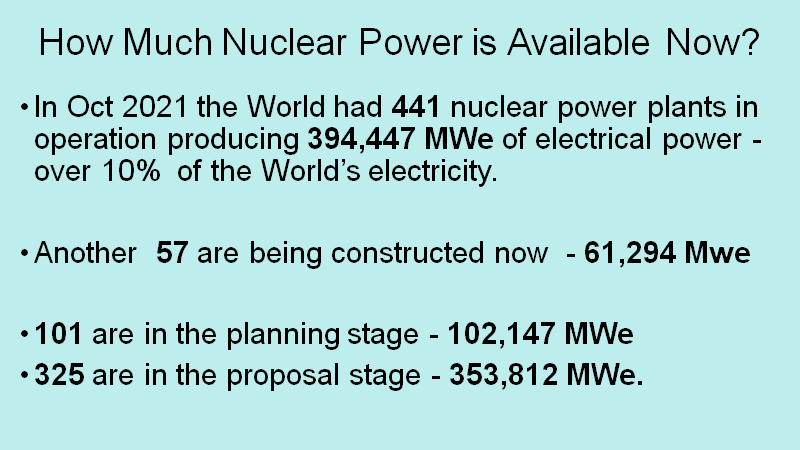
Since the beginning of 2022, many countries in Europe are doing a U-turn away from closing down their nuclear power stations to planning new nuclear power plants.


The BWR type reactors work in exactly the same way as shown in the general schematic for a power plant.
Light-water reactors use ordinary water, also called light water, to produce steam to drive their turbines. Water also acts as a neutron moderator that slows neutrons down so more reactions can occur. Water absorbs too many neutrons to be used with unenriched natural uranium as fuel. So, the fuel used is enriched to 3-5% U238. Canada’s CANDU reactors can use natural uranium as fuel, but they are not light-water nuclear reactors. Instead, the reactor water used is heavy water.

PWRs have one more system that circulates water. Water passing through the reactors is separate to that in the circuit that drives the turbines. In order to generate steam efficiently, the “reactor water” is maintained at a high pressure and thus higher temperatures can be reached.


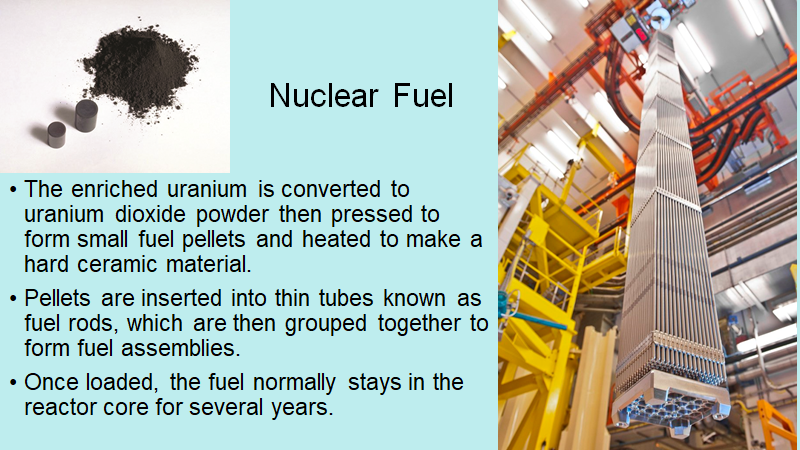
Many people visualise nuclear waste from reactors as a liquid. All highly radioactive waste is solid and contained in fuel rods within a fuel assembly and then kept within further layers of protective containment More details about waste handling is presented in later blogs.
Discover more from My Blog has become My Nuclear Journey
Subscribe to get the latest posts sent to your email.
 My Blog has become My Nuclear Journey