Queensland Government claims that our greenhouse emissions have reduced substantially since 2005. As I revealed in my last blog, it is only the reduction in land clearing that has reduced our reported emissions in a meaningful way.
Despite the substantial uptake and use of rooftop solar, our emissions from public electricity are still as high as ever.
It is our forests in Queensland that has been doing the hard work.
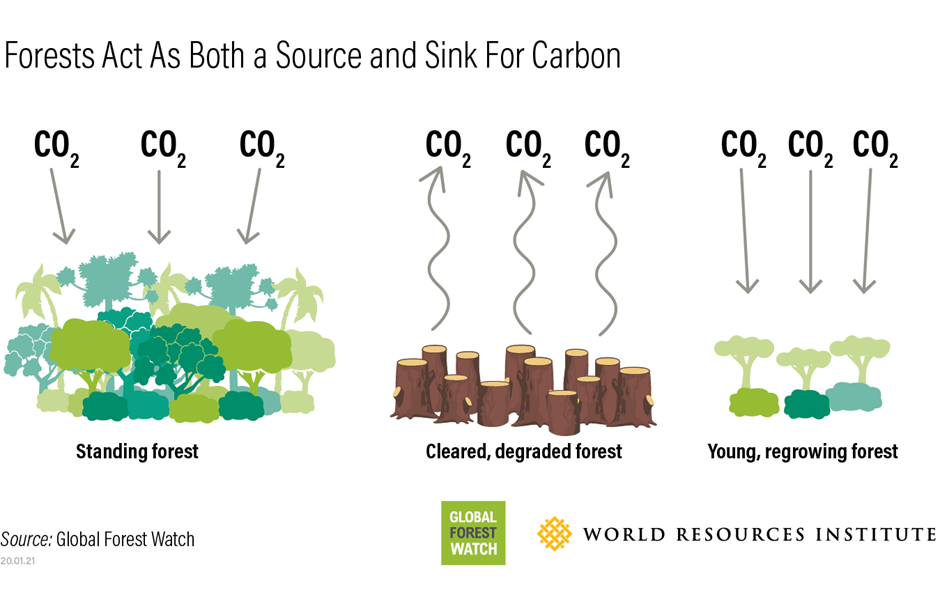
Sometimes, I read that many of the world’s forests are no longer carbon sinks or are heading that way. These statements can be misleading as they suggest forests are no longer working hard storing carbon. If a forested area has increasing areas that are cleared, the overall balance may be more like that of degraded land. Every time we clear, we reduce the forest’s ability to sequester carbon and release more carbon dioxide to the atmosphere from the felled trees and the soil.
Where are the forests in Queensland and which ones do the most work storing carbon? Unfortunately, some of the most important lie in Queensland’s designated Energy Zones for the building of “renewable” energy projects. This particularly applies in the Northern Renewable Energy Zone.
This blog presents a quick overview of Australian forests. My later blogs will examine the implications of the current energy zones in Queensland.
Forests provide many services to us. They are not just storing carbon.
Data on Forests
Australia has a total of 134 million hectares of forest, which is equivalent to 17% of Australia’s land area. Australia has about 3% of the world’s forest area, and globally is the country with the seventh largest forest area.
Queensland has the largest area of Australia’s forest (51.8 million hectares) – 39% of Australia’s forest. It has most of the tropical rainforest and mangroves plus a large proportion of Australia’s eucalypt forest.
Unfortunately, the classification and definitions of forest used by the Forestry Department are not quite the same as that used in the National Greenhouse Accounts and direct comparison of data can be misleading.
The following descriptions of our forests come from https://www.agriculture.gov.au/abares/forestsaustralia/australias-forests/profiles#daff-page-main


Most of Australia’s forests are native forests and these native forests are often divided into three classes based on their crown cover, and three classes based on mature tree height. Crown cover is the area of ground covered by tree canopies, ignoring any overlaps and gaps.
Less than a third of our forests are reasonably dense with more than 50% canopy cover. Rainforest is nearly three quarters closed canopy and of medium height.
Rainforest
Well over half of Australia’s rainforest is in Queensland. Australia has 3.6 million hectares of the rainforest native forest type, which is 2.7% of Australia’s total forest area. 50% is protected in nature conservation reserves with 2 million hectare belonging to Queensland.
Australia’s rainforests are typically characterised by high rainfall, lush growth and closed canopies. They rarely experience fire.

Rainforests are very important for the conservation of biodiversity. They provide habitat for many forest-dwelling and forest-dependent species of plants and animals. This includes numerous species that are endemic to Australia, and species listed as threatened under the Commonwealth Environment Protection and Biodiversity Conservation Act 1999.
Rainforest comprises only 2.7% of Australia’s total native forest, but provides habitat for 60% of Australia’s plant species, 60% of butterfly species, 40% of bird species and 35% of mammal species.
One third of Australia’s rainforests lie within UNESCO World Heritage Areas. The World Heritage Wet Tropical Forest clusters around Cairns. The IUCN nominated this forest as the second most important natural area in the world. At the time of its listing, it was noted that the forest was partially degraded and that every effort should be made to link the various sectors together.
Eucalypts
Three quarters of Australia’s total forest area is dominated by Eucalypt forest.

Please note that the denser eucalypt forest in Queensland lies just west of the wet tropical forests clustered around Cairns. The other main zone lies to the south of Emerald and Rockhampton. Various sectors of the denser forest are protected as National Parks and Forest Reserves.
Nearly 90% of the eucalypt forest in Queensland is either leasehold or privately owned. Much of it is the open woodland forest type and is often used for cattle grazing.
My next few blogs will discuss some of the other services forests do for us and how this fits into Queensland’s Energy Plan.
Discover more from My Blog has become My Nuclear Journey
Subscribe to get the latest posts sent to your email.
 My Blog has become My Nuclear Journey