Before I write about the mechanisms all life on Earth uses to repair itself from any harm caused by low dose radiation, I feel I must present some information about tritium and the current political uproar about release of water at Fukushima in Japan.
Japan’s biggest seafood customer, China, has decided to ban seafood from Japan, followed by South Korea. New Caledonia has decided to ban swimming in the ocean.
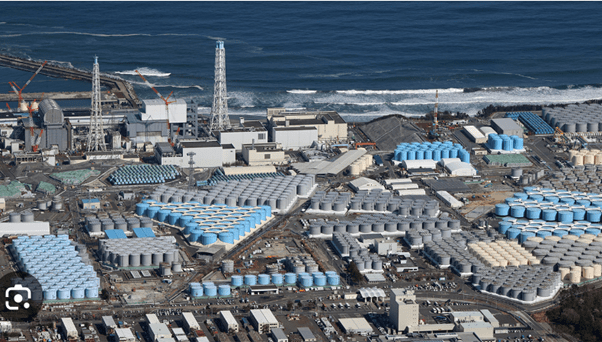
Japan has been storing treated water from the damaged Fukushima nuclear power plants in large tanks. There are about a thousand tanks containing 1.2 million tonnes of water.
Japan has begun releasing treated wastewater used to cool down the nuclear reactors damaged by the tsunami in March 2011. The water has been treated to remove radioactive material, but small quantities remain. Tritium is hard to remove as it forms part of a few of the water molecules. There are very small quantities of carbon 14 and there may be even smaller quantities of strontium and iodine isotopes. Most of the latter were dispersed by May 2011.
Tritium is formed naturally every day in our atmosphere and added to the oceans and land as rainwater. Any taken into our bodies comes out fairly quickly in our urine. Radiation from tritium is weak beta rays. These rays do not travel far and are stopped by skin. Unless the dosage is extremely high, our bodies quickly repair any damage caused.
The release from Japan into the Pacific Ocean can be made to sound bad and scary. “But it actually isn’t. Similar releases have occurred around the world for six decades, and nothing bad has ever happened.
“The radioactivity in the Fukushima water is almost entirely tritium, a type of hydrogen. For scale, the Pacific Ocean contains 8,400 grams of pure tritium, while Japan will release 0.06 grams of tritium every year. The minuscule amount of extra radiation won’t make the tiniest jot of difference. A lifetime’s worth of seafood caught a few kilometres from the ocean outlet has the tritium radiation equivalent of one bite of a banana.” according to Nigel Marks is a Professor in Physics at Curtin University
Tony Hooker, Director of the Centre for Radiation Research, Education and Innovation at The University of Adelaide says: “I would like to reiterate that the release of tritium from nuclear facilities into waterways has and is undertaken world-wide with no evidence of environmental or human health implications. “
Tony Irwin, an Honorary Associate Professor at the Australian National University is also Technical Director of SMR Nuclear Technology Pty Ltd and Chair of Engineers Australia Sydney Division Nuclear Engineering Panel: “There is an understandable perception that all radioactive materials are always and everywhere dangerous, particularly liquid waste, but not all radioactive materials are dangerous. The Fukushima water discharge will contain only harmless tritium and is not a unique event. Nuclear power plants worldwide have routinely discharged water containing tritium for over 60 years without harm to people or the environment, most at higher levels than the 22 TBq per year planned for Fukushima.
“For comparison the Kori nuclear plant in South Korea discharged 91 TBq in 2019, more than four times the planned Fukushima discharge and the French reprocessing plant at La Hague discharged 11,400 TBq in 2018 into the English Channel, more than twelve times the total contents of all the tanks at Fukushima, again without harm to people or the environment.
“It is important that the International Atomic Energy Agency (IAEA) has carried out an independent and transparent review of the procedures and equipment for discharges and its comprehensive report issued in July 2023 confirms that the release will have a negligible radiological effect on people and the environment. The IAEA will maintain a continuous on-site presence on site to independently monitor discharges.
“More tritium is created in the atmosphere than is produced by nuclear power reactors, and it then falls as rain. Ten times more tritium falls as rain on Japan every year than will be discharged. The discharge limit for release of radioactive water at Fukushima is 1/7th of the World Health Organisation standard for drinking water. The discharge is ultra-conservative.”
A paper was published in August 2021 by seven Chinese authors with assistance from authors in the Netherlands, Ukraine, South Korea, and Spain with scary looking figures of their modelling of potential release scenarios by Japan. https://www.sciencedirect.com/science/article/pii/S0025326X2100549X
On closer examination problematic zones were about 0.1 Becquerel(Bq)/m3 of sea water. These scenarios were all assuming much faster dumping of the water than Japan actually plans. The paper itself gives the background concentration of tritium in the surface water of the North Pacific Ocean as around 50 Bq/m3 (0.2% increase, less than natural variation). Good luck monitoring any difference during the release except at the actual release point.
Japan plans to dilute the water in the tanks before release with a maximum concentration of tritium in the release of 1,500 Bq/l. The WHO drinking water standard is 10,000 Bq/l.
The IAEA will monitor the release at various points in the dilution and release system. The data is available at
To understand the monitoring system watch https://twitter.com/iaeaorg/status/1694605862621380652
As I write, the tritium concentration of the discharge is 207 Bq/l. This is way less than the tough standard Japan set itself of 1,500Bq/l. The gamma ray monitoring ensures the water does not contain other radioactive contaminants.
Discover more from My Blog has become My Nuclear Journey
Subscribe to get the latest posts sent to your email.
 My Blog has become My Nuclear Journey