The International Atomic Energy Agency (IAEA) was created in 1957 in response to the deep fears and expectations generated by the discoveries and diverse uses of nuclear technology. The Agency was set up as the world’s “Atoms for Peace” organization within the United Nations family. From the beginning, it was given the mandate to work with its Member States and multiple partners worldwide to promote safe, secure and peaceful nuclear technologies.
The IAEA’s headquarters are in Vienna, Austria. It also has two regional offices located in Toronto, Canada (since 1979) and Tokyo, Japan (since 1984). The Agency runs laboratories specialized in nuclear technology in Vienna and Seibersdorf, Austria, and in Monaco.
Due to the involvement of both my husband and I in the regulation of uranium mining in Australia, we have a few friends who have worked for the IAEA in the laboratories and in the cleanup of mining areas in parts of the old Soviet Union. One of them had his office across the corridor from the man most responsible for the data on Chernobyl. David did a short consultancy in the Vienna offices. The scientists of the IAEA take their responsibility for nuclear safety very seriously and come from dozens of nations.
When Japan proposed the water discharge from the Fukushima nuclear plant, the IAEA examined the strategy very closely and gave its blessing but insisted that the discharge be monitored very carefully. Japan gave itself a tough standard of 1500 Bq/L knowing that the WHO standard for drinking water was 10,000Bq/L. A lot of data is available online which I have viewed. It is possible to see the data for every tank on site. Some of the tanks containing water cleaned up early in the process contain a fraction too much caesium isotopes. This water will be cleaned up again before release. The IAEA has a website that shows the monitoring data during the discharge in real time.
A snapshot in time (as I am writing) is shown below:
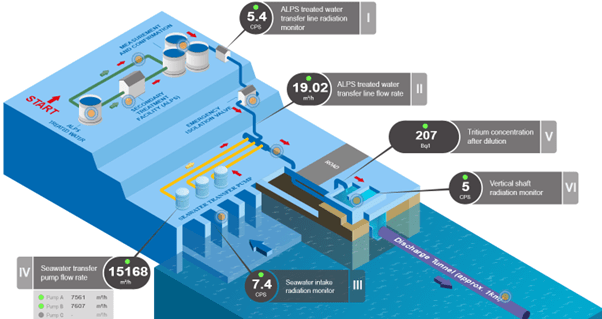
Green dots show that the data indicates that everything is OK. A red dot would indicate that the nuclear company, Tepco, should take action. A grey dot shows that a pump is not operating.
The water after dilution is shown as 207 Bq/L, way below the level Japan set for itself and only 2% of the WHO drinking water standard. It is about this amount each time I looked at the data.
What fascinated me was that seawater has slightly more radiation than the treated water as measured in cps. Although details are not given, Geiger type counters probably do not pick up tritium as the beta rays are so weak. These measurements are used to ensure other radioactive elements such as caesium are not being discharged. As the data shows, the levels in both the treated water and the seawater are very low.
Discover more from My Blog has become My Nuclear Journey
Subscribe to get the latest posts sent to your email.
 My Blog has become My Nuclear Journey