The Adverse Impacts of Wind Turbine Developments on Australia’s Biodiversity and Climate
Most of our big cities are spread along the East Coast of Australia. They were sited where they are because of the environmental conditions resulting from the Great Dividing Range and its forests. We are still undervaluing these assets and underestimating the threats even as we face the ravages of climate change. In Far North Queensland our tropical rainforests and wet sclerophyll forests are now being severely threatened by wind turbine developments. There is little of this forest left. Forest is more than trees. The biodiversity is enormous. In our ignorance, yet another project has recently been passed under the EPBC Act. But it is not just the biodiversity that is lost. The forests on the ridges of the Great Dividing Range help to stabilise the local climate in many ways. Undisturbed tropical forests are usually fire resistant.
Forests play so many roles. They tie the soil together, preventing erosion and absorbing the water to form deep sponges slowing down the passage of water and cleaning it on the way. In other words, forests help to lessen the impact of floods, feed ground water and keep the area moist and cooler. While doing all these services, they sequester carbon dioxide in their wood and their roots, pouring oxygen into the atmosphere and producing food and habitat for other living creatures. Recent studies suggest that the trees on lower ranges, as we have in Australia, also help it to rain in two ways: evapotranspiration help clouds reach saturation levels and organic compounds rising from the trees seed the clouds. This becomes more and more important as temperatures rise with climate change as warmer air holds more water before it becomes saturated.
It is not enough to claim that a wind turbine development only effects the actual cleared area. Any disturbance leads to edge effects that have now been shown to penetrate as much as 3 km into adjacent tropical forests, drying out the soil and vegetation, making wide bands of land more susceptible to fire and windstorms. This leads to progressive degradation and the damage grows exponentially hot summer by hot summer. When this forest with all its diversity is gone, it is gone. It cannot be restored by replanting a few trees. Rainfall comes less often but when it does rain, the amount is increased with bigger drops. Flooding and soil erosion can become massive.
Carbon Dioxide
Australia is the driest continent on Earth. Like every other nation on earth, we will be affected by climate change. We certainly don’t like the idea of becoming hotter and drier in the future. When I look at the data on global carbon dioxide levels and rising temperatures, I see that we are not winning the so-called war on carbon dioxide levels despite the amount of wind and solar projects being built around the world and the trillions of dollars already spent.
Despite many dire predictions, the Earth’s natural systems are still doing most of the heavy lifting. It is hard to comprehend that we humans, one of the most successful species to have evolved on our planet is unbalancing a range of natural systems on which our very existence depends. If we wish to leave a liveable planet to our children and grandchildren, we need to consider all the components that are threatening our natural systems. When we speak of saving the climate, it’s really the Holocene climate we are trying to save, and the biological richness holding it up.
In our haste to save the climate we have separated two of the important dynamics that affect carbon dioxide levels. In the race to replace fossil fuels with “renewables”, we seem to be overlooking other large factors. Well over a decade ago, the Australian Government funded a project to really look at the big picture to determine just what should be done. How should our money and resources best be spent mitigating climate change? The images below illustrate the situation both globally and in Australia.

Source: Global Carbon Project – the numbers are in billions of tons of carbon dioxide per year averaged between 2010 and 2019.
The arrows show the major fluxes. So, fossil fuels and industry produced 34.4 billion tons per year (Pg CO2/yr) while land use change emitted 5.7 for a total carbon dioxide source of 40.1 billion tons CO2/yr.
The land sink is 12.5 billion tons of CO2 per year and the ocean absorbs 9.2 making a total sink of 21.7 billion tons of carbon dioxide per year. The data shows that natural systems were removing more than half of anthropogenic (man-made) carbon dioxide between 2010 and 2019 averaged over this period. It has continued to do this enormous task for the last 60 years on a proportionate basis. The sections of the United Nations that look at this side of the equation have reiterated this information for many years.

Source: Global Carbon Project – the numbers are in millions of tons of carbon dioxide per year averaged between 2010 and 2019. (Note that the units are millions of tons of carbon dioxide per year.)
Look at the impact of FIRE! It had a much larger impact than our electricity production.
Australia only produced 0.12% of the net emissions of the world and we were nearly carbon dioxide neutral from 2010 to 2019 while the sequestration by ocean was not even counted!
If only it were that simple. We are a small nation but we emit 1% of the world’s carbon dioxide from fossil fuels and industry. Add our emissions from bushfires and that doubles our emissions to 2 %. BUT our wonderful land sequestered most of this , bringing our overall emissions down to .1%. How much longer can the natural world help us if we continue to chop down trees and let fires burn? Both decisions dry out our soil and the consequences compound.
What about our coal and gas exports? The reality is that we are buying our wind turbines and solar systems and batteries and EV cars from overseas, some parts of which have been manufactured using energy from fossil fuels, possibly even our coal. Simplistically, one could suggest that Australia’s transition to renewables is actually bad for climate change mitigation. Particularly so when we destroy Nature’s system of carbon sequestration when installing wind turbines on ridges in forested areas.
Topography and Climate in Australia

Topographic map of Australia from https://www.nationsencyclopedia.com/Asia-and-Oceania/Australia-TOPOGRAPHY.html – image by Arid Ocean
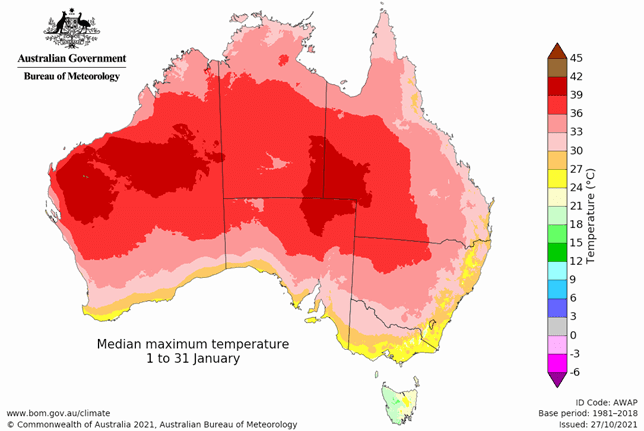
Elevation doesn’t offer protection from heat in Western Australia. Neither does it correspond with rainfall despite the nightly impression we see on the TV weather maps of clouds passing from North West to South East over our continent.
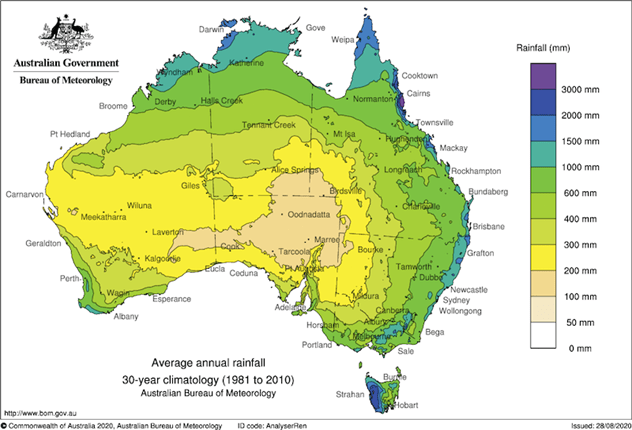
It is no surprise that most Australians live close to the Great Dividing Range in Eastern Australia.
As compared to rainfall in Australia where are our remaining forests?
Forests in Australia

Distribution of Australia’s Forest Types 2018
In 2019, Australia had a total of 134 million hectares of forest, which is equivalent to 17% of Australia’s land area. Australia had about 3% of the world’s forest area, and globally is the country with the seventh largest forest area.
Queensland had the largest area of Australia’s forest (51.8 million hectares) – 39% of Australia’s forest. It has most of the tropical rainforest and mangroves plus a large proportion of Australia’s eucalypt forest. (2019 data and forest maps are from https://www.agriculture.gov.au/abares/forestsaustralia/australias-forests/profiles#daff-page-main)
Most of Australia’s forests are native forests and these native forests are often divided into three classes based on their crown cover and three classes based on mature tree height. Crown cover is the area of ground covered by tree canopies, ignoring any overlaps and gaps.
Less than a third of our forests are reasonably dense with more than 50% canopy cover. Rainforest is nearly three quarters closed canopy and of medium height.
Rainforest
Well over half of Australia’s rainforest is in Queensland. Australia has 3.6 million hectares of the rainforest native forest type, which is 2.7% of Australia’s total forest area. Half of this is protected in nature conservation reserves with 2 million hectare belonging to Queensland.
Australia’s rainforests are typically characterised by high rainfall, lush growth and closed canopies. They rarely experience fire. However, currently planned renewable energy projects will change this dramatically. Recent studies undertaken in the Amazon and Brazil show that fragmentation dries out the soil and the forest for up to 3 km from the cleared area making the rainforest much more prone to both bushfire and wind storm damage. This damage extends further and further into the forest with each event. It has been shown in China that wind turbines act as giant fans leading to extra drying. These same mechanisms apply to other forest types as well. Eucalypt forests can recover from fire if given the chance to do so. Studies in Indonesia and the Amazon indicate that this is not the case for tropical rainforests. Fire and wind storms do not recognise boundaries between conservation zones and private land. Our World Heritage Areas have no special protection from fire and edge effects resulting from clearing on nearby land.

Distribution of the Rainforest Native Forest Type 2018
Rainforests are very important for the conservation of biodiversity. They provide habitat for many forest-dwelling and forest-dependent species of plants and animals. This includes numerous species that are endemic to Australia, and species listed as threatened under the Commonwealth Environment Protection and Biodiversity Conservation Act 1999.
Rainforest comprises only 2.7% of Australia’s total native forest, but provides habitat for 60% of Australia’s plant species, 60% of butterfly species, 40% of bird species and 35% of mammal species.
One third of Australia’s rainforests lie within UNESCO World Heritage Areas. The World Heritage Wet Tropical Forest clusters around Cairns. The IUCN nominated this forest as the second most important natural area in the world. At the time of its listing, it was noted that the forest was partially degraded and that every effort should be made to link the various sectors together.
Recent studies have indicated that wet forests including wet sclerophyll forests help to cool the temperature of Earth down and will continue to do so as temperatures rise unlike other forest types.
The albedo effect of forests, because they are darker and absorb more light energy, causes warming. This is counteracted in tropical wet forests due to the greater extent of cooling caused by evapotranspiration from their leaves. The UN has estimated that that the overall worldwide cooling effect may be as much as 1 degree Centigrade.
Eucalypts
Three quarters of Australia’s total forest area is dominated by Eucalypt forest.

Distribution of Eucalypt Native Forest 2018
Please note that the denser eucalypt forest in Queensland lies just west of the wet tropical forests clustered around Cairns. The other main zone lies to the south of Emerald and Rockhampton. While some of the denser forest are protected as National Parks and Forest Reserves, nearly 90% of the eucalypt forest in Queensland is either leasehold or privately owned. Much of it is the open woodland forest type and is often used for cattle grazing.
The Hydrological Cycle, Clouds, Mountains and Rain
The Great Dividing Range consists of a complex of mountain ranges, plateaus, upland areas and escarpments. A very simplistic view of the rainfall is that moisture laden air brought in by the trade winds rises up the sides of the Range and the moisture condenses in the higher cooler air and down it comes as rain (orographic rain). A rain shadow can then form on the other side of the Range. However, our peaks are not very high. An increasing number of studies hypothesise that the clouds form and are seeded as the result of organic compounds rising from trees on the mountain ridges. It has also been suggested that additional moisture needs to be added to the air from land evaporation and tree evapotranspiration before critical moisture levels are reached and it rains.
Currently there are over 60 renewable energy projects planned for the Great Dividing Range between Cairns and Brisbane most of them in our precious remaining forest. Steve video ref Far too many of them require clearing for access roads and blasting of the mountain tops to catch the best winds available. Queensland’s wind resources are not wonderful as recorded daily by current operating wind turbines. Their placement is understandable from the project proponents’ viewpoints as this is where access to transmission lines and the QLD Renewable Energy Zones were placed. BUT what are the consequences.
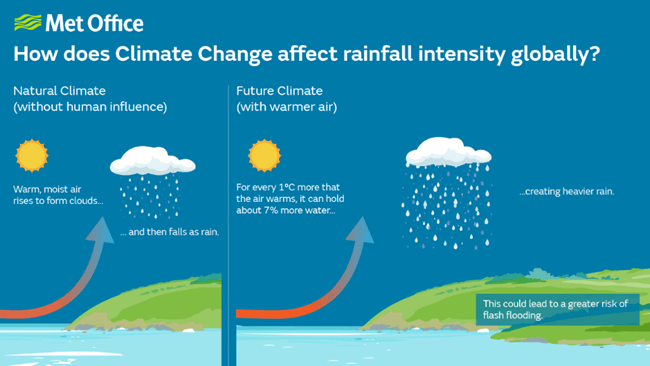
Do we know? Current climate models do not take all these details into account. One thing is certain that as temperatures rise the air can hold more moisture. Two things can happen as a result. It is harder for moisture to condense and rain to fall. BUT when it does rain, the volume and intensity of the rain will be much greater.
Forests play many roles. They tie the soil together, preventing erosion and absorbing the water to form deep sponges slowing down the passage of water and cleaning it on the way. In other words, forests help to lessen the impact of floods, feed ground water and keep the area moist and cooler. While doing all these services, they sequester carbon dioxide in their wood and their roots, pouring oxygen into the atmosphere and producing food and nice places for other living creatures.
So, if instead we put wind turbines on the mountain ridges, we dry out the soil and the nearby forest, increase the temperature, affect rainfall patterns, decrease carbon sequestration, increase bushfire intensity and occurrence, destroy biodiversity, waste lots of rare resources while making unreliable energy, killing our remaining manufacturing and businesses while costing our nation a fortune which will have to be repeated again before 2050. In the meantime, China has discovered that it is possible to lower urban temperatures by planting a forest around their cities.
It would be nice to believe that fragmenting the remaining forests would not do too much damage. This is not the case. It is absolutely critical that our northern forests are left intact. Thousands of recent ecological and forestry studies show that we are reaching a tipping point of tropical forest survival. Death by a thousand cuts? No just a few more may well be enough. So many species are on the edge. No, we don’t have every answer or absolute proof. By the time it is available it will be too late.
Why are we risking Australia’s future on a poorly thought out strategy.
Discover more from My Blog has become My Nuclear Journey
Subscribe to get the latest posts sent to your email.
 My Blog has become My Nuclear Journey