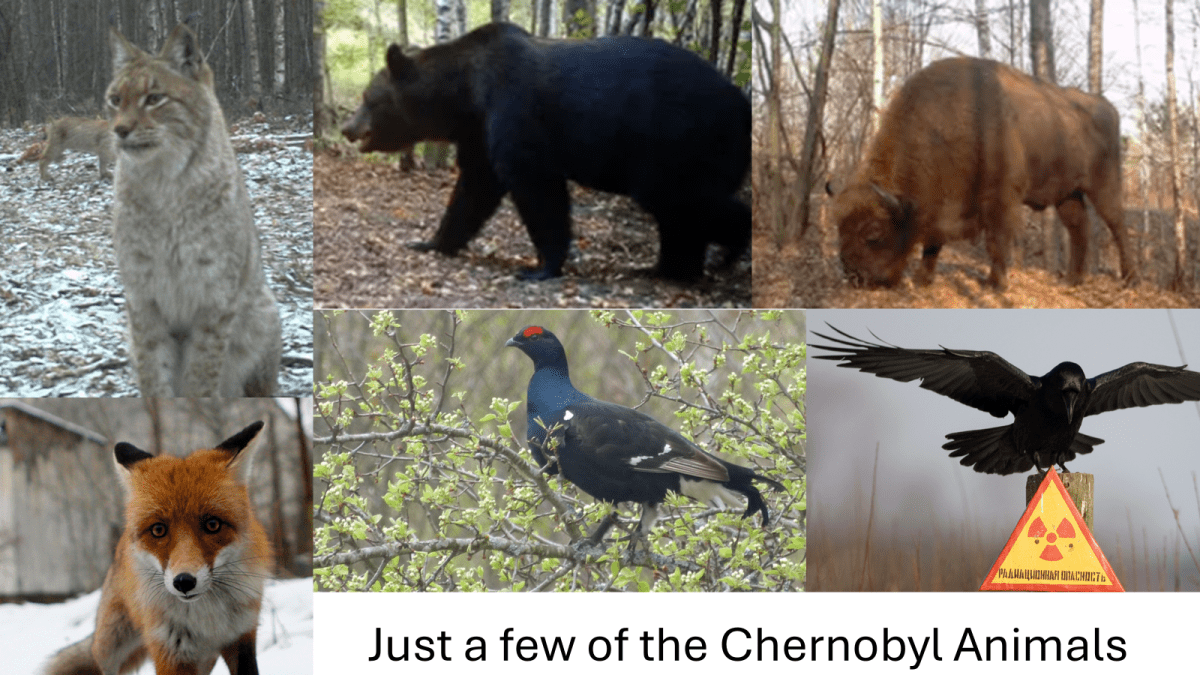
In the first few years after the Chernobyl Catastrophe, most of the attention was focused on human health. The general impression was that any animals living nearby were either killed or badly maimed and the forest was quiet. Some farm animals were born malformed with extra limbs and a few forest creatures were also seen to be mutated. It is no surprise that in those early years very high levels of radiation either killed or maimed. Creatures in utero or in the period of rapid cell growth and organ differentiation were particularly vulnerable. Expectations for the future were very pessimistic.
Few researchers expected what then happened!
Ecologists have found the land surrounding the damaged nuclear power plant, which has been largely off limits to humans for three decades, has become a haven for wildlife, with lynx, bison, deer and other animals roaming through thick forests. This so-called Chernobyl Exclusion Zone (CEZ), which covers 2,800 square km of northern Ukraine, now represents the third-largest nature reserve in mainland Europe and has become an iconic – if accidental – experiment in rewilding.
Contamination Levels in the CEZ
The contamination levels within CEZ vary considerably. The highest levels are in the “Red Forest”. Around the destroyed nuclear power plant and in the nearby city of Pripyat, the radiation caused the leaves of thousands of trees to turn a rust color, giving a new name to the surrounding woods. Workers eventually bulldozed and buried the radioactive trees. What these levels actually are vary from source to source but they are still very high.

The levels of contamination by iodine 131 dropped quickly in the first year as it has a half-life of 8 days. Similarly cesium 134, with a half-life of 2 years, has almost disappeared. The isotopes cesium 137 and strontium 90 remain mostly tied up by the clay in the soil. Fungi can have relatively high levels of cesium 137. Recent radiation levels in most of the CEZ vary from less than 1 to over 800 mSv /year.
Cesium 137 and strontium 90 have half-lives of about 30 years. Thus the radiation levels will have now halved since the disaster. In about 200-300 years there will be very little radiation left. Cesium is not easy to absorb. Clay binds to it strongly. The cesium that is absorbed has a biological half-life of 90 days. Similarly strontium is also bound to clay but once in a vertebrate, it is bound into bones and stays there for a long time as it is not excreted. It should also be remembered that both isotopes are toxic chemically as well as being radioactive.
The Animals of Chernobyl
Top predators like wolves that ate other contaminated animals were assumed to be particularly vulnerable.
The reality has been that larger mammals have thrived. These include Eurasian lynx, gray wolf, wild boar, brown bear, European bison, elk, red deer, red fox, roe deer, raccoon dog, and Przewalski’s horse. Thirty horses were introduced in the late 1990s. Cameras traps now indicate that there are over 100 of this special breed.
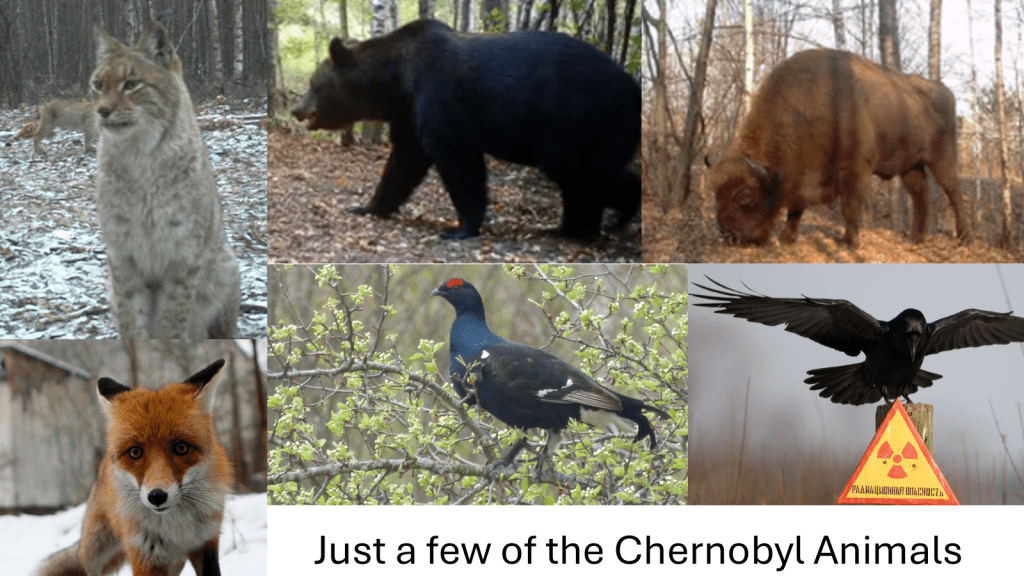
Top: European Lynx (U.K. Centre for Ecology and Hydrology), Brown Bear and Bison (Sergey Gaschack), then below Fox (AP PHOTO / Sergui Chuzavkov), Black Grouse (Nick Beresford), Raptor (REUTERS/Vasily Fedosenko).
Other commonly observed animals include moose, black grouse, snakes, owls, raccoon dogs, foxes, pine martens, and badgers. There have been suggestions that foxes may not be reproducing as fast as other animals. Perhaps the lack of farmers’ chicken pens has reduced their feed source!
Domestic cats have now bred for many generations without the presence of farming families. There are lots of rodents as a food source. Dogs left behind vary in their quality of life with the situation being complicated by human activities.
The monitoring of animals has become much more sophisticated and some creatures are now being tagged. Recent work includes genetics, and biochemistry of blood and tissue samples.
I have included the following video. The story is great and the animals shown wonderful. Some of the ideas may be outdated but the video is fascinating. I loved watching it. There are lots of other videos on the web. They vary in quality and degree of bias. The pictures of mutated animals appear to have been taken prior to 2000.
Ecological Studies
Unfortunately no scientists or other visitors are allowed to enter the CEZ at the current time due to the war. So studies are on hold. Scientists tend to be very conservative and continue to ask each other difficult questions. Early studies did not examine the health of the animals seen.
Two evolutionary biologists teamed up to study the area’s birds. They were Anders Møller of University Paris-Saclay in France and Timothy Mousseau of the University of South Carolina. Their early surveys showed that certain bird species tended to have more genetic mutations, smaller brains and less viable sperm in sites with higher radiation levels. And in 2007, they counted 66 percent fewer birds and 50 percent fewer bird species in highly radioactive places compared to background-level sites.
In dozens of studies, the pair also documented that, with higher radiation levels, there were significantly lower numbers of soil invertebrates and a lower abundance of certain insect species and such mammals as hares and foxes. Working with collaborators in Finland, they also documented a range of health effects in bank voles.
Over the last 10 to 15 years much more detailed studies have started and early pessimistic authors are now also finding that the creatures are adapting well to higher levels of radiation including Møller and Mousseau. By 2014, in a paper they published with others: Chronic exposure to low-dose radiation at Chernobyl favours adaptation to oxidative stress in birds.
We found a pattern radically different from previous studies in wild populations, showing that GSH levels and body condition increased, and oxidative stress and DNA damage decreased, with increasing background radiation. Thus, when several species are considered, the overall pattern indicates that birds are not negatively affected by chronic exposure to radiation and may even obtain beneficial hormetic effects following an adaptive response. Analysis of the phylogenetic signal supports the existence of adaptation in the studied traits, particularly in GSH levels and DNA damage. https://besjournals.onlinelibrary.wiley.com/doi/full/10.1111/1365-2435.12283
Attitudes were changing.
When other scientists reanalyzed early data by Møller and Mousseau on a dozen mammal species, they found that radiation had indeed caused declines in abundance, but only at higher doses than the pair had originally reported. No account had been made of the radioisotopes already within the bodies of the mammals. This is Science in action.
Dr Ismael Galván, of the Spanish National Research Council said “Previous studies of wildlife at Chernobyl showed that chronic radiation exposure depleted antioxidants and increased oxidative damage. We found the opposite – that antioxidant levels increased and oxidative stress decreased with increasing background radiation.” The species surveyed were: Red-backed shrike, great tit, barn swallow, wood warbler, blackcap, whitethroat, barred warbler, tree pipit, chaffinch, hawfinch, mistle thrush, song thrush, blackbird, black redstart, robin and thrush nightingale. “Chronic exposure to low-dose radiation at Chernobyl favors adaptation to oxidative stress in birds.” https://besjournals.onlinelibrary.wiley.com/doi/10.1111/1365-2435.12283
A Recent Study on Wolves
So far the findings from this important study are only available as an abstract from 2024. A full paper has not yet been published, probably because of the pause in research. Polygenic adaptation and co-regulatory dynamics in Chernobyl wolves: Unveiling immune and oncogenic stress interactions with implications for human cancer resilience. https://doi.org/10.1158/1538-7445.AM2024-7322
Gene signature variations in CEZ wolves reveal a distinct immune profile, likely shaped by prolonged radiation exposure. These findings, along with evidence of polygenic selection, suggest adaptation to multigenerational radiation exposure (an oncogenic stress). Notably, the enrichment of genes with positive prognosis in human cancer overexpressed in CEZ wolves present a valuable model to explore genetic underpinnings of cancer immunity and advance our understanding of cancer resilience in humans.
In other words, the wolves in the CEZ are a unique population of gray wolves that have adapted to survive levels of radiation six times higher than the legal limit for humans. They are the subject of scientific research that aims to understand how animals can survive in these conditions. The research so far suggests that the wolves have developed genetic mutations that make them resistant to cancer. The wolves are thriving. Their population in the CEZ is seven times denser than in low radiation protected areas in Belarus.
Next time: what has happened to the humans that live and work in the CEZ?
Discover more from My Blog has become My Nuclear Journey
Subscribe to get the latest posts sent to your email.
 My Blog has become My Nuclear Journey
Really interestingDr Corinne Unger PhD (Management) BScDipEd DipGeoscResearch FellowCentre for Social Responsibility in MiningSustainable Minerals Institute&P/t UQ Business School, Strategy and Entrepreneurship&Mine Land Rehabilitation Authority Board member, DEECA Victoria
LikeLike
Thanks!
LikeLike