Whoops! He Bought Plutonium Online.

Many press stories were published onFri 21 Mar 2025 including this extract from Australian Associated Press.

“Homegrown scientist faces 10 years’ mail for importing plutonium.  His package delivery locked down his street as special agents in hazmat suits swooped. Now he will be the first person ever to be sentenced under a decades-old law.

Sydney ‘science nerd’ may face jail for importing plutonium in bid to collect all elements of periodic table

Emmanuel Lidden, 24, to learn fate after breaching nuclear non-proliferation laws by shipping samples of radioactive material to parents’ suburban home.

A “science nerd” who wanted to collect all the elements of the periodic table could face jail time after ordering radioactive material over the internet.

But Emmanuel Lidden, 24, will have to wait to learn his sentence after breaching nuclear non-proliferation laws by shipping samples of plutonium to his parents’ suburban Sydney apartment.

Lidden pleaded guilty to offences under Australia’s Nuclear Non-Proliferation Act that carry a possible 10-year jail sentence and is due to receive his sentence from the judge Leonie Flannery on 11 April.

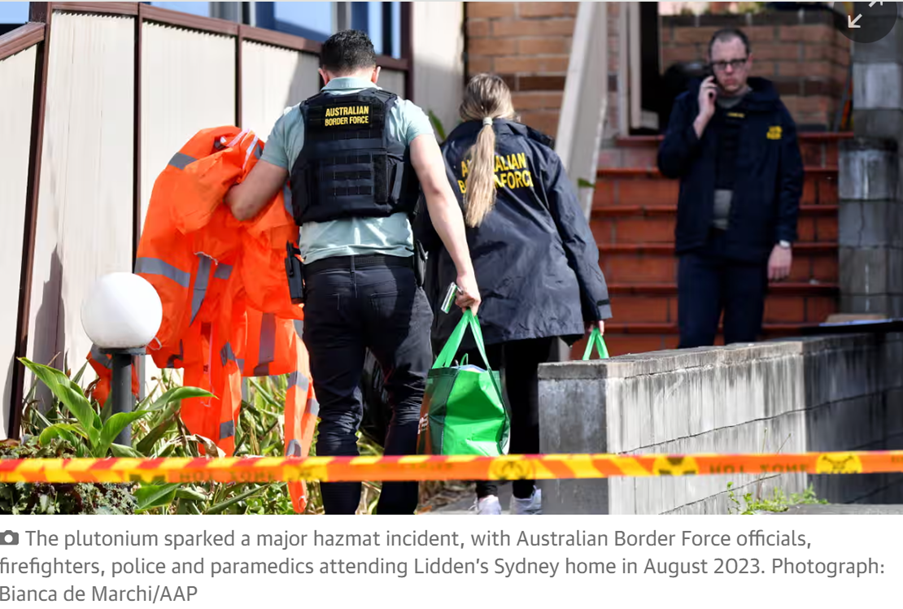
The importation sparked a major hazmat alert, with Australian Border Force (ABF) officials, firefighters, police and paramedics all attending the scene in August 2023.

Far from there being any intention of building something nefarious like a nuclear weapon, Lidden’s lawyer John Sutton described his client as an “innocent collector” and “science nerd” who had been left flipping burgers after being sacked from his job because of the investigation.

“He did not import or possess these items with any sinister intent … these were offences committed out of pure naivety,” Sutton told Sydney’s Downing Centre district court on Friday.

“It was a manifestation of self-soothing retreating into collection, it could have been anything but in this case, he latched on to the collection of the periodic table.”

Lidden had also been a keen collector of stamps, banknotes and coins.

But prosecutors said describing the young man as a simple collector and science nerd was a mischaracterisation.”

https://www.theguardian.com/australia-news/2025/mar/21/emmanuel-lidden-sydney-science-nerd-importing-plutonium-

An Earlier Press Report

David Southwell’s article for the Daily Mail Australia was published on 15 December 2024.

A science enthusiast is facing 10 years’ jail for importing nuclear material even though it was found to be harmless. 

Emmanuel Steven Lidden, 24, was arrested in August 2023 when officers in full hazmat suits swooped on his parents’ Arncliffe unit in southern Sydney, blocking off the street and evacuating neighbours.

They confiscated plutonium and depleted uranium in decorative vials and polymer cubes that Lidden kept by his bedside after buying from a US science collectables website to complete a real-life periodic table.

Scientists found the samples were harmless, but Lidden pleaded guilty to importing nuclear material into Australia and possessing nuclear material without permission, which could land him in prison for over 10 years. 

Lidden’s lawyer John Sutton said the anti-terror laws were clearly not aimed at people like Lidden.

‘These laws were created to protect society from terrorists and people who intend to cause mass destruction, not naive young science fans,’ he told the Daily Telegraph.

The laws were created in 1987 and Lidden is the only person to have been prosecuted under them. 

Asked about the appropriateness of pursuing Lidden, a Commonwealth Director of Public Prosecutions spokeswoman said it ‘conducts all prosecutions in accordance with the Prosecution Policy of the Commonwealth’.

https://www.dailymail.co.uk/news/article-14193785/Emmanuel-Steven-Lidden-plutonium-arncliffe.html?ito=native_share_article-nativemenubutton

The Online Store

 Lidden ordered the materials from an online store in the US. As the online store says Collecting elements is a fun way to learn about chemistry and nature in general. They have a range of display cases and element samples made to fit the different display cases. The cheapest one is shown below.
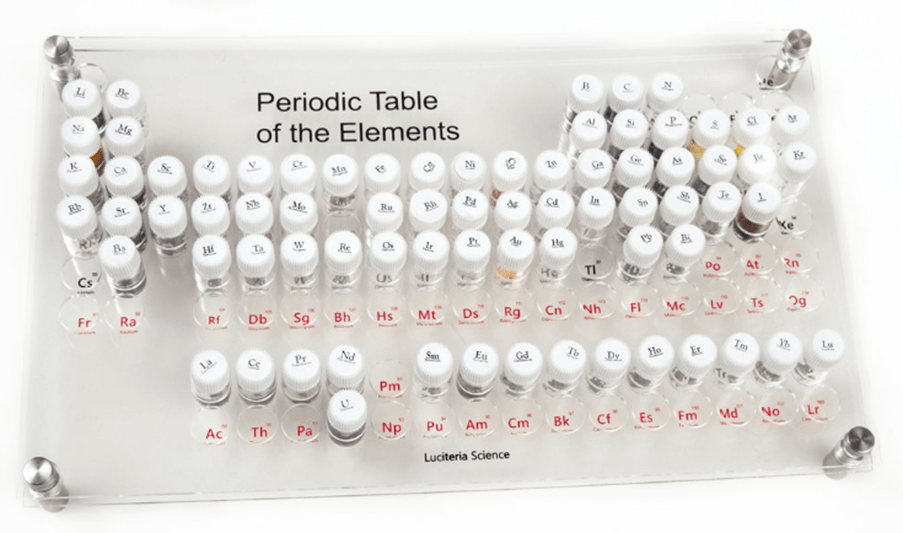
Originally, five radioactive elements were available for sale. The site warns – Don’t worry about their safety. Because of the small size samples their level of radioactivity is far too small to be hazardous to health so long as you keep these well out of the reach of children. Accidental ingestion, or particulates which are allowed to become airborne where they could be breathed in, do pose a serious health risk.

The more expensive kits use lucite cubes or glass vials. The containers used to hold the samples would have stopped any alpha rays. The uranium would have looked like this:

Many Elements are Radioactive

Most elements have one or more radioactive forms that occur naturally as a percentage of the whole. For example, potassium – 40 makes up about 0.012% or 120 parts per million of natural potassium. All our food is radioactive as are our bodies. Sleeping next to your spouse provides you with more background radiation. Potatoes are radioactive as are bananas. For more information on background radiation see my blog post. https://onewomanjourney.com.au/2024/12/30/background-radiation-how-much-radiation-do-we-experience-on-earth/

Interestingly, bismuth is not classified as radioactive and is sold as a treatment for travellers’ tummy wogs. Actually, it has no stable isotopes and a very, very long half-life.

Is Plutonium the Most Dangerous Substance on Earth?

As the late John Fremlin, professor of radioactivity at Birmingham University, famously advised a public inquiry, plutonium can be sat upon safely by someone wearing only a stout pair of jeans. At Harwell in the 1950s the newly-crowned Queen Elizabeth was handed a lump of plutonium in a plastic bag and invited to feel how warm it was.  https://www.neimagazine.com/uncategorized/the-drama-of-plutonium/?cf-view

Plutonium is radioactive, but it doesn’t seem that harmful at first glance. It looks like any other metal, with a silvery sheen that turns dull in contact with the air. Queen Elizabeth II held a piece during a visit to Britain’s Atomic Energy Research facility at Harwell in 1957. It was warm to the touch, but it didn’t hurt. 

According to some references the incidence happened in 1956 at the opening of the Calder Hall UK. A young Queen Elizabeth was invited to handle a lump of plutonium and feel the warmth of the extraordinary material, which she did. The shielding was a plastic bag and I presume the royal gloves. The Queen outlived almost all her contemporaries. (D Fishlock. ‘The Last Retort.’ Chemistry World 99, March 2005.)

According to the World Nuclear Association, even eating plutonium doesn’t really do any harm, although it’s definitely not recommended! https://www.space.com/what-is-plutonium

Galen Winsor

Galen Winsor worked with plutonium for over 3 decades in the US. In the video below he talks about his experiences. Then he talks about his utter dismay when the Hi-Level Waste Disposal Act of 1982 was passed as part of “The Nuclear Scare Scam”- (about 26minutes into the video). This is a fascinating video for those interested in plutonium.

Galen Winsor – What stopped the plutonium economy? https://www.youtube.com/watch?v=8VvGw1tkT1Q

It is time Australia dealt with real risks appropriately rather than over-reacting to trivial issues. Fear of radiation is both costly and ignorant of the science.
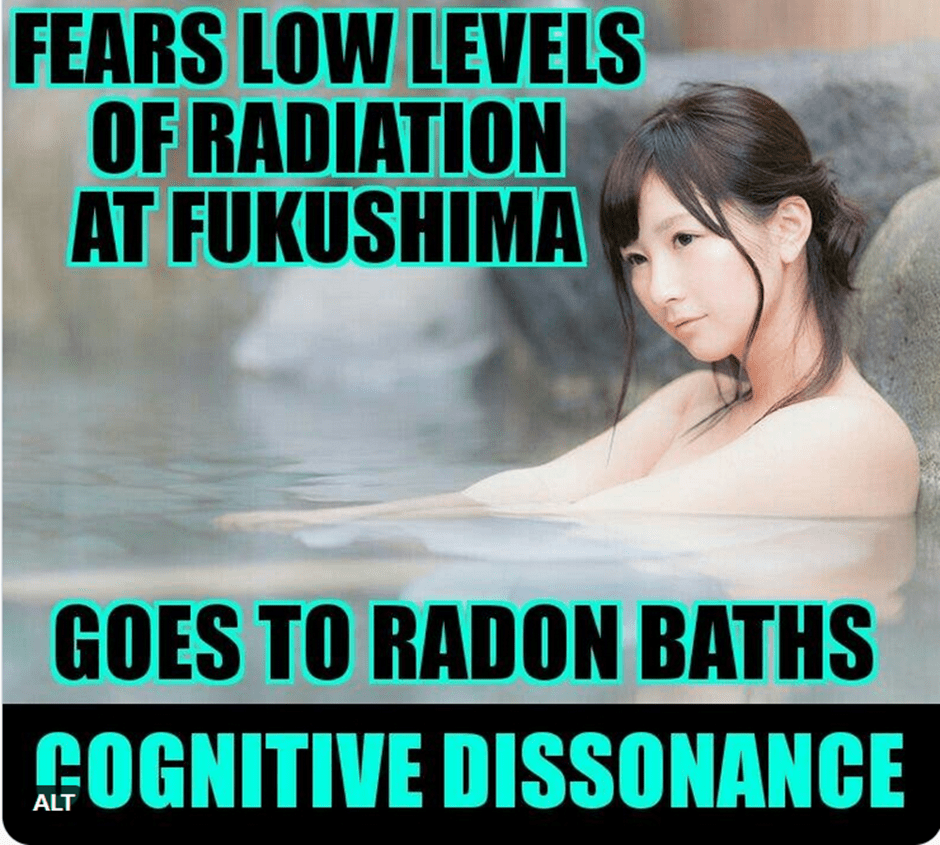
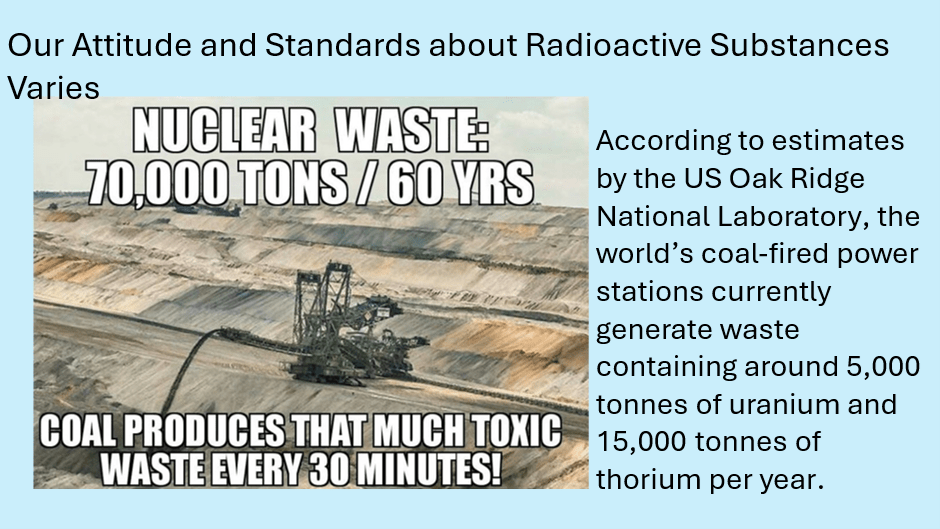
Cognitive Dissonance and Low-Dose Radiation

Germany has more radon baths than any other country. Yet they fear nuclear power plants. They closed them down and opened up coal mines knocking down ancient forests in the process. Medical benefit payments are paid out to people who attend the radon spas for relief of muscular-skeletal ailments. The medical fraternity warns of the dangers of radon yet people in pain still seek relief.

People have been using radon baths for thousands of years.  Low dose radiation seems to lessen the pain and immobility of osteoarthritis. But not every patient benefits.

https://www.fau.eu/2019/01/17/news/research/the-healing-effect-of-radon/#:~:text=Thermal%20water%20that%20contains%20radon,Steben%20Health%20Spa%20Research%20Association).

https://pmc.ncbi.nlm.nih.gov/articles/PMC2477705/#:~:text=Radon%20Via%20Bath%20or%20Steam,for%20three%20or%20more%20weeks.

Many studies have shown that the more low dose radiation a population receives, the less cancer there is in the population. This effect is known as hormesis. I can also find studies that state that low dose radiation causes cancer.

 Is anything black or white or just shades of grey? Is anybody totally truthful? We all have our biases. To get a message across about cognitive dissonance I wrote “Low Dose Radiation is not Harmful and May Even Be Good for Us! Nobody Died from Radiation at Fukushima”

But panic and fear of radiation caused the unnecessary deaths of over a thousand Japanese people following the evacuation.

Every decision we make in life rests on our perception of the risk involved versus the benefits. That balancing act changes with circumstances. For example, the amount of radiation used for cancer treatment is huge. None of us would want to receive that much in ordinary circumstances. A medical specialist tells us it is our best chance of beating deadly cancer and we accept the treatment for 2 reasons. Firstly, the radiation will be applied under very controlled conditions to a limited area. Secondly, the whole balance of the situation has changed.

A few years ago, I didn’t agree that Australia should have a nuclear power industry. Did we plan long term enough? Did we plan carefully? Were we just too Gung-ho?

I am now watching the destruction of Australia’s wonderful unique biodiversity as we lose forest and mountain ridges to wind turbine projects in Queensland in the “fight against climate change”. Is the balance, right? Do we have to destroy nature to save the planet?

Ecologists, Barry W. Brook and Corey J. A. Bradshaw ranked 7 major electricity-generation sources (coal, gas, nuclear, biomass, hydro, wind, and solar) based on costs and benefits. They published a paper in 2014 called:  Key role for nuclear energy in global biodiversity conservation. https://conbio.onlinelibrary.wiley.com/doi/full/10.1111/cobi.12433.

This study still stands out. It used multicriteria decision-making analysis and ranked 7 major electricity-generation sources based on costs and benefits. It then tested the sensitivity of the rankings to biases stemming from contrasting philosophical ideals. Irrespective of weightings, nuclear and wind energy had the highest benefit-to-cost ratio.

The Integrated Life-cycle Assessment of Electricity Sources undertaken by the United Nations Economic Commission for Europe which concentrated on Carbon Neutrality in the UNECE Region has been extensively quoted by Oscar Martin on LinkedIn. https://digitallibrary.un.org/record/4020227?ln=en&v=pdf

Nuclear scored far better than wind power (and all other electricity generation types) on nearly all rankings with the exception of water use and of course radiation. Public and occupational exposures to radiation from electricity generation was far higher from coal and even geothermal systems than from conventional nuclear power plants. Likewise, every other of 22 assessed electricity generation types were more carcinogenic than conventional nuclear power.

Potential impacts such as specific biodiversity-related impacts, noise or aesthetic disturbance were not assessed under the land use analysis. Nuclear had the lowest lifecycle impacts on ecosystems, followed by various forms of wind and solar power. Under the land use assessment, renewable technologies were assumed to be readily built on various land types without heavy modifications such as land sealing, mountaintop removal, and flooding.

The assessment of land use which was used in the assessment of ecological impact for wind projects only considered the directly disturbed land (turbine pads, access roads) and assumed the surrounding land could be used for other purposes such as agriculture. For disturbed forests this leads to massive underestimation of the impact. Research in far northern Queensland is finding that impacts from wind turbines on some species in forests can extend 3 km or more from a turbine.

Nature is doing over half the work of reducing carbon dioxide levels worldwide. We can save nature and the planet. With a carefully planned mix of nuclear and other energy sources, we can preserve our biodiversity.

Yes, nuclear power is not 100% safe and clean. Nothing ever is. The benefits to humanity and nature are too great to ignore and far greater than the risk.

Australians for Nature and Nuclear!

The Effect of False Fear of Low-Dose Radiation – Fake Graph of Fukushima

Japanese Tsunami March 2011

A magnitude 9.0 earthquake, centred to the east of Sendai caused  a wave 10m high travelling at 800 kph .  The highest wave hitting the coast of Japan was 23m. It travelled inland for 10 km in some places. The Hawaiian Islands had waves over 3 metres high. As many as 19,500 lives were lost from both the earthquake and tsunami.

Misinformation

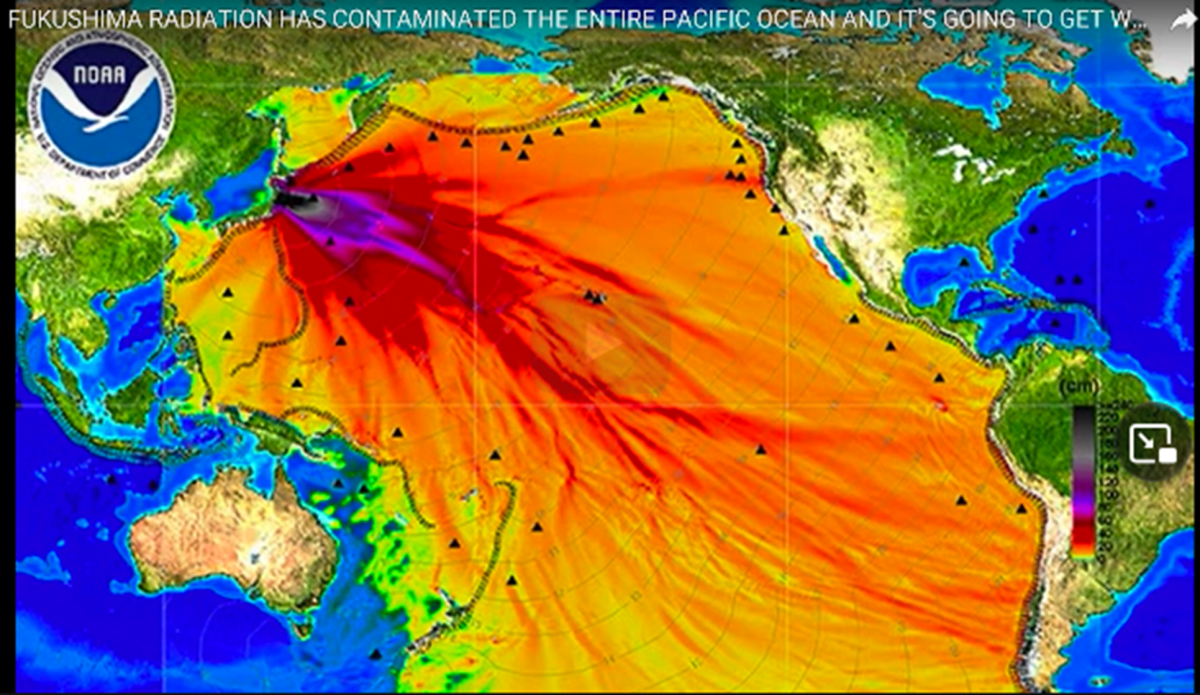
The following figure, with the added title “FUKISHIMA RADIATION HAS CONTAMINATED THE ENTIRE PACIFIC OCEAN AND ITS ONLY GOING TO GET WORSE!” was repeated over and over again on the web by various “green” groups.

Yes, the figure was produced by NOAA (National Oceanic and Atmospheric Administration of the US Government). BUT it is a graph of WAVE HEIGHTS after the tsunami. NOAA does not measure radiation levels.

A similar graph has been used for years by Helen Caldicott including during a presentation to Teals before the last election. Helen’s graph had a logo from a company in Australia that does undertake radiological measurements. The company stated on their website that it was not their work and that their logo was falsely included. She must have known for nearly ten years that the graph was false. I am also horrified by nuclear war and nuclear bombs and admire her work in this area but not at the cost of truth about low dose radiation.

Nuclear power plants and nuclear bombs are very different. I hate nuclear weapons. However, the use of falsified information when advocating for the banning of nuclear weapons or nuclear power is not OK. It is particularly abhorrent when scientific data is used in a way that the author knows to be untrue. I was told to use this technique in an environmental campaigning course by a famous international “Green” organisation.

These types of fear peddling are totally unethical, particularly when they pretend to be scientific in nature.

Why Do the Media call the Tsunami, the Fukushima Nuclear Disaster?

How many deaths could have been avoided if suggestions for evacuation or shelter in place standards suggested by the IAEA had been used. But Fear and Panicked Evacuation of about 100,000 people was responsible for 2313 disaster-related deaths among evacuees from Fukushima prefecture.

An old nuclear power plant overdue for decommissioning was damaged at Fukushima Daiichi by a wave 13-15m high. The placing and tsunami protection of the Daiichi plant assumed a 3m wave.

Eleven reactors at four nuclear power plants in the region were operating at the time and all shut down automatically when the earthquake hit. Subsequent inspection showed no significant damage to any from the earthquake itself.

The residual heat cooling systems worked for 8 out of the 11 power plants. At Fukushima Daiichi, electrical power from all 6 external sources stopped and the generators turned on until the tsunami flooding disabled 12 0f 13 backup generators running the cooling systems. Switching gear was also damaged.

Heat built up causing steam in the cooling systems. Hydrogen was produced by the steam reacting with exposed Zircaloy cladding. The containments were filled with inert nitrogen, which prevented hydrogen from burning in the containment. However, the hydrogen leaked from the containment into the reactor buildings, where it mixed with air and exploded. 3 of the 4 reactor buildings were damaged by hydrogen explosions. This was not a nuclear explosion. It was simple chemistry. To prevent further explosions, vent holes were opened in the top of the remaining reactor buildings. All reactors were stable within 2 weeks.

Three Tepco employees at the Daiichi and Daini plants were killed directly by the earthquake and tsunami. There have been no deaths or cases of radiation sickness from the nuclear power plant incident. One man from the plant died of cancer died soon afterwards but it is thought to be unrelated.

But in contrast there were 2,300 deaths caused by fear of radiation that triggered the evacuation.

Government nervousness to this day has delayed the return of many evacuees to their homes. Concerns about radiation in the sea caused panic even in the USA and some people made themselves sick with overdoses of iodine.

Tritium.

About 18 months ago, South Korea and China advised their citizens to stop eating seafood. Water used to cool the Fukushima reactors had been decontaminated and stored in large tanks and was finally to be released to the sea by Japan. The IAEA carefully monitored the releases. Korean fishermen were suffering loss of income as a result of the bans. After Korea monitored the sea water, they reversed their advice. China has only recently lifted their ban as they could not detect any contaminants. I followed the data for a while. Sometimes the tritium levels were so low in the discharge, the discharge water was diluting the tritium levels in the the sea water.

Tritium is created every day in our atmosphere and comes down in the rain, ending up in the sea. This natural process is the overwhelming source of tritium in the ocean.

For more of my blogs about tritium, see https://onewomanjourney.com.au/2023/08/25/tritium-trivia/

https://onewomanjourney.com.au/2023/08/31/its-raining-i-might-get-tritium-in-my-hair/

https://onewomanjourney.com.au/2023/09/06/the-iaea-and-fukushima-water-release/

https://onewomanjourney.com.au/2023/09/09/south-korea-monitors-fukushima-release/

False Fear of Low-Dose Radiation – Strawberries – A Personal Experience

Radioactive Strawberries?

In 2008, David presented a paper in the International Mine Water Association conference in Karlovy-Vary (Karlsbad, Czech Republic). As part of our conference trip, we included a field trip to Hamr-Stráž, an area where uranium deposits had been exploited by the USSR with little regard for the environment or the health of workers. As part of the field trip we learnt about one of the huge legacies left for the Czech people to clean up. Technical details of the current chemistry and radiology were presented along with technological details needed for the rehabilitation of the ground water. Following the presentation we visited the extensive site where I spotted wild strawberries.

I decided to eat some and bent down and picked a few. Suddenly, I was the centre of attention. “Do you think you should eat them. Aren’t you scared of the radiation in the strawberries?” I looked at the men around me and said “You have seen the data, yes I will eat them.” Once I ate one, suddenly the atmosphere changed and many others joined me. The strawberries were wonderful. We had been given much more data than appears in the reference below yet fear came first, not data and rational thinking.

Remediation of consequences of chemical leaching of uranium
in Stráž pod Ralskem
https://www.imwa.info/docs/imwa_2008/IMWA2008_036_Muzak.pdf

Photographs in Hamr-Stráž by Dr David Jones

Next time: the effect of false fear of low-dose radiation – Fukushima

The Chernobyl Liquidators: Where Are They Now? How Are They Now?

The Chernobyl liquidators are the people who were called in to deal with the immediate aftermath of the Chernobyl nuclear disaster in 1986. They lived in tents close to Reactor 4 and did so much work to keep the site safer and cleaner than it would have been. They are the firefighters, the men who cleaned off the burnt material on the roof of the reactor building. They built the sarcophagus, worked in the power stations, buried parts of the red forest and buried topsoil and nearby villages.

An estimated 350 000 clean-up workers or “liquidators” from the army, power plant staff, local police and fire services were initially involved in containing and cleaning up the radioactive debris during 1986-1987. About 240 000 liquidators received the highest radiation doses while conducting major
mitigation activities within the 30 km zone around the reactor. Later, the number of registered liquidators rose to 600 000, although only a small fraction of these were exposed to high levels of radiation.
https://www.who.int/docs/default-source/documents/publications/health-effects-of-the-chernobyl-accident.pdf

The full WHO 167 page report can be found on https://iris.who.int/bitstream/handle/10665/43447/9241594179_eng.pdf

Where Do the Liquidators of Chernobyl Live Now?

The majority still live in Russia, a few thousand still live in Estonia, many live in Slavutych and about 1500 moved to Israel. Chernobyl has been a Jewish enclave down through the centuries. The original liquidators were given little protection in very highly radioactive situations. My surprise is that some staff from Reactor 4 and some of the firefighters that crucial night are still alive. Depending on their country of residence, some of the liquidators receive pensions and/or have received compensation payments.

In the years before and after the Chernobyl Accident, the people of the USSR and later the independent states went through a period of poor nutrition and absent or very inadequate medical facilities. The average life span of men in these countries has increased dramatically as living conditions have improved. For example, people in Russia only had an average life span of 65 in 1993 and a life span of 73 in 2022. I saw one figure of only 53 years in the 1980s. In 2022, Ukrainians still only had a life span of 69 years. Smoking and drinking vodka were frequent pastimes during the hard years.

In 2006, Opinion was Divided over Chernobyl’s True Toll

The World Health Organisation and UNSCEAR (The United Nations Scientific Committee on the Effects of Atomic Radiation) both published reports in 2005. A fierce debate broke out fueled by scientists in Ukraine, Belarus and Russia as well as entities like Greenpeace that felt that the health impacts of Chernobyl were badly underestimated by WHO and UNSCEAR. The WHO and UNSCEAR reports claimed that fewer than 50 people died as a result of radiation from the Chernobyl Accident. Other estimates of the number of deaths so far in the former Soviet countries range as high as 50,000, reflecting deep splits in opinion over the appropriate way to evaluate the long-term effects of the tragedy. https://www.thelancet.com/action/showPdf?pii=S0140-6736%2806%2968559-0

There is no doubt that evacuation, dislocation and treatment of the liquidators led to severe mental illness in many people. Fear and stress can cause many illnesses. Claims by a Russian scientist of genomic instability is concerning. Genomic instability is only one of the many factors needed for cancer to manifest.

Unfortunately, many of the higher estimates from epidemiological modelling are based on the LNT Model formulated after WW2. It is now known to overestimate the potential impacts of low dose radiation.

Experts talk About the Health Effects of Chernobyl

https://www.unscear.org/docs/reports/2008/11-80076_Report_2008_Annex_D.pdf

Being exposed to the sort of doses that come out of nuclear power plant accidents is far less dangerous than going sitting on a beach in Australia.” – Jerry Thomas

The People Who Live and Work in the Chernobyl Exclusion Zone-2. Workers, Scientists, Tour Operators and Illegal Families

It was the Number Four RBMK reactor at the nuclear power plant at Chernobyl, Ukraine that caught on fire on April 26, 1986 demolishing the reactor building and then releasing large amounts of radiation into the atmosphere. The other 3 reactors kept operating, the last of them closing on December 15, 2000, and finally the decommissioning phase began.

Construction of the new city of Slavutych started in 1986, and the first inhabitants settled in October 1988. This new city was intended to replace the ghost city of Pripyat. Slavutych is sited on the left bank of the Dnieper River about 30 miles east of the Nuclear Power Plants (NPP). It is mostly home to survivors of the disaster who had to be relocated from Pripyat, among them about 8,000 people who were children when the disaster occurred. Many inhabitants still work at the site of the former plant for monitoring, maintenance, or scientific purposes. They commute to the zone on a regular basis. A rail line (twice crossing the international border with Belarus) runs directly from the city to the site of the NPP.

In 2021, of the approximately 7,000 people who came in and out of the CEZ to work, more than 4,000 had shifts of either 15 days a month or four days a week—schedules devised to minimize exposure to ionizing radiation. They are security guards, firefighters, scientists, decommissioning workers or those who maintain the infrastructure of this unique community. Many lived part-time in the ancient city of Chernobyl occupying some of the rooms and apartments that were evacuated in 1986. A few even lived in Pripyat.

About 70,00 tourists visited the inner zone of the CEZ prior to the war.

https://www.nationalgeographic.com/culture/article/life-goes-on-chernobyl-35-years-after-worlds-worst-nuclear-accident has some great pictures.

https://www.bbc.co.uk/news/resources/idt-sh/moving_to_Chernobyl This is a very moving story.https://www.nationalgeographic.com/culture/article/life-goes-on-chernobyl-35-years-after-worlds-worst-nuclear-accident

What Has Happened During the War?

On 24 February, 2022 Russia invaded Ukraine and took over the CEZ. Ukrainians were allowed to keep doing work essential to the safety of the site under Energoatom but the rotation system broke down. On March 20 roughly half of the staff who were on shift when the Russians took over, were allowed to return home to Slavutych for the first time. The second rotation was allowed on 11th April. The Russian military controlled the CEZ for five weeks until they withdrew on 31 March. But roads had been made impassable and workers had to be brought via boat down the Dnieper River. The CEZ has remained in Ukrainian control since.

It has been reported that the Russians looted and destroyed a lot of equipment including 1000 computers and firefighting equipment. They laid mines but I have just read that the Ukrainians say they have cleared these.

Tanks and Russian Armed Forces caused a lot of harm to infrastructure and to the Red Forest area. It was claimed that an enormous spike in radiation (even in Chernobyl city) measured at the time by the gamma dose rate
monitoring network in the CEZ was caused by tank movements disturbing the soil.

Beresford et al think that the effect was temporary and the high readings may have been due to military electro-magnetic frequency interference causing reporting anomalies from the detectors. https://pubmed.ncbi.nlm.nih.gov/37352719/ .

They have also published https://pubmed.ncbi.nlm.nih.gov/35196340/ Current ionising radiation doses in the Chernobyl Exclusion Zone do not directly impact on soil biological activity.

What is Happening to Slavutych and the City of Chernobyl?

Slavutych is often cut off from the rest of Ukraine, and Belarus is hostile now. Bombing occurs and many people have fled. Even so, civilians with children have settled in Chernobyl as the housing is cheap. Slavutych was seen as a wonderful place to live but the population is dropping, noting that parts of Eastern Ukraine have lost half their population due to the war. With time the well paid work at the NPP is becoming less.

Decommissioning the NPP

The work is being funded by the Ukrainian Government, the European Bank for Reconstruction and Development and Other International Private Donors. (I ask why aren’t the Russians paying?)

The stages and actions are:

Shut down: The last reactor at the plant was shut down in 2000.
Remove fuel: Nuclear fuel was moved to a storage facility in the first stage of the decommissioning process.
Deactivate reactors: All reactors will be deactivated in the second stage.
Maintain reactors: The reactors will be maintained until radiation levels drop to an acceptable level.
Dismantle reactors: The reactors will be dismantled and the site cleared.
Decontaminate: The plant and surrounding area will be decontaminated, including any radioactive soil and water.
Restore environment: The site will be restored to an environmentally safe state.

The first waste canister containing highly radioactive spent nuclear fuel from the Chernobyl nuclear power plant in Ukraine has been successfully processed.

There was a sarcophagus rapidly put in place on Reactor 4 as an emergency solution. It was starting to disintegrate. Better containment has always been needed.

Chernobyl’s New Safe Confinement

Chernobyl’s New Safe Confinement (NSC) is a design and construction project unprecedented in the history of engineering. Never before has such a huge structure been constructed at a heavily contaminated site.

It was started at the site in late 2010 and the structure was moved into position on Reactor 4 in November 2016. Following systems installation, testing and commissioning the New Safe Confinement has now been handed over to the Ukrainian authorities and the Chernobyl Shelter Fund was closed in late 2020. https://www.ebrd.com/what-we-do/sectors/nuclear-safety/chernobyl-new-safe-confinement.html

The Health of Workers of Slavutych

City authorities for Slavutych have stated that there is less cancer and heart problems than in other cities in Ukraine. This is interesting as many of the “Liquidators” still live in Slavutych. There are also claims that fertility levels in Slavutych are higher than in similar cities in Eastern Europe. Unfortunately references I saved from a few years ago, even if they are still on the web, have become impossible to translate. I would love more data. The effects of the war will probably confuse health data. People are fleeing due to bombing and isolation from the rest of Ukraine.

Current Radiation levels in the CEZ

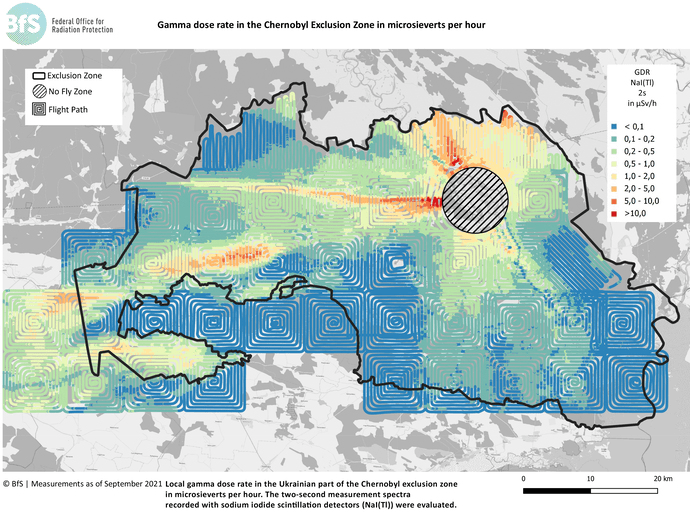
In 2022, the German entity, the Federal Office for Radiation Protection (BfS) published the first area-wide radiological mapping of the exclusion zone in over 30 years at the request of the Ukrainian Government. BfS works for the safety and protection of man and the environment against damage due to ionising and non-ionising radiation.

The data were collected in 2021, using extensive aerial surveys as well as ground truthing for the cesium 137 in the soil. The elevated local dose rate values measured in the exclusion zone today are almost exclusively due to cesium 137, which has a half-life of 30 years. Short-lived radioactive substances such as iodine-131 have not been detected for years. https://www.bfs.de/SharedDocs/Pressemitteilungen/BfS/EN/2022/006.html

Local gamma dose rate in the exclusion zone of Chernobyl in microsieverts per hour

A conversion table to help aid understanding of the radiation levels is given below.

Spatial distribution of cesium-137 in the exclusion zone in kilobecquerels per square metre

In my next blog I will write about the Liquidators of Chernobyl. Where are they now? How are they now?

The People Who Live and Work in the Chernobyl Exclusion Zone-1. “The Babushkas of Chernobyl”

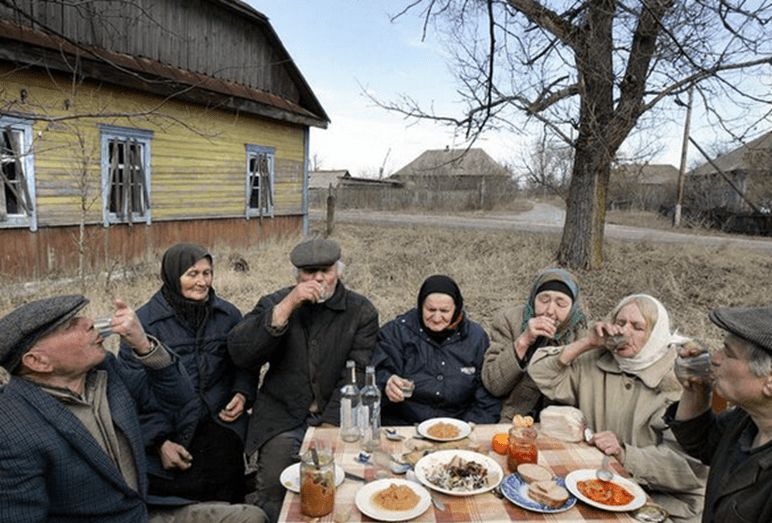
AFP photograph by Victor Drakov

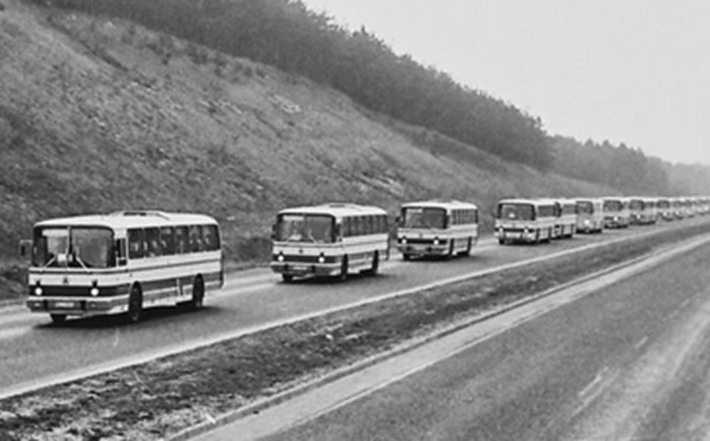
In 1986, 115,000 people were forced to leave “for 3 days and no more” starting 36 hours after the Chernobyl explosion including the inhabitants of 81 villages. After 1986, another 200 000 people from Belarus, the Russian Federation and Ukraine were relocated. If you really wish to visit this period again this website will bring you almost up-to-date. https://world-nuclear.org/information-library/safety-and-security/safety-of-plants/chernobyl-accident .

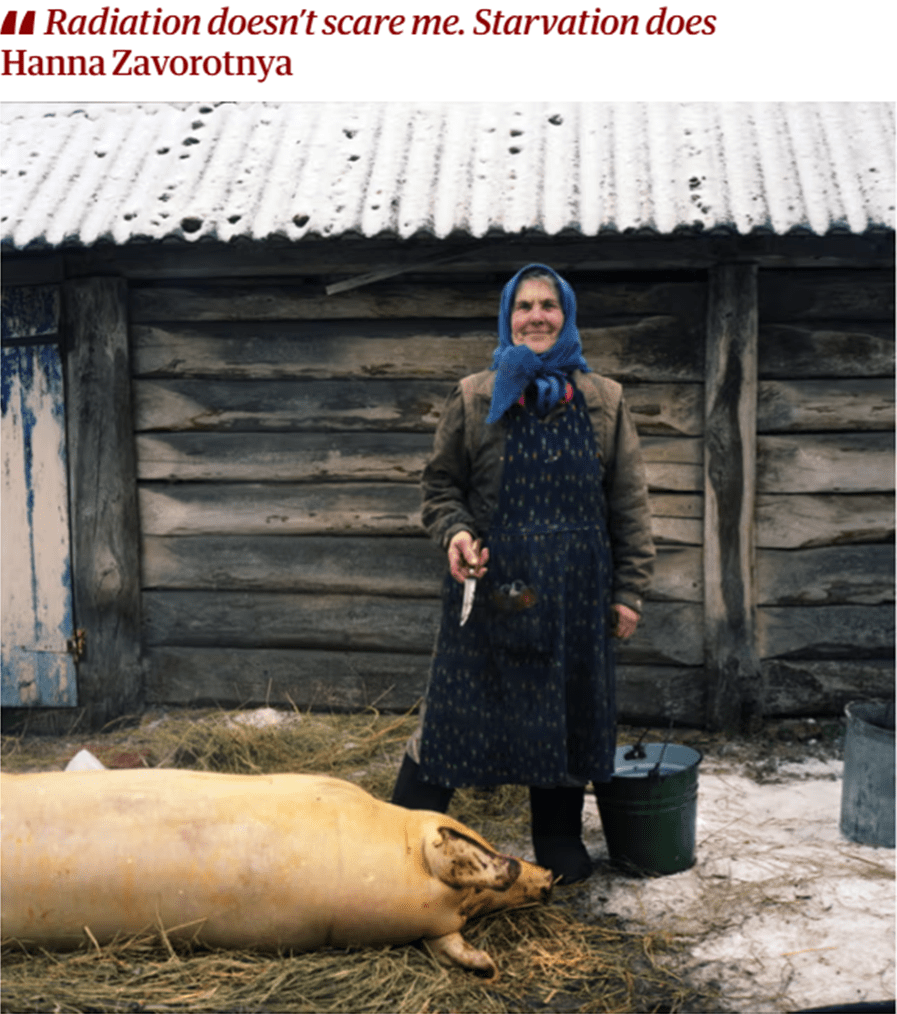
Some of the residents started to return to their villages within weeks. These waves continued for about 4 years despite efforts to stop them. “Samosely” or selfsettlers are still residents of the Chernobyl Exclusion Zone – mostly  Babushkas. By 1987, 1200 people had returned to live in their old homes. Eventually women past child-bearing years were allowed to stay. That means that nearly 40 years later the surviving residents have to be at least 90.

Today, there are about a 100 still surviving. This number has dropped from about 250 only a few years ago. They live off the land, growing their own food and picking Cesium 137 laced mushrooms. They have foraging pigs and chickens.

Hanna Zavorotnya and a pig in front of her home in the CEZ. Photo: Rena Effendi

Hanna is one of the 3 stars in the 2015 documentary “The Babushkas of Chernobyl“. It can still be viewed or bought on the web from various sources.

The Samosely have lived hard lives and remember so much: the starvation of 1932 under Stalin when millions died, the brutality of Nazi occupation then forced eviction from their Motherland. Now they fight to keep their crops from wild animals. Finally, the Russians took over the area again for a time following years of Ukrainian independence. The war continues. For a time, landmines were in parts of the forests.

The Joy of Harvest: Photograph by Yuli Solsken

Photo by Jorick de Kruif in 2018: Ivan Semenyuk was 82 years old and lived in the house he built in the 1950s in the village of Paryshev.


When interviewed in 2018, Ivan was growing cabbages, tomatoes, cucumbers, carrots, shallots, potatoes and beans on his allotment. He loved to fish and gathered mushrooms, berries and medicinal herbs in the forest. A mobile shop, which was supposed to visit every Friday, brought food, household chemicals and basic necessities, which he could buy with his pension which is delivered to him and other elderly inhabitants of the zone. Ivan has mains electricity, and recalls that they did not have to pay for it for two years after he returned.
He draws water from his own well on his land. He has a mobile phone, television and radio, and keeps in touch with the outside world between visits from his son.

Like other inhabitants Ivan had trouble with wild animals destroying
vegetables growing in his garden. He respected radiation but greatly feared the packs of wolves and the snakes. He and his dogs had been attacked by large packs of wolves, 6 dogs being killed in one week. Eventually, the authorities permitted him to shoot wolves.

What of the radiation? Ivan explained how men with dosimeters checked levels in his well and land. He stated that there was now no radiation in the village. (Visitors are warned not to eat anything in the zone.)

There is no doubt that like the animals of the CEZ, the Samosely experienced higher levels of ionising radiation than the normally accepted levels for humans. However, I suspect that the levels were in the low dose range. Yet these people seem to have outlived those of similar age and background who left their “MotherLand” and lived elsewhere. I would like to have seen better radiological data.

Next time: thousands still work at the nuclear power stations. A few people live in the ancient city of Chernobyl.

The Animals of Chernobyl

In the first few years after the Chernobyl Catastrophe, most of the attention was focused on human health. The general impression was that any animals living nearby were either killed or badly maimed and the forest was quiet. Some farm animals were born malformed with extra limbs and a few forest creatures were also seen to be mutated. It is no surprise that in those early years very high levels of radiation either killed or maimed. Creatures in utero or in the period of rapid cell growth and organ differentiation were particularly vulnerable. Expectations for the future were very pessimistic.

Few researchers expected what then happened!

Ecologists have found the land surrounding the damaged nuclear power plant, which has been largely off limits to humans for three decades, has become a haven for wildlife, with lynx, bison, deer and other animals roaming through thick forests. This so-called Chernobyl Exclusion Zone (CEZ), which covers 2,800 square km of northern Ukraine, now represents the third-largest nature reserve in mainland Europe and has become an iconic – if accidental – experiment in rewilding.

Contamination Levels in the CEZ

The contamination levels within CEZ vary considerably. The highest levels are in the “Red Forest”. Around the destroyed nuclear power plant and in the nearby city of Pripyat, the radiation caused the leaves of thousands of trees to turn a rust color, giving a new name to the surrounding woods. Workers eventually bulldozed and buried the radioactive trees. What these levels actually are vary from source to source but they are still very high.

The levels of contamination by iodine 131 dropped quickly in the first year as it has a half-life of 8 days. Similarly cesium 134, with a half-life of 2 years, has almost disappeared. The isotopes cesium 137 and strontium 90 remain mostly tied up by the clay in the soil. Fungi can have relatively high levels of cesium 137. Recent radiation levels in most of the CEZ vary from less than 1 to over 800 mSv /year.

Cesium 137 and strontium 90 have half-lives of about 30 years. Thus the radiation levels will have now halved since the disaster. In about 200-300 years there will be very little radiation left. Cesium is not easy to absorb. Clay binds to it strongly. The cesium that is absorbed has a biological half-life of 90 days. Similarly strontium is also bound to clay but once in a vertebrate, it is bound into bones and stays there for a long time as it is not excreted. It should also be remembered that both isotopes are toxic chemically as well as being radioactive.

The Animals of Chernobyl

Top predators like wolves that ate other contaminated animals were assumed to be particularly vulnerable.

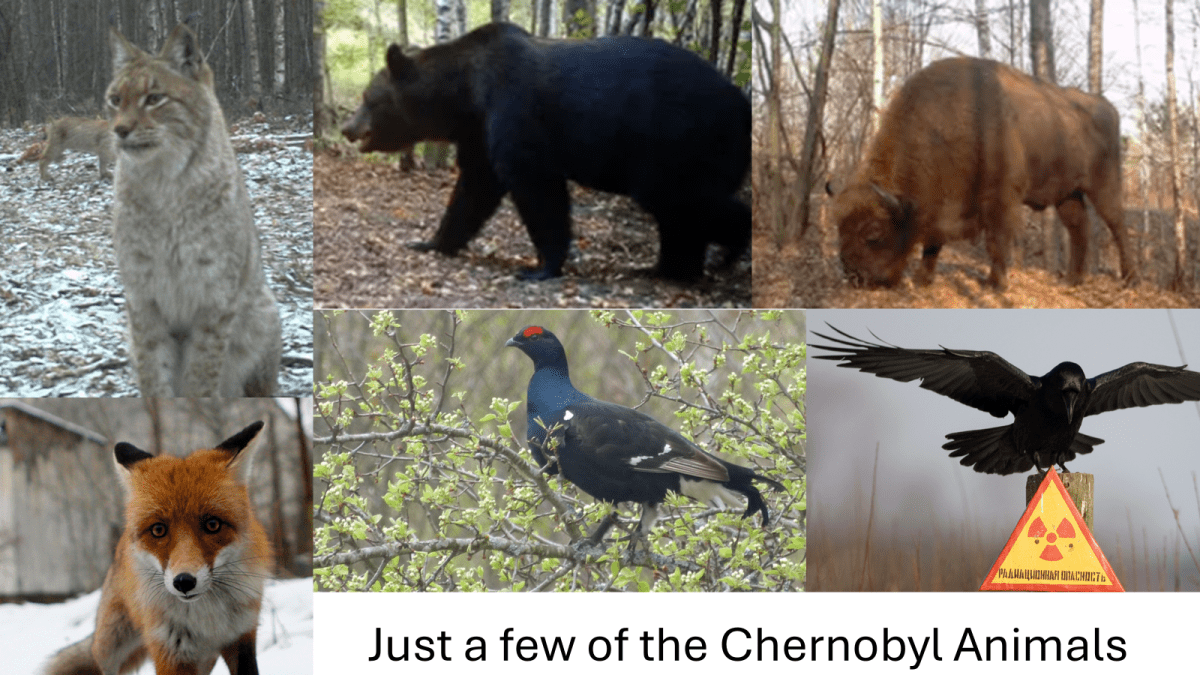
The reality has been that larger mammals have thrived. These include Eurasian lynx, gray wolf, wild boar, brown bear, European bison, elk, red deer, red fox, roe deer, raccoon dog, and Przewalski’s horse. Thirty horses were introduced in the late 1990s. Cameras traps now indicate that there are over 100 of this special breed.

Top: European Lynx (U.K. Centre for Ecology and Hydrology), Brown Bear and Bison (Sergey Gaschack), then below Fox (AP PHOTO / Sergui Chuzavkov), Black Grouse (Nick Beresford), Raptor (REUTERS/Vasily Fedosenko).

Other commonly observed animals include moose, black grouse, snakes, owls, raccoon dogs, foxes, pine martens, and badgers. There have been suggestions that foxes may not be reproducing as fast as other animals. Perhaps the lack of farmers’ chicken pens has reduced their feed source!

Domestic cats have now bred for many generations without the presence of farming families. There are lots of rodents as a food source. Dogs left behind vary in their quality of life with the situation being complicated by human activities.

The monitoring of animals has become much more sophisticated and some creatures are now being tagged. Recent work includes genetics, and biochemistry of blood and tissue samples.

I have included the following video. The story is great and the animals shown wonderful. Some of the ideas may be outdated but the video is fascinating. I loved watching it. There are lots of other videos on the web. They vary in quality and degree of bias. The pictures of mutated animals appear to have been taken prior to 2000.

Ecological Studies

Unfortunately no scientists or other visitors are allowed to enter the CEZ at the current time due to the war. So studies are on hold. Scientists tend to be very conservative and continue to ask each other difficult questions. Early studies did not examine the health of the animals seen.

Two evolutionary biologists teamed up to study the area’s birds. They were Anders Møller of University Paris-Saclay in France and Timothy Mousseau of the University of South Carolina. Their early surveys showed that certain bird species tended to have more genetic mutations, smaller brains and less viable sperm in sites with higher radiation levels. And in 2007, they counted 66 percent fewer birds and 50 percent fewer bird species in highly radioactive places compared to background-level sites.


In dozens of studies, the pair also documented that, with higher radiation levels, there were significantly lower numbers of soil invertebrates and a lower abundance of certain insect species and such mammals as hares and foxes. Working with collaborators in Finland, they also documented a range of health effects in bank voles.

Over the last 10 to 15 years much more detailed studies have started and early pessimistic authors are now also finding that the creatures are adapting well to higher levels of radiation including Møller and Mousseau. By 2014, in a paper they published with others: Chronic exposure to low-dose radiation at Chernobyl favours adaptation to oxidative stress in birds.

We found a pattern radically different from previous studies in wild populations, showing that GSH levels and body condition increased, and oxidative stress and DNA damage decreased, with increasing background radiation. Thus, when several species are considered, the overall pattern indicates that birds are not negatively affected by chronic exposure to radiation and may even obtain beneficial hormetic effects following an adaptive response. Analysis of the phylogenetic signal supports the existence of adaptation in the studied traits, particularly in GSH levels and DNA damage. https://besjournals.onlinelibrary.wiley.com/doi/full/10.1111/1365-2435.12283

Attitudes were changing.

When other scientists reanalyzed early data by Møller and Mousseau on a dozen mammal species, they found that radiation had indeed caused declines in abundance, but only at higher doses than the pair had originally reported. No account had been made of the radioisotopes already within the bodies of the mammals. This is Science in action.

Dr Ismael Galván, of the Spanish National Research Council said “Previous studies of wildlife at Chernobyl showed that chronic radiation exposure depleted antioxidants and increased oxidative damage. We found the opposite – that antioxidant levels increased and oxidative stress decreased with increasing background radiation.” The species surveyed were: Red-backed shrike, great tit, barn swallow, wood warbler, blackcap, whitethroat, barred warbler, tree pipit, chaffinch, hawfinch, mistle thrush, song thrush, blackbird, black redstart, robin and thrush nightingale. “Chronic exposure to low-dose radiation at Chernobyl favors adaptation to oxidative stress in birds.” https://besjournals.onlinelibrary.wiley.com/doi/10.1111/1365-2435.12283

A Recent Study on Wolves

So far the findings from this important study are only available as an abstract from 2024. A full paper has not yet been published, probably because of the pause in research. Polygenic adaptation and co-regulatory dynamics in Chernobyl wolves: Unveiling immune and oncogenic stress interactions with implications for human cancer resilience. https://doi.org/10.1158/1538-7445.AM2024-7322

Gene signature variations in CEZ wolves reveal a distinct immune profile, likely shaped by prolonged radiation exposure. These findings, along with evidence of polygenic selection, suggest adaptation to multigenerational radiation exposure (an oncogenic stress). Notably, the enrichment of genes with positive prognosis in human cancer overexpressed in CEZ wolves present a valuable model to explore genetic underpinnings of cancer immunity and advance our understanding of cancer resilience in humans.

In other words, the wolves in the CEZ are a unique population of gray wolves that have adapted to survive levels of radiation six times higher than the legal limit for humans. They are the subject of scientific research that aims to understand how animals can survive in these conditions. The research so far suggests that the wolves have developed genetic mutations that make them resistant to cancer. The wolves are thriving. Their population in the CEZ is seven times denser than in low radiation protected areas in Belarus.

Next time: what has happened to the humans that live and work in the CEZ?

There is No Doubt that High Dose Radiation Kills or Maims But Damage is NOT Passed On to Future Generations!

Why Do We Fear Radiation 8

Photo taken in Nagasaki Atomic Bomb Museum in May 2024 by my husband Dr. David Jones

The Bombing Of Japan in 1945

On 6 and 9 August 1945, the United States detonated two atomic bombs over the Japanese cities of Hiroshima and Nagasaki. Japan surrendered to the Allies on 15 August, six days after the bombing of Nagasaki and the Soviet Union’s declaration of war against Japan and invasion of Japanese-occupied Manchuria. The Japanese government signed the instrument of surrender on 2 September, effectively ending the war.

The firebombing of Tokyo, on 9–10 March, killed an estimated 100,000 people and destroyed 41 km2 (16 sq mi) of the city and 267,000 buildings in a single night. Firebombing then switched to smaller cities. According to Yuki Tanaka, the U.S. fire-bombed over a hundred Japanese towns and cities. (Tanaka, Yuki; Young, Marilyn B. (2009). Bombing Civilians: A Twentieth Century History. New York: New Press, and Kerr, E. Bartlett (1991). Flames Over Tokyo: the US Army Air Forces’ Incendiary Campaign against Japan 1944–1945. New York)

Two Atomic Bombs Were Dropped

These are the only nuclear weapons to ever be used. All war is horrific. Nuclear weapons should not be used. A uranium bomb was dropped on Hiroshima and a plutonium bomb on Nagasaki.

An estimated 90,000 to 166,000 people in Hiroshima (between 26 and 49 percent of its population) and 60,000 to 80,000 people in Nagasaki (between 22 and 32 percent of its population) died in 1945, of which a majority in each case were killed on the days of the bombings, due to the force and heat of the blasts themselves. Nearly all of the remainder of victims died within two to four months, due to radiation exposure and resulting complications.

Cancer

Cancers do not immediately emerge after exposure to radiation; instead, radiation-induced cancer has a minimum latency period of some five years and above, and leukemia some two years and above, peaking around six to eight years later. Almost all cases of leukemia over the following 50 years were in people exposed to more than 1Gy (1000mSv).

The Hibakusha

The survivors of the bombings are called hibakusha (被爆者), a Japanese word that translates to “explosion-affected people”. The Japanese government has recognized about 650,000 people as hibakusha. As of 31 March 2024, 79 years later, 106,825 were still alive.

Hibakusha and their children were (and still are) victims of fear-based discrimination and exclusion for marriage or work due to public ignorance. So they married each other. Some of the public persist with the belief that the hibakusha carry some hereditary or even contagious disease. This is despite the fact that no statistically demonstrable increase of birth defects/congenital malformations was found among the later conceived children born to survivors of the nuclear weapons used at Hiroshima and Nagasaki, or has been found in the later conceived children of cancer survivors who had previously received radiotherapy. The surviving women of Hiroshima and Nagasaki, who were exposed to substantial amounts of radiation, had children with no higher incidence of abnormalities/birth defects than the rate which is observed in the Japanese average.

A study of the long-term psychological effects of the bombings on the survivors found that even 17–20 years after the bombings had occurred survivors showed a higher prevalence of anxiety and somatization symptoms. (Yamada, Michiko; Izumi, Shizue (2002), Social Psychiatry and Psychiatric Epidemiology. 37 (9): 409–415.)

City of Hiroshima Statement

https://www.city.hiroshima.lg.jp/site/english/9809.html#:~:text=Is%20there%20still%20radiation%20in%20Hiroshima%20and%20Nagasaki?

Talking to residents in Nagasaki last year, we found very varying views. One tourist operator claimed she was scared to work in Nagasaki as you couldn’t believe what the Government tells you and fears that Nagasaki is still radioactive. She did not live there. Another resident loved living in Nagasaki and said, “what radiation?”.

LNT: Linear No-Threshold Model

A great deal of research has been undertaken about the effects of radiation from the use of the 2 bombs. Research still continues particularly on the offspring of survivors. Some of the early results led to the creation of the LNT which has been used extensively ever since.

The Linear No-Threshold Model describes the relationship between the amount of exposure to ionizing radiation and the risk of harmful effects. It is graphed as a straight line and passes through zero despite the fact that there is no data in the low dose region. This assumes that even low levels of radiation exposure are harmful.

LNT is used to set radiation standards. The LNT model remains a prudent basis for radiological protection at low doses and low dose rates. It is simple to use and is strongly protective and conservative. However, there is increasing evidence that it is overprotective and leads to massive unnecessary costs.

The LNT does not take into account 2 important facts about low dose radiation. Firstly, it assumes radiation is accumulative and takes no account of the fact that all cellular living things have repair mechanisms. Secondly, it does not differentiate between total dose and dose rate. However, attempts to further lower the standards must be carefully justified and based on thorough research.

However, when collective dose is combined with a linear dose-response coefficient to predict risk in large populations exposed to low doses, the number generated will overestimate real risk. The slope of the graph is often used in epidemiological studies to calculate risk and relative risk thus assuming the risk to calculate the risk. This is biased thinking and may even lead to fear mongering.

If you are interested in reading more about the bombing of Japan this Wikipedia article is very extensive and thorough. It has hundreds of reference links. https://en.wikipedia.org/wiki/Atomic_bombings_of_Hiroshima_and_Nagasaki#CITEREFKerr1991

No radiation-induced genetic (= hereditary) diseases have so far been demonstrated in human populations exposed to ionizing radiation. (HEREDITARY EFFECTS OF RADIATION United Nations Scientific Committee on the Effects of Atomic Radiation UNSCEAR 2001 Report to the General Assembly, with Scientific Annex) https://www.unscear.org/docs/publications/2001/UNSCEAR_2001_Report.pdf

Dose Makes the Poison.

Why Do We Fear Radiation 7

What Does the Term Low Dose Radiation Really Mean?

Scientists in Radiation Research or those in the Nuclear Power Industry define radiation levels over 100mSv as high dose. Levels must be under 100 mSv to be called low dose. In the medical field the term low dose is not defined and treatment doses are described as high, medium or low. This is very confusing as in the medical literature low dose refers to levels of radiation that are extremely high and usually thousands of mSv.

Dose Makes the Poison

We all know that too much of anything is bad for us, even water. I was a student in Vietnam War days and remember being horrified at the use of water torture. A prisoner was tied down, a funnel put in his mouth and water poured in his mouth until he told all or…

Conversely, it seems likely that too little of almost anything can also be harmful. There is a sweet spot for everything but this zone varies from person to person, species to species and depends on the mineral, the vitamin, the substance or activity, and even radiation. Even arsenic is needed as a co-factor for one enzyme to work.

Ah, What About Dose Rate?

De Toledo et al. 2006

Yes, the graph above is real! There was far more chromosome damage in the control cells than in the cells receiving 10cGy (100mSv) spread out over 48 hours. We now know about many of the changes that occur in cells and tissues and organs dosed with radiation.

We may know more about low dose radiation and its effect on the body than almost any other substance. Thousands and thousands of scientific papers have been published. A book published by Dr Antone L Brooks summarised the work of a US DOE research group he led as Chief Scientist in the period 1998 to 2008 with over 800 references. I have read this book which I obtained a couple of years ago plus hundreds of other scientific and medical journal articles and I read more each day.

There is a major difference between the effects of high and low dose radiation. At low doses and low dose rates the system has time to repair damage that occurs. Most of the biochemical changes are very positive and can even protect the cell or tissue from further insult.

Very High Background Radiation Areas Of Ramsar, Iran – An Example of Adaptive Response

An in vitro (in the lab) challenge dose of 1.5 Gy (1,500mSv) of gamma rays was administered to the lymphocytes, which showed significantly reduced frequency for chromosome aberrations of people living in the high background compared to those in normal background areas in and near Ramsar.

Specifically, inhabitants of high background radiation areas had about 50% the average of induced chromosomal abnormalities of normal background radiation areas inhabitants following this exposure.” Health Physics 82(1):p 87-93, Jan 2002.

All Living Things on Earth Can Repair Low-Dose Rate Ionizing Radiation

Most of the repair mechanisms seem to have evolved very early in the history of life on Earth at a time when radiation levels were very high. Without these repair mechanisms, life could not have evolved to use oxygen in energy production and there would not be any plants or animals on land. More on how this works in a future blog. All living things have these repair mechanisms.

I have a hypothesis that the reason we can’t sense radiation is that we don’t need to do so. There would have been no evolutionary advantage in having that ability.

How Much Radiation Causes Cancer and Heart Disease?

Why Do We Fear Radiation 6

Ref: Wade Allison Emeritus Prof of Physics lecture 2018, Dun School of Pathology, Oxford

There are many articles on the web that link cancer treatment with heart disease. An example from the Cleveland Clinic states “Radiation heart disease is a side effect of radiation therapy for cancers in the chest and includes a wide range of heart conditions. Because it can occur many years after exposure, close monitoring is essential.

There is no doubt that high doses of radiation can cause cancer. This has been well known since the Second World War when two nuclear bombs were dropped on Japan. Medical journal articles linking radiation treatment for cancer to later heart conditions have been around for at least 4 decades. It is important to read the full papers as the term “low dose” radiation often actually refers to quite high radiation doses well above 100mSv.

But How Much Radiation Causes Cancer and Heart Disease?

By the early 1980s, it was becoming widely known that radiation treatment for cancers of the chest increased a wide range of heart problems. Medical studies of the period described how patients receiving more than 30 grays during treatment had a high risk of developing heart issues in coming years. Just how much is 30 grays? 30 grays is 30 sieverts that is 30,000 mSv. This is an enormous amount of radiation! These 1980 studies have been quoted over and over again in medical review documents. Unfortunately, the radiation dose levels are not often discussed leaving some readers in doubt that very high doses of radiation are the cause. Personally I am still astonished at the amount of radiation used for cancer treatment.

Modern radiotherapy for cancer treatment has taken giant strides. Many cancers are treated with radiopharmaceuticals. These agents combine relatively short-lived radioisotopes with biological compounds that target the radiation much more precisely to the cancer cells avoiding as much radiation to nearby healthy cells as possible. Doses need to be high enough to kill the cancer cells. The doses are much lower than they used to be but they are still levels like 3 gray or 3,000 mSv. Chemotherapy is often used to make the cancer cells more sensitive to ionizing radiation.

Ref: https://www.arpansa.gov.au/sites/default/files/2021_ionising_radiation_and_health.pdf

There have been many large studies on people developing cancer from radiation exposure. Scientific evidence shows that the increased risk of developing cancer occurs at exposure levels of 100 mSv or higher. However, it is worth noting that outside of radiotherapy treatments, which is the targeted use of radiation to destroy cancer cells, the risk of being exposed to radiation doses at 100 mSv or higher is extremely low.

For radiation exposures less than 100 mSv, the scientific evidence for increased health risk is more limited. This is because the risk of developing cancer from low radiation dose is very small compared to the overall cancer rates, which makes it very difficult to measure, even with a very large study. It is plausible that health effects could occur at levels below 100 mSv.

These statements from ARPANSA mirror a very wide range of scientific literature I have read over many years.

The only way to pick up health effects at levels under 100mSv has been to use epidemiological approaches. Unfortunately, these studies do not always agree with each other. I have seen two camps undertake complex calculations on the same data and come to totally opposite conclusions.

The amount of radiation used in medical diagnoses is also rather high but only exceeds 100mSv when used over and over again on large area scans such as whole body CT scans. Again the amount of radiation used has dropped considerably over time with new techniques as the use of targeted radiopharmaceuticals such as Technetium-99m compounds.

Since some of the earliest life appeared on Earth, living things have had the ability to repair radiation damage. More on this topic in future blogs.

ANSTO highlights that some members of the public fear that external radiation can build up in the body until it gets to a point where it kills you. This is not the case. Ionising radiation does not build up in your body any more than light which falls on you builds up. The radiation that reaches you is gone a fraction of a second later. https://www.ansto.gov.au/sites/default/files/2019-01/What%20is%20radiation%20brochure%202018%20final%20eVersion.pdf

This raises the question of how radiation does cause any harm. I plan to address this issue in a later blog.

Background Radiation: How Much Radiation Do We Experience on Earth?

Why Do We Fear Radiation? 5

Australia experiences low background levels of nuclear radiation.

The most variation in background levels in Australia results from higher levels of radon due to the geology of an area. ARPANSA has produced a map that can be easily accessed for those wanting to know more. https://www.arpansa.gov.au/understanding-radiation/radiation-sources/more-radiation-sources/radon-map

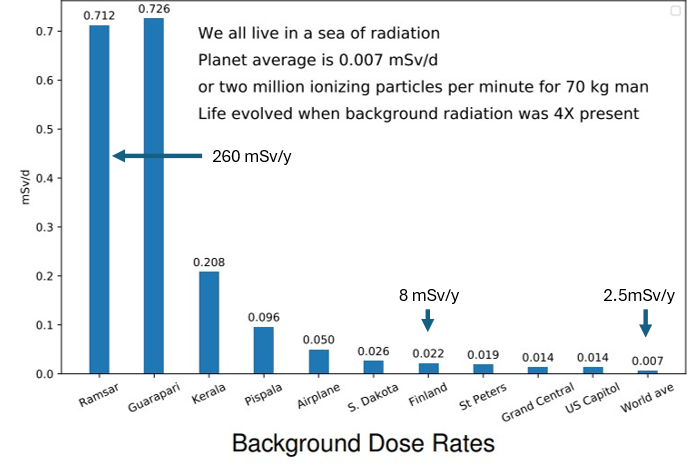
Some areas of the world have much higher background levels, some patches being one hundred times higher than the world average. In general terms, multiple studies have suggested that long term residents of these higher background areas do not suffer from higher rates of cancer or heart disease. They may even develop extra protective measures. I will provide more information on this topic some of which can be controversial, in later blogs.

Background Radiation Dose Rate in mSv/day. Graph by Jack Devaney

Not all background data is easily available in mSv. Some interesting facts may be shown in other units such as grays. For X-rays, gamma rays and beta emitters, the gray is numerically the same value when expressed in sieverts, but for alpha particles one gray is equivalent to 20 sieverts, as a radiation weighting factor is applied accordingly. Alpha particles are easy to stop but once in the body, they inflict more damage.

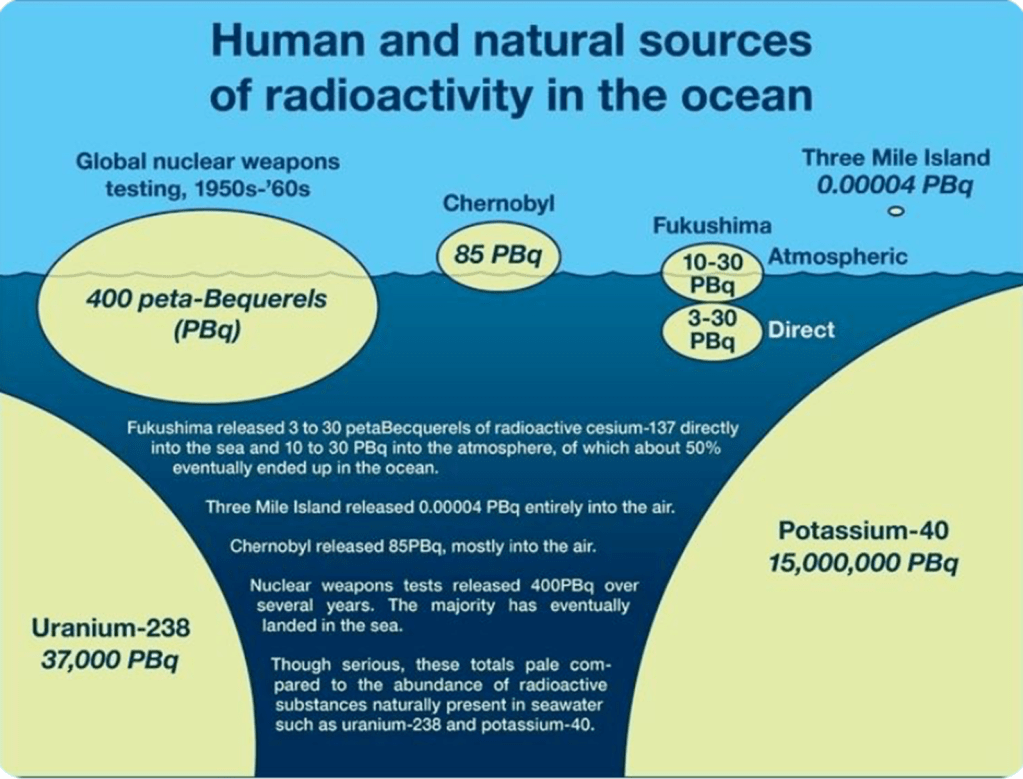
When radiation is measured using instruments like a geiger counter, the unit is becquerels (Bq). One becquerel is equal to one nuclear decay per second.  Conversions from becquerels to mSv can be done accurately for a single radionuclide but mixtures are very complex. For reference to the figure below, there are one thousand trillion becquerels in a Petabequerel, an almost unimaginable number. The overall message is clear. Human influence on background levels is small. As large as the effect of the dreadful nuclear bomb testing was, it is relatively tiny fraction of the total and diminishes every year.

I first saw this posted by Robert Hargraves and again recently on a post by Oscar L Martin on LinkedIn.

Natural Uranium is More Hazardous as a Heavy Metal Than as a Radioactive Substance

Natural Uranium is More Hazardous as a Heavy Metal Than as a Radioactive Substance. This blog has had its titles rearranged to make the content clearer. It was posted over the Christmas period and deserves more scrutiny.

Why Do We Fear Radiation? 4

Based on health considerations, the concentration of uranium in drinking water should not exceed the health-based guideline value of 0.02 mg/L. This health-based guideline value is based on chemical toxicity. The chemical toxicity of uranium is more restrictive than its radiological toxicity. – Australian Drinking Water Guidelines (ADWG).

Uranium in the Environment

Uranium is naturally present in the environment as a result of leaching from soils, rocks and natural deposits. It can also be released from mining and mill tailings, from the combustion of coal and other fuels, and from the production or use of phosphate fertilizers (which can contain as much as 150 mg/kg uranium).

Food is the major source of uranium intake and the highest concentrations are typically found in shellfish (UNSCEAR 2000). Dietary intake of uranium through food is estimated between 0.001 and 0.004 mg/day (WHO 2004). Intake through drinking water is normally low; however, drinking water can contribute the majority of daily intake in circumstances where uranium is present at higher concentrations in drinking water (WHO 2004).

In most Australian drinking water supplies uranium concentrations are well below 0.02 mg /L. However, concentrations up to 0.12 mg/L have been measured in some groundwater supplies in remote areas. In humans and experimental animals, the main toxic effect of short-term exposure to high concentrations of uranium is inflammation of the kidney. Little information is available on the effects of long-term exposure to low concentrations. (AWQG).

Comparison of the Chemical and Radiological Standards for Uranium

The Radiological drinking water standard for uranium in Australia is incredibly conservative. It is calculated using a maximum addition of radiation of 0.1mSv/year. This is one tenth of the already very conservative allowable extra exposure limit of 1mSv/year.

The radiological standard is incredibly low at 3 Bq/L based on consuming 2 litres of water every day for a year. https://www.waterquality.gov.au/guidelines

The health-based guideline value of 0.02 mg/L is equivalent to an activity concentration of 0.2Bq/L. This indicates that the health-based guideline value based on chemical toxicity is considerably more restrictive than one based on radiological data. -(AWGL)

The chemical toxicity of uranium at least 15 times more hazardous than the radiation from uranium.

The Pine Creek Geosycline

Australia is rich in uranium deposits in a number of geological formations. The Pine Creek Geosyncline covers a large part of the Northern Territory and has many major uranium deposits. In the early part of this millenium, I managed a travelling monitoring team as a regulator for mining in the NT. Consequently, I saw data from rivers and streams all over the Pine Creek Geosyncline. Often the lowest levels of uranium measured were downstream of Ranger and Jabiluka uranium mines.

It is too easy to blame radiation from substances that do emit radiation for any “sickness”. I remember one instance when Aboriginals that lived not far downstream of Ranger mine were all becoming ill. Investigation showed the illness to result from faecal bacteria in the billabong. Work undertaken to prevent raw sewage entering the billabong led to a rapid cure.

Remote Community Sues NT Government for Compensation

In 2018, the government-owned utility company Power and Water Corporation (PWC) found that the drinking water in Laramba contained 0.046 milligrams of uranium per litre (mg/L), which was more than twice the recommended level. The community had known about problems with the water supply since at least 2008, but the scale of the issue was not revealed until 2018. A new water treatment plant using ion-exchange technology was opened in 2023, making the uranium almost undetectable. https://www.abc.net.au/news/2023-04-30/water-treatment-plant-opens-in-remote-laramba

The Laramba community celebrates their new water supply which ensures uranium levels are extremely low. (ABC Alice Springs: Charmayne Allison)

The Northern Territory’s Court of Appeal on Friday 29 November heard arguments from lawyers representing the Territory government and the residents of Laramba, a town of just more than 200 people 205km northwest of Alice Springs. It was the latest instalment in a five-year legal battle, which could continue beyond this court’s eventual decision.
The court case centres on whether the NT government, as landlord to the Laramba residents, should be responsible for the quality of the drinking water.

The NT Supreme Court last year found the Territory government was responsible, with judge Peter Barr ruling the quality of the water went to the habitability of the housing. The NT government subsequently appealed the decision. https://www.theaustralian.com.au/nation/indigenous/call-for-feds-to-sort-out-remote-community-drinking-water-issues/news-story/75bc23a800352ee822123a5b170c30ac

“The case continues, because we say our clients were forced to drink that water for over 10 years so they should be entitled to some compensation,”

“But more importantly, we want to establish the point that the government in remote communities has an obligation to provide people with safe water.”

Nowhere in the press reports I read, was it clarified that the uranium level was a chemical toxicity issue and not a radiological one. This builds unnecessary fear of radiation in both Aboriginal communities and the general public.

Pamela Jones

Why Do We Fear Radiation? 3

Pamela Jones

Nuclear Radiation 101 part 2 and last

How did you go with my question at the end of the last blog? I am about to hand you a kilogram of a radioactive substance. I have 2 choices. One has a very short half-life and one has an extremely long half-life. Which one is the safest?

The radioactive substance with the short half-life is very dangerous. It has a short half-life because it is decaying quickly and sending out a lot of energy and particles. The substance with a long half-life decays very slowly and may even be safe to hold with very little protection. As a teenager, I held a bar of uranium in my bare hands during a special visit to Lucas Heights. These days they would insist on gloves. In the fifties, Queen Elizabeth II was given a plastic bag containing a large amount of plutonium to hold during her visit to Sellafield.

What implications does this insight have when considering nuclear waste management?

Here is Dr Don Lincoln describing more about radiation.

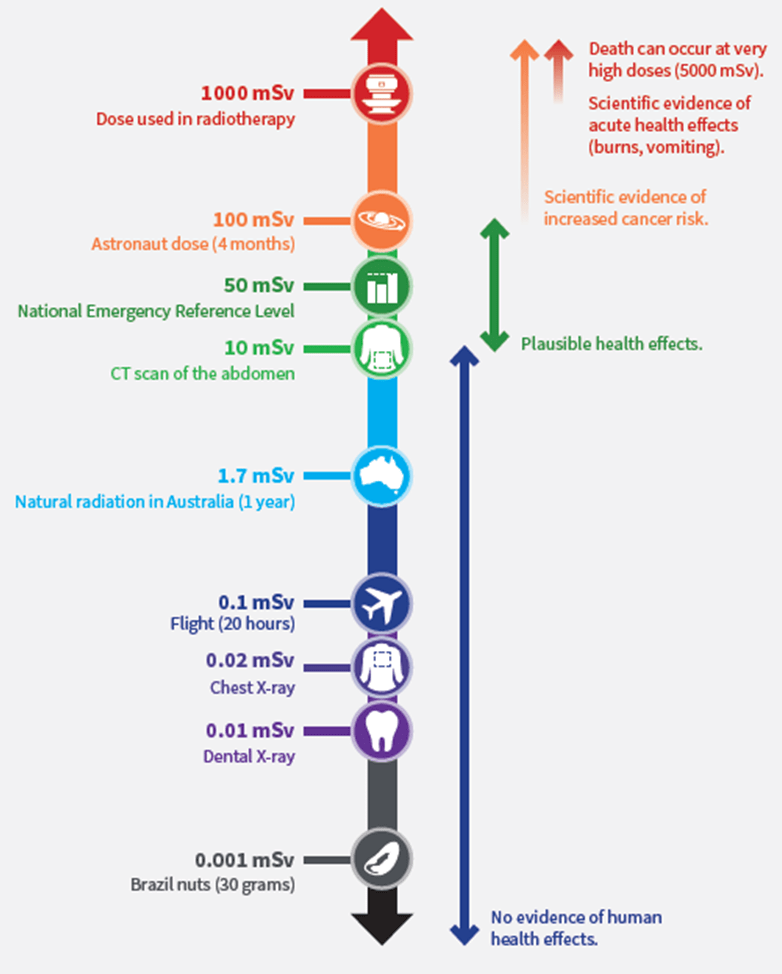
When discussing the levels of radiation experienced on Earth except in exceptional circumstances, I find it easier to understand if the units are in millisieverts or a thousandth of a sievert.

Don’s Examples of Radiation Levels Expressed as mSv per Year

Woodchopper in woods USA 3
City Dweller with medical tests USA 6
Just from your own body 0.4
Plane trip across the Atlantic 0.025
Whole body CT Scan 10
Nuclear worker maximum allowed 50
Cancer risk starts 100
Radiation sickness 400
Severe radiation poisoning 2000
Usually kills but may survive with medical care 4000
Death certain 8000

The first 6 items in the table are all examples from the USA. Background radiation levels around the world vary enormously as my next blog illustrates.

Why Do We Fear Radiation? 2 Blog by Pamela Jones

Nuclear Radiation 101

How much do you know about nuclear radiation? Here is an opportunity to learn about it in an easy manner. Many of you will know far more about radiation than shown here. However, you too can enjoy these great video segments.

Yes, Earth is a radioactive planet. But just how radioactive is the zone in which we live? Is it dangerous and harmful? And if it is, when is it harmful? In order to really examine these questions, it is important to understand the basics.

There are lots of units used in the nuclear radiation field and it is important to understand what these units mean. Scientists have become very clever at measuring extremely low levels of everything from chemicals to radiation . Just because something can be measured does not tell us whether something is harmful to life or critical for its existence .

In order to illustrate some basic concepts and the language used, I am showing some parts of a few video presentations which describe these concepts in a clear manner in this blog and the next. Each video segment is about 6 minutes long. The full videos are available on YouTube

What is Radiation by the Canadian Nuclear Safety Commission.

Types of Radiation by Dr Don Lincoln of Fermilab 2017

Is Radiation Dangerous by Dr Don Lincoln of Fermilab 2017

Enough for today! Each new blog will provide more information such as the variability of background radiation on our planet.

But before you go, I would like you to consider the following question. I am about to hand you a kilogram of a radioactive substance. I have 2 choices. One has a very short half-life and one has an extremely long half-life. Which one is the safest?

Why Do We Fear Radiation? 1

Earth is made of Stardust –We live on a Radioactive Planet, a Nuclear Planet

  • Every element in the Universe was made by nuclear reactions in stars.
  • When stars age, they break apart and form stardust.
  • Gravity combined this dust to make solar systems of planets.
  • The core of our planet is radioactive and provides us with a warmer planet surface and a magnetic field.

For A Planet to Generate Its Own Magnetic Field by the Geodynamo Process – It Must Have the Following Characteristics

  • The planet must rotate fast enough.
  • Its interior must have a fluid medium.
  • The interior medium must have the ability to conduct electricity.
  • The core must have an internal source of energy that propels convection currents in the liquid medium.
  • On Earth where does the energy come from? Radiogenic heat comes from the radioactive elements: Uranium 238,Thorium 232 and Potassium 40. All have very long half-lives.
  • Iron and Nickel conduct the electricity in the core.

Today, Mars does not have a global magnetic field. However, Mars did power an early dynamo that produced a strong magnetic field 4 billion years ago, comparable to Earth’s current surface field.

https://www.space.com/earths-magnetic-field-explained

Without a Magnetic Field Our Atmosphere Would be Stripped Away by Solar Winds. Life on Earth Would Not be Possible.

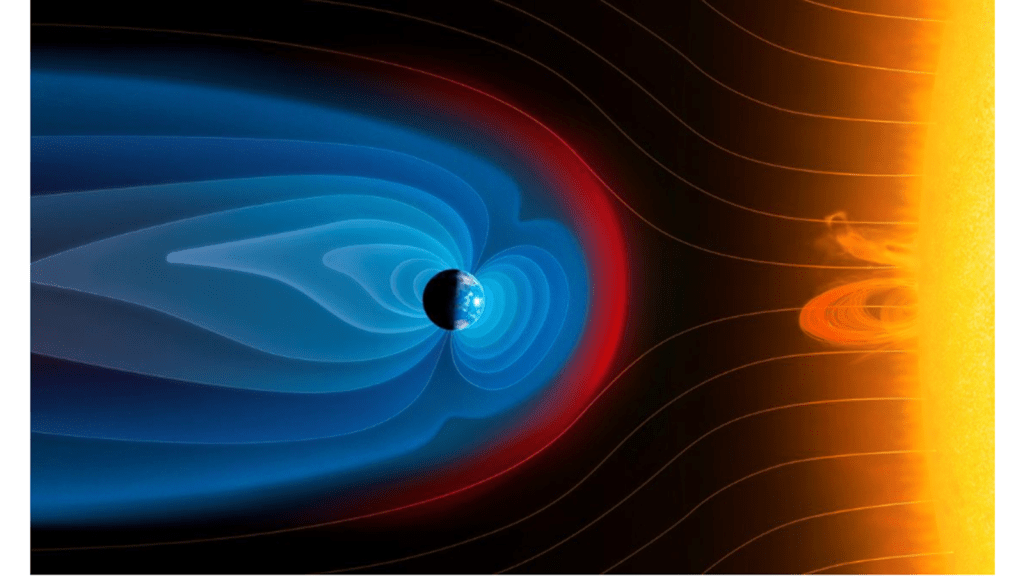
Earth’s Magnetic Field – Our Protective Blanket Helps Shield Us From Unruly Space Weather.

According to NASA, the magnetosphere also protects Earth from large quantities of particle radiation emitted during sun storms as well as cosmic rays – atom fragments – raining down on Earth from deep space. Our magnetic field repels harmful energy away from Earth and traps it in zones called Van Allen radiation belts.

But our protective shield is not completely invincible. Cosmic rays are part of the background radiation we receive every day.

Tritium is created in our upper atmosphere every day and comes down in the rain.

None of this protection would be possible if Earth was not enough of a nuclear planet with sufficient quantities of radioactive substances.

The next two blogs in the series illustrate the basics of just what radiation actually is and provides terms necessary to understand later blogs. The third blog discusses the range of background radiation found naturally on the surface of our planet. For some readers there will be surprises in store.