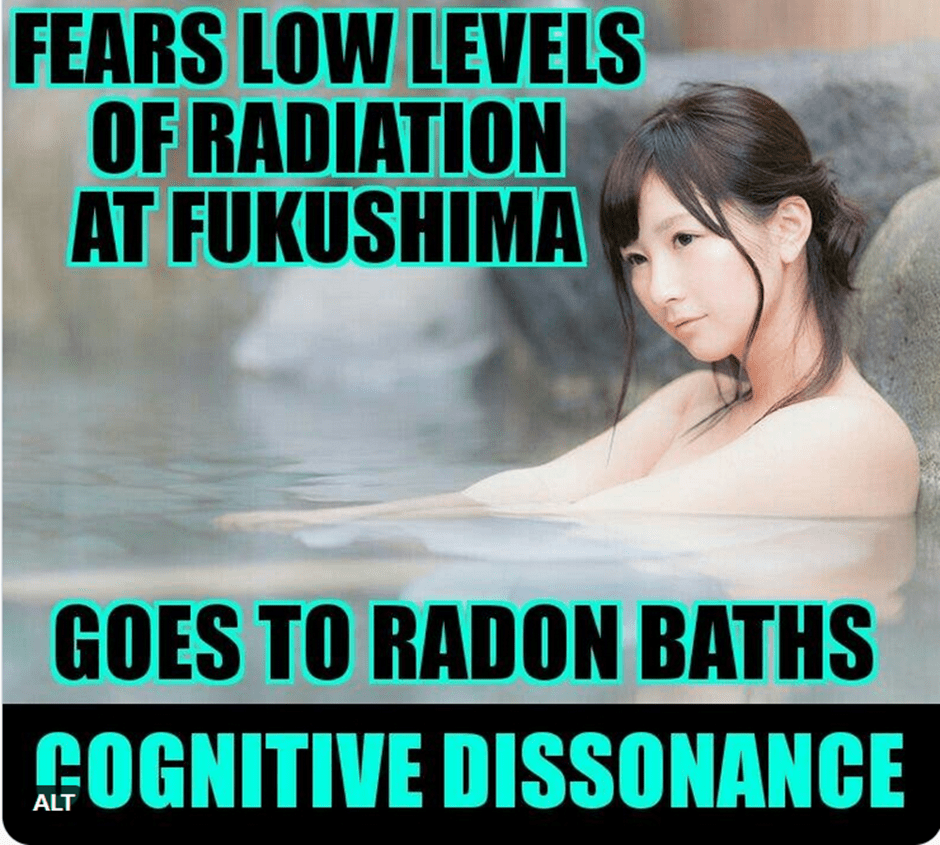
Germany has more radon baths than any other country. Yet they fear nuclear power plants. They closed them down and opened up coal mines knocking down ancient forests in the process. Medical benefit payments are paid out to people who attend the radon spas for relief of muscular-skeletal ailments. The medical fraternity warns of the dangers of radon yet people in pain still seek relief.
People have been using radon baths for thousands of years. Low dose radiation seems to lessen the pain and immobility of osteoarthritis. But not every patient benefits.
Many studies have shown that the more low dose radiation a population receives, the less cancer there is in the population. This effect is known as hormesis. I can also find studies that state that low dose radiation causes cancer.
Is anything black or white or just shades of grey? Is anybody totally truthful? We all have our biases. To get a message across about cognitive dissonance I wrote “Low Dose Radiation is not Harmful and May Even Be Good for Us!Nobody Died from Radiation at Fukushima”
But panic and fear of radiation caused the unnecessary deaths of over a thousand Japanese people following the evacuation.
Every decision we make in life rests on our perception of the risk involved versus the benefits. That balancing act changes with circumstances. For example, the amount of radiation used for cancer treatment is huge. None of us would want to receive that much in ordinary circumstances. A medical specialist tells us it is our best chance of beating deadly cancer and we accept the treatment for 2 reasons. Firstly, the radiation will be applied under very controlled conditions to a limited area. Secondly, the whole balance of the situation has changed.
A few years ago, I didn’t agree that Australia should have a nuclear power industry. Did we plan long term enough? Did we plan carefully? Were we just too Gung-ho?
I am now watching the destruction of Australia’s wonderful unique biodiversity as we lose forest and mountain ridges to wind turbine projects in Queensland in the “fight against climate change”. Is the balance, right? Do we have to destroy nature to save the planet?
Ecologists, Barry W. Brook and Corey J. A. Bradshaw ranked 7 major electricity-generation sources (coal, gas, nuclear, biomass, hydro, wind, and solar) based on costs and benefits. They published a paper in 2014 called: Key role for nuclear energy in global biodiversity conservation. https://conbio.onlinelibrary.wiley.com/doi/full/10.1111/cobi.12433.
This study still stands out. It used multicriteria decision-making analysis and ranked 7 major electricity-generation sources based on costs and benefits. It then tested the sensitivity of the rankings to biases stemming from contrasting philosophical ideals. Irrespective of weightings, nuclear and wind energy had the highest benefit-to-cost ratio.
The Integrated Life-cycle Assessment of Electricity Sources undertaken by the United Nations Economic Commission for Europe which concentrated on Carbon Neutrality in the UNECE Region has been extensively quoted by Oscar Martin on LinkedIn. https://digitallibrary.un.org/record/4020227?ln=en&v=pdf
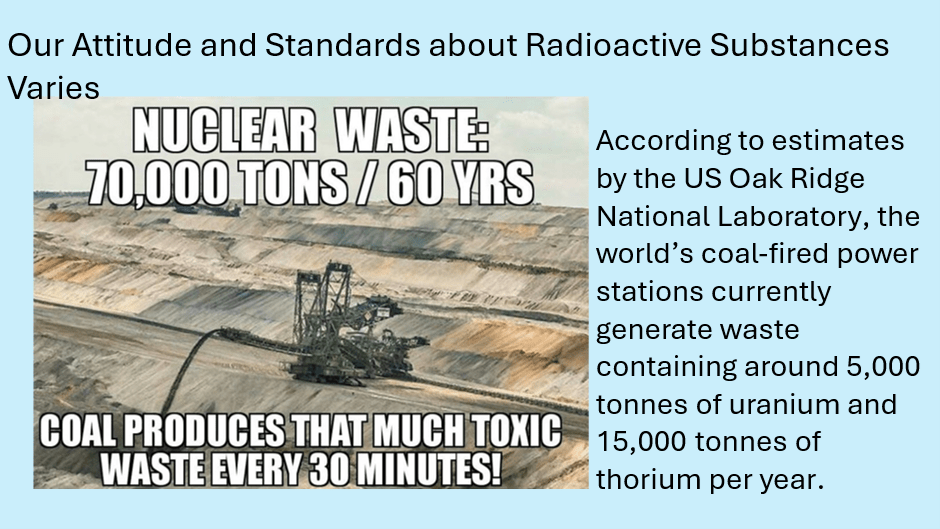
Nuclear scored far better than wind power (and all other electricity generation types) on nearly all rankings with the exception of water use and of course radiation. Public and occupational exposures to radiation from electricity generation was far higher from coal and even geothermal systems than from conventional nuclear power plants. Likewise, every other of 22 assessed electricity generation types were more carcinogenic than conventional nuclear power.
Potential impacts such as specific biodiversity-related impacts, noise or aesthetic disturbance were not assessed under the land use analysis. Nuclear had the lowest lifecycle impacts on ecosystems, followed by various forms of wind and solar power. Under the land use assessment, renewable technologies were assumed to be readily built on various land types without heavy modifications such as land sealing, mountaintop removal, and flooding.
The assessment of land use which was used in the assessment of ecological impact for wind projects only considered the directly disturbed land (turbine pads, access roads) and assumed the surrounding land could be used for other purposes such as agriculture. For disturbed forests this leads to massive underestimation of the impact. Research in far northern Queensland is finding that impacts from wind turbines on some species in forests can extend 3 km or more from a turbine.
Nature is doing over half the work of reducing carbon dioxide levels worldwide. We can save nature and the planet. With a carefully planned mix of nuclear and other energy sources, we can preserve our biodiversity.
Yes, nuclear power is not 100% safe and clean. Nothing ever is. The benefits to humanity and nature are too great to ignore and far greater than the risk.
It is now more than 10 days since the massive rally at Ravenshoe, Far North Queensland, recorded by Nick Cater of the Menzies Research Centre. The question now arises as to whether Tania Plibersek, the Minister for the Environment and Water, will again postpone her decision on the fate of this extremely special forested area right next to the Wet Tropics World Heritage Area. The week before the rally, Ark Energy decided to submit a variation to their project. The project had been the subject of a Public Environmental Report. They even changed the name of the project. Locals still know it as Chalumbin Wind Farm. Locals have never confused the Wet Tropics World Heritage Area with the Ark Energy Project Site.
A map of the changes is given below, followed by my response to a Press Statement by Ark Energy. Lastly, I enclose the Statement itself in italics.
Copy of map on the project website
Last Ditch Stand by Ark Energy to Build the Chalumbin Wind Farm
It is only days before the Federal Environment Department were due to announce their decision about Ark Energy’s plan to build a wind farm near Ravenshoe in Far North Queensland. In their desperation, they have even renamed the wind farm and modified the project.
I have not been able to find any reference to the submitted design change or the name change on the EBPC site. I wonder if this is a back door route to keep other Ministers happy.
The site of the proposed wind development, whatever its name, lies within the catchment area of the Great Barrier Reef. Parts of the eastern boundary of the site are contiguous with the World Heritage Wet Tropics Area. This area was named by the IUCN as the second most valuable natural site in the world. It has been recognised for a long time that a much wider barrier protection area is needed next to the World Heritage Area. The ecological value of wet tropical forest is increased by the presence of wet sclerophyll and other forest beside it and should form connectivity between the sections of the World Heritage Area.
Ark Energy divided the proposed “Chalumbin wind farm” into two stages just before issuing the Public Environment Report for comment by the public.
Stage 1 turbines, roads and other infrastructure were mostly in dense, biodiverse forested areas. Stage 2 had areas of more open woodland where cattle grazed and there were some weed and pest infested areas. The forest and waterways of Stage 2 area were still of major importance from a biodiversity viewpoint but not as critical. As a last-ditch stand, Ark Energy has put in a variation of the project to government. If they had really wished to improve the impact of the project, it might have made sense to remove the turbines of Stage I and keep Stage 2.
But, No! Their new concept has basically removed turbines from the Stage 2 area and left the turbines of Stage 1. In other words, they have not removed the major environmental impacts of the proposed project but are making it sound as if they had. Their statements are extremely misleading and only careful perusal of their press release makes this apparent. It was not until we had a clear map of the turbine removal and remaining sites that the real situation could be seen. The press release states that the project completely avoids wet sclerophyll forest adjoining the World Heritage Area. Further information in the document states that “These changes reduce the impacts of the development to 0.7% of wet sclerophyll within 10 km of the project area.” These are carefully worded statements and are very misleading.
The claim is made that “After rehabilitation of the temporary construction disturbance the wind farm would have an operational footprint of approximately 57.6 hectares.” This suggests that full rehabilitation can happen relatively early and that the roads will be mostly rehabilitated. Even if rehabilitation planting could start immediately after the main construction phase, the restoration of actual habitat takes time. However, the roads are still needed for maintenance activities such as lubrication of the turbines, replacement of blades and ultimately removal of the entire wind turbine. I very much doubt that the area of cleared land will become only 57.6 hectares for a long time. In addition, about half a million tons of concrete would be used to form the bases for the turbines and these would not be removed or rehabilitated if the development was to go ahead. Neither will the deep scars on the landscape be rehabilitated.
The offsets are a joke as are so many other statements made in their press release. Offsets should be additional areas, not areas that are left alone. Actually, as I will explain in another blog, the “offset areas” may be subject to impact from the project. The impact assessments do not take into account the loss of soil water by the project.
Do not be fooled! Yet again Ark Energy showed pictures of cattle grazing in areas not impacted by the turbines, roads and other infrastructure. It should be remembered that the cattle stations range from heavily forested land to the east and open forest and pasture to the west.
The whole press statement has been written to make it sound as if they are really caring for our precious biodiversity when they are not. When our biodiversity is lost it is gone forever. It is not only the endangered species that are affected. There are no ways to rehabilitate or offset the loss.
By cutting down and dividing forest which currently works hard to sequester carbon, slow and clean and store water and cool the earth, the gains made by any renewable, unreliable electricity produced are greatly diminished. Indeed, the roads and the giant fan turbines will dry out large areas of forest and turn them into carbon sources rather than carbon sinks. It is quite possible that the carbon dioxide reductions afforded by wind power will be negated by the impact of the project itself. Will the forest itself be destroyed by poor climate change mitigation?
Media release Tuesday 5 September 2023
Controversial wind farm project in Queensland redesigned and renamed.
Environmental impacts reduced to low levels.
A proposed wind farm in north Queensland has shed its controversial name and responded to environmental concerns with a drastic redesign that halves its size.
The former Chalumbin Wind Farm has been renamed Wooroora Station Wind Farm, after its host property Wooroora Pastoral Station, a large cattle-grazing property, and has undergone a drastic redesign in response to concerns about the visual and construction impacts on the property, which is located next to national parks that form part of the Wet Tropics of Queensland World Heritage Area.
Forty-four of 86 wind turbines have been removed, halving the size of the project, and leaving a layout of 42 wind turbines. The new design includes a minimum buffer of 1 km to neighbouring World Heritage areas, and completely avoids wet sclerophyll forest adjoining the World Heritage Area as well as all known magnificent brood frog habitat.
A comprehensive nature positive plan includes rehabilitation of most of the construction disturbance and the establishment of magnificent brood frog nature reserves totalling 1,255 hectares. It also includes First Nations-led fire management and control of widespread feral pests (pigs, dogs, and cats) and invasive weeds, to improve the host property’s habitat for key species including the northern greater glider, masked owl, and spectacled flying-fox.
“These changes reduce the impacts to very low levels. We believe the benefits to the natural environment of this project far outweigh its impacts. Not least of them more clean energy into the grid in a relatively short time period and a significant improvement in habitat for protected species on private land adjacent to protected forests,” said Ark Energy General Manager Development for Queensland, Anthony Russo.
“After extensive public consultation, we have listened to feedback from the community, government, and the traditional owners, and made changes to the project to meet expectations. We look forward to working with all key stakeholders to achieve positive outcomes and we are committed to getting this project right from the outset and delivering on world’s best practice in the energy sector.
“We must navigate the tension between the construction required to transition to a clean energy system and protecting nature, and this project’s evolution offers an excellent case study of major design iterations to achieve nature positive outcomes.”
After rehabilitation of the temporary construction disturbance the wind farm would have an operational footprint of approximately 57.6 hectares.
It is hoped that the new name will also help to address a misunderstanding that the development could impact a nearby wilderness area also known as ‘Chalumbin’.
“Some opponents took advantage of the former name to spread misinformation and make unsubstantiated claims about what kind of habitat and species are in the project area and therefore the environmental impacts of the development. The reality is the project is NOT within the World Heritage area and it is important that the project is represented accurately, and the public have the facts,” said Mr Russo.
A variation has been lodged with the Department of Climate Change, Energy, the Environment and Water, which is currently assessing the proposal. More information on the project is available online at wooroorastationwindfarm.com.au
Humans have lived through a range of temperature changes. It is recent civilization that we are trying to save with people living all over the earth in great numbers needing a lot of energy not least in the form of food. We tend to forget how hard life was trying to have enough energy to survive even after we discovered fire. For most of our existence, the only way for a few individuals to get ahead a little was to use slaves or beasts of burden or warriors. These living energy sources were fed as little as possible or used as canon fodder. They rarely lived very long.
Then, only a few centuries ago, we discovered much more energy dense fossil fuels. Suddenly, we could abhor slave labour, care about animal welfare and we could all have good shelter and food. Poverty has been slowly disappearing in many parts of the world.
Our modern food production is very dependent on a stable climate. It is also very energy intensive. A few degrees of extra heat or a little less rain has devastating effects on production levels.
How do we balance energy needs with maintaining a stable climate? The critical action at this time is lowering greenhouse gas emissions. To do this, the biggest tasks are the electrification of many processes as possible, decarbonization of electricity generation and carbon capture and storage. What is the only energy efficient and cost-effective method of carbon capture and storage? As discussed in my previous blog natural systems are wonderful at carbon capture and storage. Let nature do its work!
Hydro, wind, solar, nuclear, and geothermal power plants all use up energy and produce relatively small amounts of carbon dioxide in their manufacture, construction, demolition, and recycling. Energy is used in the mining for their manufacture. Some require lots of backup storage or have other firming or conversion requirements. All require transmission lines.
What are Queensland’s Plans?
Queensland Government plans to deliver:
50% renewable energy target by 2030
30% emissions reduction below 2005 levels by 2030
70% renewable energy by 2032
80% renewable energy by 2035
zero net emissions by 2050.
Far North Queensland has two wind farms, Mt Emerald (180MW) and Windy Hill(24MW), with a third, the Kaban Green Power Hub under construction. Under Phase 1, the government has invested $40 million to upgrade the coastal 157 KV transmission infrastructure between Cairns and Townsville to 275KV. This investment will provide up to 500 MW of renewable energy connection potential in Far North Queensland. Several investors have shown interest in the area, with the $400 million 157 MW Kaban Wind Farm now under construction and expected to be operational this year. At Kaban there are 28 wind turbines which are 226m in height to the tip of the blade.
A photograph of Kaban Wind Farm taken Dec 2022. More roads and turbines can be seen in the distance.
Windy Hill has been running just over 20 years and has already needed to replace the wind turbine blades.
During the second half of last year, the Draft Public Environment Report was issued for the proposed Chalumbin Wind Farm on two grazing properties in Far North Queensland. These properties border the World Heritage Wet Tropics on the East and extend westward to the scattered woodland of the Einasleigh Uplands on the West. Early pictures of the site by Epuron showed cattle grazing in scattered woodland but in reality, most of the wind turbines were to be sited on mountain ridges close to the eastern boundary in dense eucalypt and transitional forest. The potential impacts from the project are substantial and wide-ranging including threats to endangered species and aboriginal cultural heritage.
The site of the proposed Chalumbin Wind farm.
Photos used in publicity about Chalumbin Wind Farm
Under the current Australian system, comments on a draft PER can only be submitted to the Project Proponent. The proponent then revises the document and sends the document plus the comments to The Federal Minister for the Environment. A decision on the Chalumbin project under the EPBC Act is yet to be issued and has already been postponed a few times. At one stage during the comment period, the Proponent put a full-page ad in the Cairns Post stating that they would welcome positive comments thus inferring that they would not accept negative comments.
A few locals have calculated the implications of the project from a carbon dioxide viewpoint. There were a number of omissions and critical mistakes in the Chalumbin PER about this topic such as equating carbon loads with carbon dioxide loads. This is a factor of 44 to 12.
Figures for the loss of forest carbon storage following clearance vary depending on the type of forest. The Chalumbin site is mostly pretty dense forest with good canopy cover for much of the areas where turbines are to be located. There are many trees with diameters of a metre or more. The carbon stored in these trees would be lost immediately if the trees are piled up and burnt or more slowly if the biomass is just allowed to rot.
Other losses following clearing include soil carbon, carbon from the roots and from soil biota. Estimates made on eucalypt plantations of soil carbon and root carbon loss suggest this can be double or more the above ground loss depending on the eucalypt species, the age of the trees and the rainfall.
Many studies suggest that natural forests are better at carbon sequestration than plantation eucalypts and that tropical wetter eucalypt forests are better still.
At Chalumbin, I have conservatively calculated that loss of carbon dioxide to the atmosphere during clearing will be about 2 million tonnes. Loss of sequestration over 20 years by this lost forest is 1.1 million tonnes or more. The carbon dioxide footprint of the wind turbines during their manufacture and transport to the site is about 300,000 tonnes. This is a total of 3.4 million tonnes.
The maximum savings in carbon dioxide made by replacing current power production with wind power at Chalumbin is 12 million tonnes of carbon dioxide over a period of 20 years assuming a capacity factor of 30%. The currently operating Mt Emerald Wind Farm has not achieved this capacity. So, this estimate should be dropped to 10 million tonnes or less.
This means that at least a third of the lowering of greenhouse gas emissions are lost by building a wind farm in this precious forest.
The losses don’t stop with Chalumbin.
Wind farm projects being proposed in the Wet Tropics Catchment Area are numerous and in areas of high biodiversity value, close to World Heritage areas and on the mountain ridges. This is death by a thousand cuts. The cumulative impacts from wind farm projects in the Wet Tropics Area will be unacceptability large and not usually considered.
Fragmentation of Forest and Edge Effects Destroy Biodiversity and Carbon Sequestration
Edge effects strongly affect forest microclimate, tree mortality, carbon storage and a diversity of fauna.
The hydrological regimes of fragmented landscapes differ markedly from those of intact forest. Desiccating conditions may penetrate up to 100m into areas near the roads. Streams in fragmented landscapes experience greater temporal variation in flow rate than do those in intact forests. Cleared areas have less evapotranspiration and rainfall interception and absorption by vegetation. Rapid runoff promotes localized flooding in the wet season and stream failure in the dry season, with potentially important impacts on aquatic animals.
Even narrow forest roads (20–30m) result in increased tree mortality and damage with wide-ranging alterations in the community composition of trees and undergrowth. Some insects and other fauna will not cross even narrow roads, yet hundreds of km of 70m or wider roads are being proposed.
If our forests are themselves at risk from Climate Change, forest fragmentation will accelerate the process.
Proposed Wind Farms Could Add Pollution to the Great Barrier Reef
Projects like Chalumbin lie on the head waters of the river catchments of the Wet Tropics Area. Hundreds of kms of unsealed 70-metre-wide roads that cross waterways have the potential to dump turbid water and other pollutants down rivers through areas of World Heritage Rain Forest out to the Great Barrier Reef. Farmers fear they will be blamed for the impacts.
We should remember that pollution accidents do happen. Wind turbines need lubricating and “oil changes” every 3 to 7 years. Over 200 litres of oil or synthetic lubricant is needed per turbine.
Building Wind Farms in Forests is a Terrible Waste
Forests are giant carbon and water storage batteries. Why discharge greenhouse gases to the atmosphere by land clearing and lose all the benefits forests provide in the mitigation of climate change? When they are gone, we lose all the carbon sequestration and cooling they do every day. Natural forests do this better than plantation forests.
By clearing forest to build wind farms, we lose a very substantial proportion of the carbon savings we would make by siting them elsewhere. A substantial proportion of what we gain in lower carbon emissions from wind power, we lose by destroying forests.
Even worse, we contribute to climate change through the loss of a range of mechanisms forests provide, long before any of the benefits of wind energy mitigate carbon emissions. This is needlessly making climate change worse in the short term which is the opposite to why we are setting 2030 targets.
We are also desecrating our irreplaceable biodiversity, Aboriginal cultural heritage, and tourist jobs in areas of high importance. High quality patches of remnant forest are rare and precious, and one proposed windfarm project area was being planned for inclusion in National Parks in the future. What a waste! We can fight climate change and protect our natural diversity at the same time. When our natural assets are gone, they are gone!
Loss of Forest Affects Cloud Formation and Alters the Hydrological Cycles
Loss of forest on mountain tops will lessen rainfall and lead to more droughts and flooding. While one project may have almost negligible impact on weather, many more wind farms are proposed. The wind farm projects change the land use from forest to major industrial, with major extensions to each project being possible with much less assessment. This will impact on both our World Heritage listed Wet Tropical Forests and Great Barrier Reef while drying our inland agricultural lands to the west. Good agricultural land is critical to our future.
In Conclusion
A substantial portion of the savings in carbon dioxide emissions made by using wind power are lost by building them in our precious forests. What a waste!
What worth do we put on the loss of biodiversity and ecosystems, stunning landscapes, natural carbon sequestration and storage. Forests cool the earth and make it rain. Forests soak up runoff like giant sponges and help prevent flooding, while recharging aquifers. They clean the water of pollutants so that most of the water going to the Great Barrier Reef is clean. Forest stabilises the soil so that turbid water does not kill frogs, fish, or corals.
We are putting so much at risk by building wind farms where they should not be.
I thought the goal was to fight climate change, not make it worse.
The photos in this blog are courtesy of Michael Seebeck and Steven Nowakowski
In my next blog I will provide more information about Queensland’s Energy and Jobs Plan, the Queensland SuperGrid.
The Damage from One Wind Farm May Not Cripple the Environment – But Lots of Them Could Be Catastrophic for our Biodiversity
The Queensland Renewable Energy Zones take in the entire length of the Great Dividing Range. Wind farm projects being sanctioned in the wet tropics catchment area alone are numerous and in areas of high biodiversity value, close to World Heritage areas and on the mountain ridges. This is death by a thousand cuts, and nothing is done to even evaluate the consequences. There is no mechanism either under the Commonwealth EBPC Act or at state level to consider cumulative impacts. Our World Heritage Wet Tropics is listed as the second most irreplaceable natural World Heritage site on earth by the International Union for the Conservation of Nature (IUCN). Wind turbines are planned within 500m of the World Heritage site. The forest is unbroken between the some of the planned wind farms and the World Heritage areas.
Fragmentation of Forest and Edge Effects Destroy Biodiversity
Edge effects are a prominent driver of fragment dynamics, strongly affecting forest microclimate, tree mortality, carbon storage and a diversity of fauna.
The hydrological regimes of fragmented landscapes differ markedly from those of intact forest. Desiccating conditions may penetrate up to 100m into areas near the roads. Streams in fragmented landscapes experience greater temporal variation in flow rate than do those in intact forests. Cleared areas have less evapotranspiration and rainfall interception and absorption by vegetation. Rapid runoff promotes localized flooding in the wet season and stream failure in the dry season, with potentially important impacts on aquatic animals.
Even narrow forest roads (20–30m) result in increased tree mortality and damage with wide-ranging alterations in the community composition of trees and undergrowth. Many insects and other fauna will not cross narrow roads, yet hundreds of 70m roads are proposed.
Proposed Wind Farms Could Add Pollution to the Great Barrier Reef
Projects like Chalumbin lie on the head waters of the river catchments of the Wet Tropics Area. Hundreds of kms of unsealed 70-metre-wide roads that cross waterways have the potential to dump sediment and other pollutants down rivers through areas of World Heritage Rain Forest and cane farms out to the Great Barrier Reef. Farmers fear they will be blamed. There is no provision under the EBPC Act to consider any type of off-site impact. Water quality is not considered.
Building Wind Farms in Forests is a Terrible Waste
Forests are giant carbon and water storage batteries. Why discharge greenhouse gases to the atmosphere by land clearing and lose all the benefits forests provide in the mitigation of climate change? When they are gone, we lose all the carbon sequestration and cooling they do every day. Natural forests do this better than plantation forests.
By clearing forest to build wind farms, we lose a very substantial proportion of the carbon savings we would make by siting them elsewhere. Much of what we gain in lower carbon emissions from wind power, we lose by destroying forest.
Even worse, we contribute to climate change through the loss of a range of mechanisms forests provide long before any of the benefits of wind energy mitigate carbon emissions. This is making climate change worse needlessly on a temporal basis which is the opposite to why we are setting 2030 targets.
We are also desecrating our irreplaceable biodiversity, Aboriginal cultural heritage, and tourist jobs in areas of high importance. High quality patches of remnant forest are rare and precious, and some of windfarm project areas were being planned for inclusion in National Parks in the future. What a waste!
Loss of Forest Affects Cloud Formation and Alters the Hydrological
Loss of forest on mountain tops will lessen rainfall and lead to more droughts and flooding. While one project may have almost negligible impact on weather, more and more wind farms are proposed. A major failing of the EBPC Act is the absence of assessment of cumulative impacts. The wind farm projects change the land use from forest to major industrial, permitting major extensions to each project being possible with much less assessment. This will impact on both our World Heritage listed Wet Tropical Forests and Great Barrier Reef while drying our inland agricultural lands to the west.
Consideration of Aboriginal Science and Sites of Aboriginal Cultural Heritage
Aboriginal science is not considered by developer-led ecologists. For example, Traditional Owners speak of the impacts to migratory birdlife and the harms related to wildlife removal – why are their voices excluded from any meaningful reporting?
Many of these sites are sacred regions of high significance for the tribes and their clans’ peoples, including The Ancestors. What should the response be when it is stated, “Our culture means more to us than anything else. We know where we belong – we belong to the land. It is the land where our Ancestors reside, and where our future generations will go too. The land should remain undisturbed”.
Are We Getting our Money’s Worth?
It is very difficult to estimate how much the renewables sector is being subsidised by taxpayers’ money.
On Sky News in 2020, Nationals MP Barnaby Joyce said it is important to remember each wind turbine costs the taxpayer $660,000 per year, per tower, due to the government subsidy scheme for renewable energy developments. He was commenting on a $600 million, 77-turbine wind farm proposed just outside of Tamworth.
In Conclusion
What worth do we put on the loss of biodiversity and ecosystems, stunning landscapes, natural carbon sequestration and storage. Forests cool the earth and make it rain. Forests soak up runoff like giant sponges and help prevent flooding, while recharging aquifers. Forests produce lots of oxygen for us to breathe. They clean our air and water of pollutants so that most of the water going to the Great Barrier Reef is clean. Forest stabilises the soil so turbid water does not kill corals. Our drinking water is cleaner too! We are putting so much at risk by building wind farms where they should not be.
What is the cost of desertification, increased flooding and droughts? I thought the idea was to fight climate change, not make it worse.
As a reminder: The International Union for the Conservation of Nature (IUCN) has listed Our World Heritage Wet Tropics as the second most irreplaceable natural World Heritage site on earth.
We are about to turn areas close to the World Heritage Wet Tropics, such as at Chalumbin (Ravenshoe) below
into this.
This photo taken at Kaban (Ravenshoe), the least valuable of all the proposed sites in the catchment of the Wet Tropics, and only shows the site of two turbines. There are plans for hundreds of much larger turbines for the Wet Tropics catchment; many projects are already in the system. Hundreds of kilometres of roads wider than these have been designed.
We have seen and heard strong Far North Queensland Jirrbal truth-telling about their desire to preserve forest in the Wet Tropics catchment. Many of these sites are sacred regions of high significance for the tribes and their clans’ peoples, including The Ancestors. What should Australia’s response be when it is stated, “Our culture means more to us than anything else. We know where we belong – we belong to the land. It is the land where our Ancestors reside, and where our future generations will go too. The land should remain undisturbed…we are concerned about losing our identity”.
In my experience, the Jirrbal people seem to be becoming more and more positive about the use of nuclear power in Australia. It is viewed as a way of ensuring no more forests are desecrated and hence protect irreplaceable cultural heritage. A forest is not just trees and they cannot be replaced just by replanting trees. Cultural heritage is forever, and a loss of biodiversity and wildlife and totems cannot be replaced. Important decision-making is required as the ramifications are permanent and forever.
Some of my dread about more renewables arises from:
some of our best forests are being desecrated to build wind farms;
some of our best agricultural land is being covered and possibly polluted with solar farms;
no consideration is being given to the cumulative impacts;
no plans are in place for either waste disposal or recycling at the end of usefulness.
I am no longer convinced that renewable energy is cheap because of all the ancillary costs.
Everywhere that high levels of wind and solar power exist, power prices and grid problems have risen sharply if there is not high levels of hydroelectricity or geothermal power available.
Personally I think renewables should be part of the mix, if much more thought is given to their placement. Large areas of Australia have very low rainfall and relatively low biodiversity or have already been highly disturbed. Many of these areas have great solar and wind power potential if transmission lines are more carefully planned.
I would love you to spread it far and wide. These videos were recorded in Cairns 15 May. The presentation by Steven Nowakowski is wonderful. Steve is a photographer who really cares about our special places.
Recently, having coffee with a friend, we were chatting about wind power. The Mount Emerald Wind Farm lies between my town, Atherton and its sister town, Mareeba. Now it seems that the Queensland Government has planned many much bigger wind farms in our area. It was thus that I first learnt of the Save Chalumbin campaign. The area designated for this next wind farm lies beside the Wet Tropics World Heritage Area. As locals, we believed Chalumbin to be a conservation buffer zone. Forest will be cleared to build the wind farm. Prestigious ecologists believe the project will severely affect many species of wildlife including the endangered Red Goshawk and such vulnerable species as the Brood Frog and the Northern Greater Glider. It is Jirrbal land and contains places and artifacts of great cultural significance.
Until I heard of this campaign, I had not been thinking about the adverse footprint that the production of wind energy could cause.
The project area is more than 1000 ha of high biodiverse forest. At minimum, land will be cleared directly under 95 big wind turbines. Additionally, there will be 146 km of access tracks from 60 m to 100 m wide, substations, concrete batching plants and construction areas. Clearing for high and low voltage power lines both within and outside the project area will occur. According to the project proponent, long-held forested grazing properties Glen Gordon and Wooroora Station, 15km southwest of Ravenshoe, were identified because the area is an “excellent wind resource” and for the “proximity” to the grid.
This is a view looking south over much of the land to be carved up and fragmented. This Timeline photo has been copied from https://m.facebook.com/KeepChalumbinWild
Renewable wind power farms are currently being fast tracked by Queensland Government and have separate rules for environmental assessment. The proposed Chalumbin wind farm has triggered the EPBC Act.
Yes, it is urgent that we decarbonise Earth, but we do need to be incredibly careful that while saving our climate we do not destroy our world.
The assessment of renewable energy projects needs to be undertaken on a cumulative basis. It is ironic that the region now chosen for wind farms and associated infrastructure was banned for use by timbergetters. Our timber mills are now gone. What happens to all the wood resulting from the clearing for these projects? Is it burnt? Land clearing is supposed to stop! The Magnificent Brood Frog lives only on the Atherton Tableland near Ravenshoe in QLD. This is where all the windfarms and associated projects are planned.
Four broad habitats exist in the Chalumbin Wind Farm project area:
Notophyll vine forest,
Riparian zones,
Rocky pavement shrub complex, and
Eucalypt woodland.
Part of the property where cattle graze: Ben Harden
One of my burning questions was: why are wind farms being built over 1500 km from where most of the power will be used? Tim Flannery gives a reason in his book The Climate Cure. It seems the wind blows in a contrarian fashion to that of southern areas. Hmm! The Mount Emerald Wind Farm has been operating for a few years now but not at its capacity. There are technical reasons for this associated with the grid. I know that at one stage, the wind turbines were only turned on when the Barron Gorge Power Station started operating each afternoon.
The whole network of high voltage lines will need upgrading as the various projects are implemented, cutting through more swathes of forest near the peaks of our mountain ranges. There must be other alternatives.





 My Blog has become My Nuclear Journey