Have you ever wondered how green wind energy really is, especially when you see those vast piles of wind turbine blades dumped in landfills? Social media posts with photos of wind turbine blades in landfill have raised this question, casting doubts on the sustainability of wind power. Is it actually horrible for the environment?
The video below examines why recycling wind turbine blades is such a challenge, focusing on the materials and manufacturing methods involved. Then, then it scrutinizes the current recycling methods and discusses what needs to change for blades to be effectively recycled. It also evaluates the efforts of wind turbine manufacturers and composite material suppliers towards this goal. The video was made in Jan 2024.
My original training was in Chemistry but lacked the chemistry of plastics manufacture. As Rosie’s video explains, epoxy resins are thermoplastics which do not break down to their original starting materials. Epoxy resins are made from Bisphenol A but once they set, the Bisphenol A no longer exists. The process can’t reverse.
Wind turbines are an important part of our energy systems but their siting needs careful planning. In Australia they should not be placed in areas of high biodiversity.
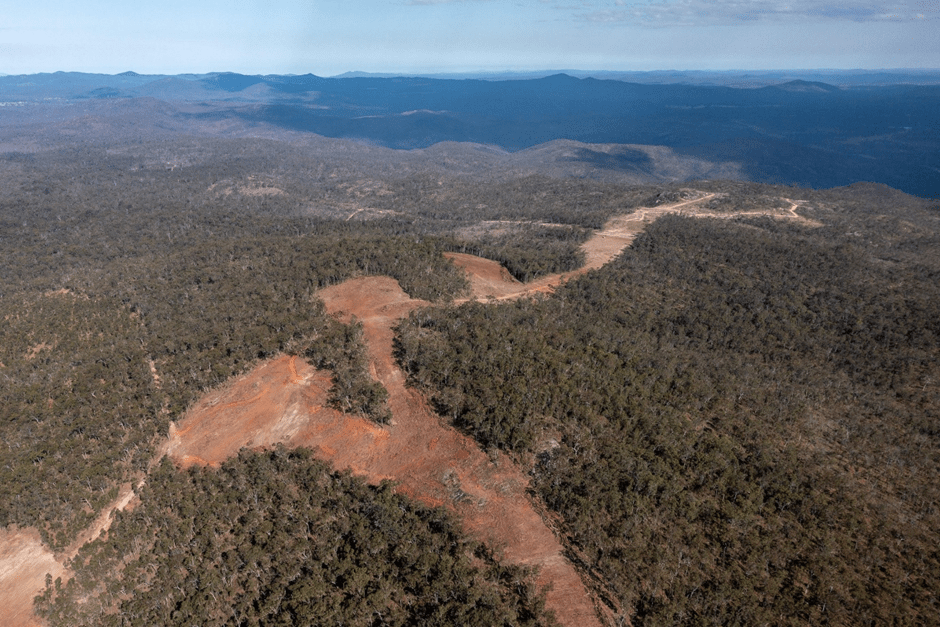
The wind turbine projects being built on the tops of the Great Dividing Range have very little sediment control. Some of the roads are very steep. I wonder how much sediment is washing into the little streams that host endangered species like the Magnificent Broodfrog. How far does the fine sediment flow? Many of these projects lie in the Great Barrier Reef catchment. Farmers must meet tougher and tougher standards regarding their properties.
For years I worked on huge infrastructure projects in Asia. Sediment control was carefully planned and monitored.
A neighbour has recently had his driveway engineered. After a relatively light rain event up here in northern Queensland, I noted that fine sediment from his driveway washed down the drains and disappeared. Sand carried for tens of metres down the roadside gutters while gravel pieces moved several metres. Here are a few photos. Note the silt still remaining on the road itself. The driveway gently slopes down to the old road-side gutters with a narrow concreted steeper area just before the gutters.
Up here, we can experience rain intensities that wash roads away and roadside slopes collapse. How much sediment will move into streams into our heritage areas from the wind turbine projects? Who is monitoring it? No-one has an obligation to report it. Thousands of kilometres of roads are being built. What is the cumulative impact?
I fight to have wind turbines built where they do not damage the Australian Environment.
Infrasound is sound with a frequency below 20 Hz. It is normally not perceptible to the ear, but it can affect animals and humans (negatively) if the levels are sufficiently high. What makes infrasound special is that it travels very far, as it is barely attenuated by the atmosphere, ground, or walls. It can pass straight through walls without significant attenuation. Sounds with higher frequencies are attenuated by the atmosphere and bounce off walls. Even though we may not hear it, physiological responses have been measurabled.
Health risks with Infrasound – Research from Sweden
“The fact that most people don’t hear it doesn’t mean it’s harmless. It is a common misconception that you have to hear a sound in order for it to affect the body. There is research showing that infrasound affects the brain and the autonomic nervous system even at levels well below the limits used today. The problem is that we have an old view of noise, focusing only on what is audible. But the research has shown that even inaudible sound can have physiological effects. Infrasound can create stress reactions in the body, affect sleep and trigger migraines, and this is an area that should have been researched much more than it has been done.”
Several studies suggest that infrasound can cause a range of negative health effects such as insomnia, migraines and high blood pressure.
“Approximately 30% of the population has an increased sensitivity to infrasound, and these people can be hit hard. I myself have experienced the effects. After measuring at wind farms, I can’t sleep for several nights and get heavy migraines. It is the same symptoms that many residents close to wind turbines describe. We’ve been out talking to people who live close to these works, and we hear the same stories over and over again – people get headaches, they feel a pressure in their heads, some get palpitations and others can’t sleep. And this is the big problem: there’s no escaping from the infrasound, it goes straight through walls and windows, and no authority has taken this seriously.”
How far does the infrasound spread from the wind turbines?
One of the most worrying aspects of infrasound is its long range. Unlike audible sound, infrasound is not dampened in the same way by the atmosphere but can travel very long distances without reducing in intensity. depending on the conditions, it is possible for the infrasound to be louder at 150 km from the source than it is at distances of 20 to 100 km from the source. This is very different from audible sound, which gets attenuated proportionately with the square of the distance from the source. https://www.sciencedirect.com/science/article/pii/S2210670722006126#:~:text=2022)%20report%20power%20spectral%20density,shifts%20the%20frequencies%20slightly%20higher.
The Attenuation of Infrasound with Distance
Infrasound levels can be significantly higher from downwind turbines compared to upwind turbines.
Queensland is building wind turbines on the tops of the Great Dividing Range
How far will their effect travel? A few small turbines might be OK.
But the plans are for thousands to be built. We already know that some of our precious wildlife such as koalas and cassowaries communicate using infrasound. Their behaviour will be strongly affected and their ability to breed. Do we really know what will happen to humans?
On 9th September, a rally was held in Ravenshoe. Theoretically it was only days before the Federal Minister for Environment was due to announce her decision on the status of the proposed “Chalumbin Wind Farm”. I fail to see how the word farm applies to the wind turbine industry. Farming involves life that grows and reproduces itself. The proposed wind farm will only kill our beloved forest and all the creatures that live in it – death and destruction while doing very little to help mitigate climate change. The forest itself is doing a much better job while not costing Australia millions of dollars.
At the 11th hour the project proponent Ark Energy has submitted a change to the project. What happens next is unknown up here on the Atherton Tablelands. The fight continues.
Hundreds of people joined the rally which was recorded by Nick Cater of the Menzies Research Centre. The link below takes you to his video on ADH TV which is then followed by his interview with the wonderful Stephen Wilson of Queensland University explaining why companies like Ark Energy are so keen to take on these projects.


 My Blog has become My Nuclear Journey