- The Damage from One Wind Farm May Not Cripple the Environment – But Lots of Them Could Be Catastrophic for our Biodiversity
The Queensland Renewable Energy Zones take in the entire length of the Great Dividing Range. Wind farm projects being sanctioned in the wet tropics catchment area alone are numerous and in areas of high biodiversity value, close to World Heritage areas and on the mountain ridges. This is death by a thousand cuts, and nothing is done to even evaluate the consequences. There is no mechanism either under the Commonwealth EBPC Act or at state level to consider cumulative impacts. Our World Heritage Wet Tropics is listed as the second most irreplaceable natural World Heritage site on earth by the International Union for the Conservation of Nature (IUCN). Wind turbines are planned within 500m of the World Heritage site. The forest is unbroken between the some of the planned wind farms and the World Heritage areas.
- Fragmentation of Forest and Edge Effects Destroy Biodiversity
Edge effects are a prominent driver of fragment dynamics, strongly affecting forest microclimate, tree mortality, carbon storage and a diversity of fauna.
The hydrological regimes of fragmented landscapes differ markedly from those of intact forest. Desiccating conditions may penetrate up to 100m into areas near the roads. Streams in fragmented landscapes experience greater temporal variation in flow rate than do those in intact forests. Cleared areas have less evapotranspiration and rainfall interception and absorption by vegetation. Rapid runoff promotes localized flooding in the wet season and stream failure in the dry season, with potentially important impacts on aquatic animals.
Even narrow forest roads (20–30m) result in increased tree mortality and damage with wide-ranging alterations in the community composition of trees and undergrowth. Many insects and other fauna will not cross narrow roads, yet hundreds of 70m roads are proposed.
- Proposed Wind Farms Could Add Pollution to the Great Barrier Reef
Projects like Chalumbin lie on the head waters of the river catchments of the Wet Tropics Area. Hundreds of kms of unsealed 70-metre-wide roads that cross waterways have the potential to dump sediment and other pollutants down rivers through areas of World Heritage Rain Forest and cane farms out to the Great Barrier Reef. Farmers fear they will be blamed. There is no provision under the EBPC Act to consider any type of off-site impact. Water quality is not considered.
- Building Wind Farms in Forests is a Terrible Waste
Forests are giant carbon and water storage batteries. Why discharge greenhouse gases to the atmosphere by land clearing and lose all the benefits forests provide in the mitigation of climate change? When they are gone, we lose all the carbon sequestration and cooling they do every day. Natural forests do this better than plantation forests.
By clearing forest to build wind farms, we lose a very substantial proportion of the carbon savings we would make by siting them elsewhere. Much of what we gain in lower carbon emissions from wind power, we lose by destroying forest.
Even worse, we contribute to climate change through the loss of a range of mechanisms forests provide long before any of the benefits of wind energy mitigate carbon emissions. This is making climate change worse needlessly on a temporal basis which is the opposite to why we are setting 2030 targets.
We are also desecrating our irreplaceable biodiversity, Aboriginal cultural heritage, and tourist jobs in areas of high importance. High quality patches of remnant forest are rare and precious, and some of windfarm project areas were being planned for inclusion in National Parks in the future. What a waste!
- Loss of Forest Affects Cloud Formation and Alters the Hydrological
Loss of forest on mountain tops will lessen rainfall and lead to more droughts and flooding. While one project may have almost negligible impact on weather, more and more wind farms are proposed. A major failing of the EBPC Act is the absence of assessment of cumulative impacts. The wind farm projects change the land use from forest to major industrial, permitting major extensions to each project being possible with much less assessment. This will impact on both our World Heritage listed Wet Tropical Forests and Great Barrier Reef while drying our inland agricultural lands to the west.
- Consideration of Aboriginal Science and Sites of Aboriginal Cultural Heritage
Aboriginal science is not considered by developer-led ecologists. For example, Traditional Owners speak of the impacts to migratory birdlife and the harms related to wildlife removal – why are their voices excluded from any meaningful reporting?
Many of these sites are sacred regions of high significance for the tribes and their clans’ peoples, including The Ancestors. What should the response be when it is stated, “Our culture means more to us than anything else. We know where we belong – we belong to the land. It is the land where our Ancestors reside, and where our future generations will go too. The land should remain undisturbed”.
- Are We Getting our Money’s Worth?
It is very difficult to estimate how much the renewables sector is being subsidised by taxpayers’ money.
In 2020, Australia invested $7.7 billion or $299 per person in renewable energy. The Clean Energy Regulator estimated that a record 7.0 gigawatts (GW) of new renewable capacity was installed in the same period. (media release by The Hon Angus Taylor MP: Minister for Industry, Energy and Emissions Reduction on 2 February 2021)
On Sky News in 2020, Nationals MP Barnaby Joyce said it is important to remember each wind turbine costs the taxpayer $660,000 per year, per tower, due to the government subsidy scheme for renewable energy developments. He was commenting on a $600 million, 77-turbine wind farm proposed just outside of Tamworth.
- In Conclusion
What worth do we put on the loss of biodiversity and ecosystems, stunning landscapes, natural carbon sequestration and storage. Forests cool the earth and make it rain. Forests soak up runoff like giant sponges and help prevent flooding, while recharging aquifers. Forests produce lots of oxygen for us to breathe. They clean our air and water of pollutants so that most of the water going to the Great Barrier Reef is clean. Forest stabilises the soil so turbid water does not kill corals. Our drinking water is cleaner too! We are putting so much at risk by building wind farms where they should not be.
What is the cost of desertification, increased flooding and droughts? I thought the idea was to fight climate change, not make it worse.
As a reminder: The International Union for the Conservation of Nature (IUCN) has listed Our World Heritage Wet Tropics as the second most irreplaceable natural World Heritage site on earth.
We are about to turn areas close to the World Heritage Wet Tropics, such as at Chalumbin (Ravenshoe) below

into this.
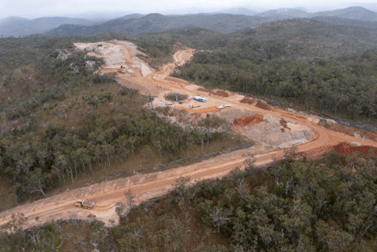
This photo taken at Kaban (Ravenshoe), the least valuable of all the proposed sites in the catchment of the Wet Tropics, and only shows the site of two turbines. There are plans for hundreds of much larger turbines for the Wet Tropics catchment; many projects are already in the system. Hundreds of kilometres of roads wider than these have been designed.
We have seen and heard strong Far North Queensland Jirrbal truth-telling about their desire to preserve forest in the Wet Tropics catchment. Many of these sites are sacred regions of high significance for the tribes and their clans’ peoples, including The Ancestors. What should Australia’s response be when it is stated, “Our culture means more to us than anything else. We know where we belong – we belong to the land. It is the land where our Ancestors reside, and where our future generations will go too. The land should remain undisturbed…we are concerned about losing our identity”.
In my experience, the Jirrbal people seem to be becoming more and more positive about the use of nuclear power in Australia. It is viewed as a way of ensuring no more forests are desecrated and hence protect irreplaceable cultural heritage. A forest is not just trees and they cannot be replaced just by replanting trees. Cultural heritage is forever, and a loss of biodiversity and wildlife and totems cannot be replaced. Important decision-making is required as the ramifications are permanent and forever.
Some of my dread about more renewables arises from:
- some of our best forests are being desecrated to build wind farms;
- some of our best agricultural land is being covered and possibly polluted with solar farms;
- no consideration is being given to the cumulative impacts;
- no plans are in place for either waste disposal or recycling at the end of usefulness.
- I am no longer convinced that renewable energy is cheap because of all the ancillary costs.
- Everywhere that high levels of wind and solar power exist, power prices and grid problems have risen sharply if there is not high levels of hydroelectricity or geothermal power available.
Personally I think renewables should be part of the mix, if much more thought is given to their placement. Large areas of Australia have very low rainfall and relatively low biodiversity or have already been highly disturbed. Many of these areas have great solar and wind power potential if transmission lines are more carefully planned.
I would love you to spread it far and wide. These videos were recorded in Cairns 15 May. The presentation by Steven Nowakowski is wonderful. Steve is a photographer who really cares about our special places.
Steven’s presentation – https://www.youtube.com/watch?v=nxw1t1qV9EM
Jirrbal Traditional owners – https://www.youtube.com/watch?v=ojUpXCHR-CQ
A short presentation I gave that day.
Discover more from My Blog has become My Nuclear Journey
Subscribe to get the latest posts sent to your email.


Thankyou Pamela for your wise words and advice. from the Cheeky Possum Ravenshoe 4888 Keep Chalumbin Wild
LikeLike