The 80% renewable electricity target by 2030 cannot be achieved unless there is sufficient storage in place for the output of variable renewables.
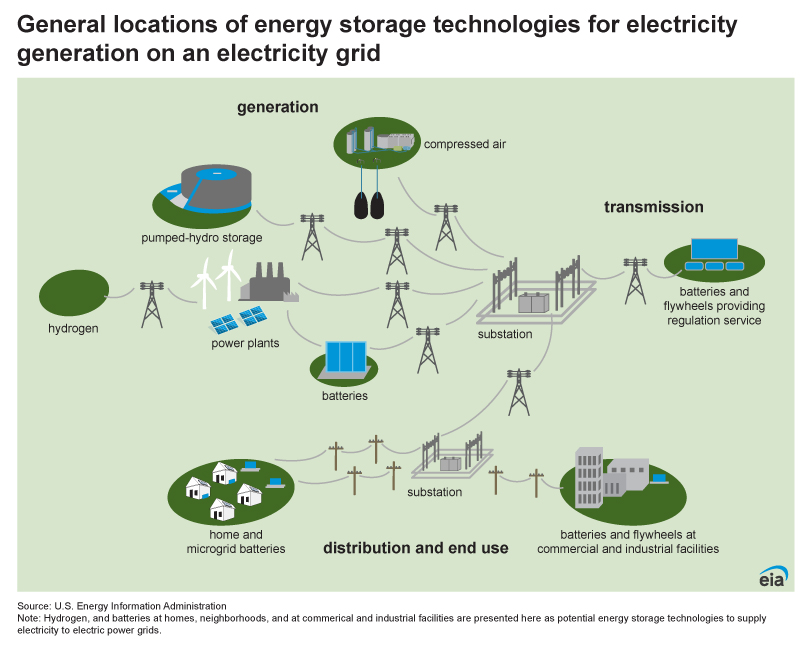
When you think about it, storage has always been a primary issue for electricity generation. In the case of coal there has always needed to be sufficient coal in bunker storage at a power station to feed the furnaces. Coal is a concentrated form of “solar energy” that was captured by plant photosynthesis many millions of years ago – so it is a form of energy storage. Likewise with gas.
As Australia transitions towards a planned renewables-based electricity generating system it will be critical to have sufficient storage to maintain power supply during periods when intermittent primary generation sources are not producing power. Shutting down existing dispatchable, fossil-fuelled generation before the required storage is in place will likely lead to frequent, unpredictable, widespread blackouts.
As discussed in a previous instalment, solar PV (especially rooftop solar) has a low capacity factor since electricity is only produced when the sun is shining. Let’s assume for simplicity that large scale solar PV with a capacity factor of 30% is the only source of generation. Electricity is produced during an 8h daytime window. What about the rest of the 24h period?
To ensure that sufficient electricity is produced for a 24h period, “surplus” electricity needs to be produced and stored during the day, for use during the dawn and dusk periods and through the night. This means that more than 3 times, over and above the daytime requirement, needs to be produced and stored. Thus, a 300MW nameplate capacity solar farm would be needed to produce 100MW, averaged over the 24h period, with sufficient storage.
The situation is more complicated with wind because of its intermittent nature, noting that the average capacity factor of an onshore windfarm in Australia is about 35%. However, in contrast to the regular and predictable day/night cycle for solar, wind is typically quite variable. So even with overbuilding x3 to allow for the capacity factor, if there is no wind (be it day or night) there will be no power produced.
So, we are going to need storage and LOTS of it, if our current electricity system is going to function with 80% renewables by 2030. What are we looking at for 2030 and how much more is going to be needed between now and then, and beyond?
Australia’s total current storage capacity is only 3GW. Current forecasts by the Australian Energy Market Operator (AEMO) show Australia will need at least 22GW by 2030 – a more than 7 fold (700%) increase in capacity in the next six years.
The market operator’s https://aemo.com.au/-/media/files/major-publications/isp/2024/2024-integrated-system-plan-isp.pdf?la=en (ISP) forecasts Australia will need at least 49GW of storage by 2050 in order to reach net zero.
In my next instalment I will be taking a closer look at the main options that are being proposed for large scale storage – pumped hydro and batteries – and the challenges associated with them.
Discover more from My Blog has become My Nuclear Journey
Subscribe to get the latest posts sent to your email.
 My Blog has become My Nuclear Journey
David,
I tried to leave the following comment but it returned an error.
“For domestic solar installations, our installer quoted 4 hours rather than 8 hours per day as what they calculate as an average for useful insolation. This means that the domestic contribution to the grid would require double the storage of that assumed.
Commercial solar farms can be expected to have somewhat longer periods of useful insolation as they are located in areas chosen for optimum photon capture. Diverse domestic roof orientations are inherently less efficient and are often impacted by shading.”
I was going to send the following privately:
Should the units quoted for storage not be GWh rather than GW?
Regards,
Bern
LikeLike
Hi Bern, We are in the process of having Pamela’s blog site worked on by a WordPress expert and are going through the “teething” stages. I’m afraid it is all black magic to me. You raise an important point about where the solar is coming from in regards to storage requirements. In a previous installment I noted that rooftop solar only has an average capacity factor of 11% compared with large solar of 25-30%. Two reasons for this is because large solar is in more open terrain (less shading overall) and often features solar tracking to maximise the time window of capture. You can see these factors at play on the NemWatch site where large solar ramps up much more quickly than rooftop in the morning, and fades away more slowly in the afternoon. So the ratio of storage to generation will need to be much higher for rooftop than large solar, assuming you were wanting the “system” to be fully covered for 24h supply. Yes – GWh is the key metric, but I was trying to keep it simple in the first instance. Indeed it is quite difficult to find out this info from the sources. It really annoys me when the term “big battery” is used. “Big” is not even a drop in the ocean when compared with what will be needed for the transition. The current battery systems typically have only a 1-2h supply rating at full discharge. This is OK if all the battery is required for is to provide a short duration buffer in the late afternoon between when solar fades out and coal/gas ramp up. Indeed filling this niche is currently extremely lucrative for the owners of these batteries as they (with gas) command the highest price. For example, the first big battery (Tesla installation in SA) paid for itself in only a few months. A good investment indeed by Musk (no altruism there).
One other very important thing about batteries. In the case of Li-ion they should be cycled between 40 and 80% capacity to maximise the lifetime – so that further increases the amount of battery storage that is needed to maximise the ROI.
I was going to talk about batteries and pumped hydro in my next installment, but will defer this. First I need to talk about the difference between GW and GWh in the context of storage duration and what it means for the generating system. It’s like the difference between nameplate capacity and capacity factor on the generating side
Regards David
LikeLike