Are Forests Becoming Carbon Sources Rather Than Carbon Sinks?

Currently, our land with its forests and other vegetation removes a massive 30% of our carbon emissions every year. Unless natural carbon removal processes are maintained, we have no chance of ever restoring carbon dioxide levels in our atmosphere to tolerable levels.

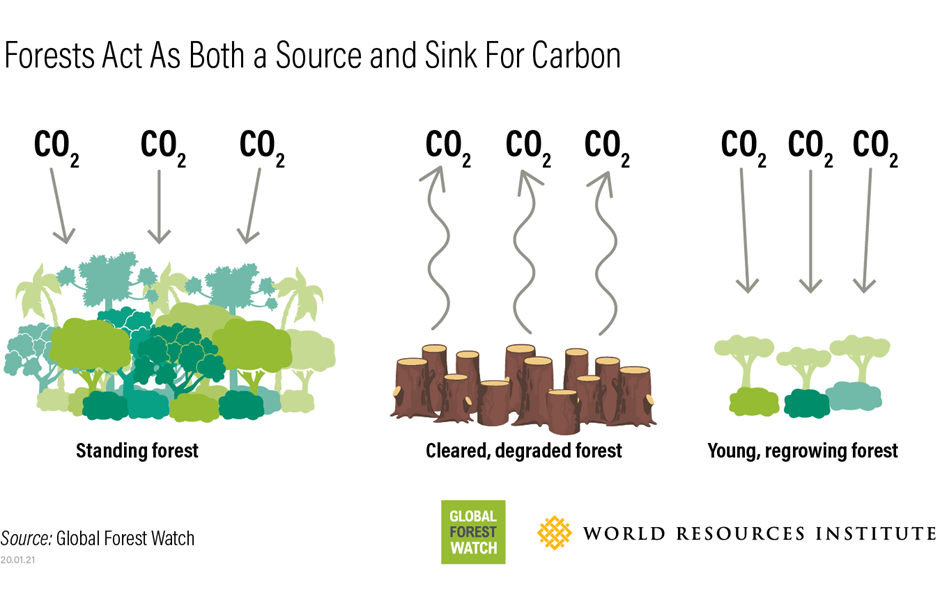
The classic diagram below is misleading in that it is too simple. The “young growing forest” in the third panel is shown as sequestering more CO2 than the “standing forest” or natural forest. This is initially true but depending on its origin and future, the young growing  forests can end up as a net carbon sources or at best carbon neutral.

There are two main groups of “young growing forests”: plantations and regrowth forest. If regrowth forest survives long enough and is ecologically diverse enough, it can take on the characteristics of older forests when it reaches an equilibrium between death and decay and natural tree replacement.
Old-Growth Forests Store Carbon Differently

When it comes to fighting climate change with forests, it’s easy to think all trees are equal. This thinking has led to simple approaches that focus on tree numbers rather than the complexity of the forest. However, science tells a different story: old-growth forests and tree plantations store carbon in distinct ways, and this matters significantly for climate action.

https://www.ecomatcher.com/why-old-growth-forests-store-carbon-differently/

Old-growth forests are sophisticated carbon storage systems that have been built over hundreds or even thousands of years. There are trees of different ages, sizes, and species, creating a complex living structure. This diversity is crucial for storing carbon. Trees do die but they are replaced, and the system reaches a wonderful equilibrium which continually sequestered carbon. The massive tree trunks in old-growth forests represent centuries of carbon buildup. A single large tree can capture as much carbon in one year as an entire medium-sized tree contains in its whole body. In some forests, large trees make up just 6% of all trees but account for 33% of the forest’s yearly growth. This shows why size matters when it comes to carbon storage.

Most importantly, old-growth forests continue to store carbon in many different ways and places. Above ground, carbon is locked in living trees, dead standing trees, and fallen logs that take decades to break down. Below ground, massive root systems and centuries of built-up soil create huge underground carbon vaults. This multi-layered storage system provides both capacity and strength.

Many of Australia’s native forests are younger remnant forests but these forests are also living ecosystems and actually work nearly as hard for us, not just by sequestering carbon and preserving our biodiversity but by helping to cool our land through evapotranspiration and shading and forming a critical part of the water cycle. Forests can store a lot of water, helping to mitigate floods, seed clouds and clean water.

Do Plantations Mitigate Climate Change?

Plantations are typically planted with a single species all at the same time. Plantation forests can remove between 4.5 and 40.7 tons of CO2 per hectare per year during their first 20 years of growth. However, they all reach maturity together and die together, throwing all that carbon back into the atmosphere if they are not logged first. Depending on the use of those forestry products a little of the carbon may be stored for a few decades. Thus, plantations end up carbon neutral at best having achieved no long-term benefits.

Unfortunately, the carbon accounting and reward systems in Australia encourage the use of plantation type forests after bush fires rather than assisting the natural but slower reforestation processes. Some of these decisions are influenced by the severity of the fires. This again emphasises the importance of doing everything we can to fight all wildfires as quickly and efficiently as possible.

What Happens If Forests Stop Absorbing Carbon? Ask Finland

Natural sinks of forests and peat were key to Finland’s ambitious target to be carbon neutral by 2035. But now, the land has started emitting more greenhouse gases than it stores. (https://www.theguardian.com/environment/2024/oct/15/finland-emissions-target-forests-peatlands-sinks-abs)

In a country of 5.6 million people with nearly 70% covered by forests and peatlands, many assumed the plan would not be a problem.

For decades, the country’s forests and peatlands had reliably removed more carbon from the atmosphere than they released. But from about 2010, the amount the land absorbed started to decline, slowly at first, then rapidly. By 2018, Finland’s land sink – the phrase scientists use to describe something that absorbs more carbon than it releases – had vanished.

Finland’s forests were mostly planted after WW2. In other words, they are mainly plantation forests. Commercial logging of forests – including rare primeval ecosystems formed since the last ice age – has increased from an already relentless pace, now making up the majority of emissions from Finland’s land sector.

Higher temperatures are causing the peat to break down and release CO2.

It has been suggested that by reducing the amount of logging and better management of their forests, the situation could be turned around. However, Finland’s Finance Ministry estimates that harvesting a third less would reduce GDP by 2.1%.

Finland is now forced to reduce its emissions by other means and won’t reach its Net Zero Target any time soon.

Are Australia’s Tropical Forests Becoming Net Carbon Sources?

An October 2025 paper published in Nature looking at Australian moist tropical forests used half a centuries’ data on above ground biomass as a measure of carbon sequestration. The above ground biomass was determined by measuring the girth and the height of every tree in each plot.

The study reported that a transition from carbon sink (0.62 ± 0.04 tonnes C /ha/ yr: 1971–2000) to carbon source (−0.93 ± 0.11 tonnes C /ha/ yr: 2010–2019) had occurred. https://doi.org/10.1038/s41586-025-09497-8

Standing carbon stored in the trees dropped almost 30% to about 200 tonnes of carbon/ha yet these Australian forests continue to be among the most carbon-dense terrestrial ecosystems on the planet as well as harbouring a very high proportion of Australia’s remaining biodiversity.

The trees are only living half as long. Death rates have doubled. Degradation has been caused by cyclones and high winds, invasive species, higher temperatures and loss of soil moisture. Canopy leaves die in hot dry weather. There has also been a change in fire regimes. Loss of pollinating species such as the spectacled flying fox means that there are less seeds to regenerate the forests. Clearing and fragmentation of the forest in earlier years left the forest more vulnerable.

Importantly, in this particular study other vegetation was excluded as was carbon stored below ground in the soil and plant roots. However, luckily this forest is still a net sink when biomass underground is considered. Could that change?

The World’s Land Sinks and Sources in 2024
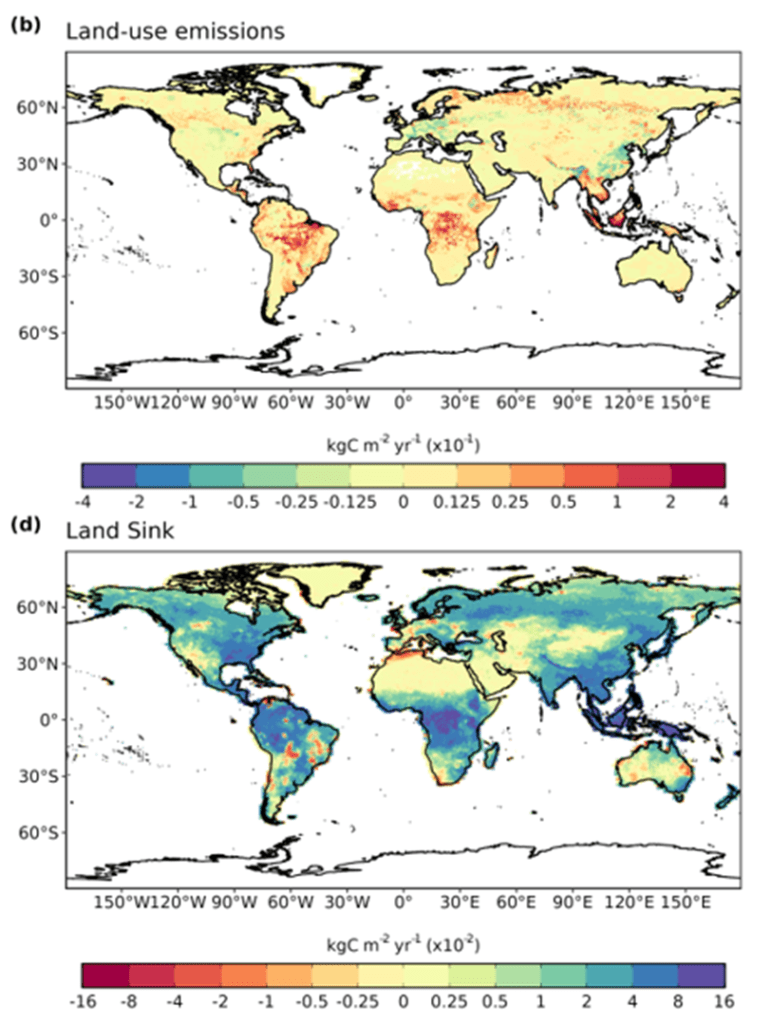
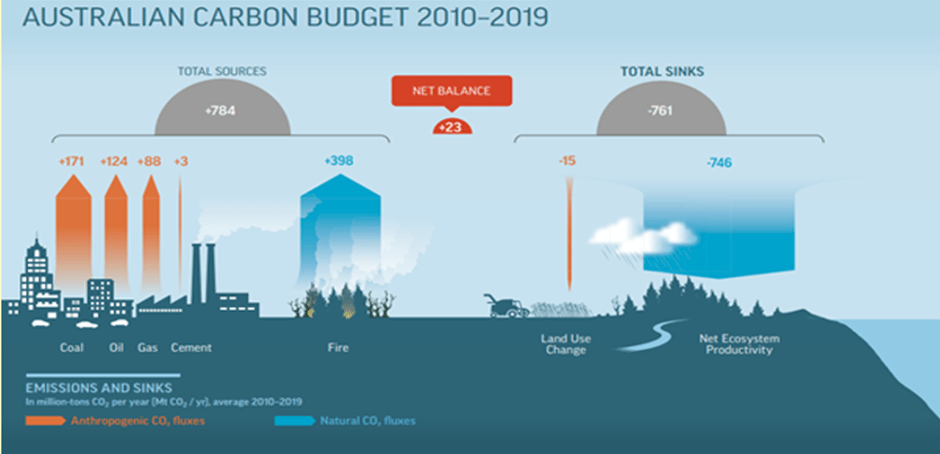
Ref: Global Carbon Project Carbon Budget 2024 slides

Note that the land of southern Queensland, despite its remaining forest, is now a carbon source.

Many areas around the world are close to a tipping point.

The Amazon basin is showing many areas of stress, the most important natural forest areas of the world.  The upper Amazon River and tributaries dried out for the first time in recent years.

A wrecked canoe lies in the dry bed of the Amazon River near San Augusto, Peru. IMAGE CREDIT: Plinio Pizango Hualinga/Rainforest Foundation US

How Much Degradation Can a Forest Take Before Becoming a Net Carbon Source?

An intact native forest will be a carbon sink.

A disturbed forest may be a carbon sink or a carbon source depending on the nature and amount of disturbance. A forest can become a net carbon source long before being totally degraded. For example, in 2025 the Amazon Basin has now been degraded to the extent that it has become a net source rather than a net sink.
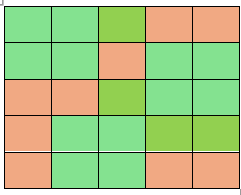
A badly degraded forest is a carbon source.

As temperatures climb, and land dries out, is there a tipping point? Of course there is!

It is not necessary to clear large areas within a forest to start it along the path to its tipping point. Studies in the Amazon basin have shown that clearing a little land in the middle of forest can dry out the soil for up to 3 km away. This has an effect on the water cycle and over time the damage gradually extends further and further into the forest.

Despite man’s disruption of some of our most important forests and increasing CO2 levels, nature has continued to remove 30 % of the carbon emissions we produce. Signs of strain are now showing. The oceans are not taking up quite the same amount that they were. The major tropical forests have sink areas but increasing source areas and the balance between sink and source is changing.
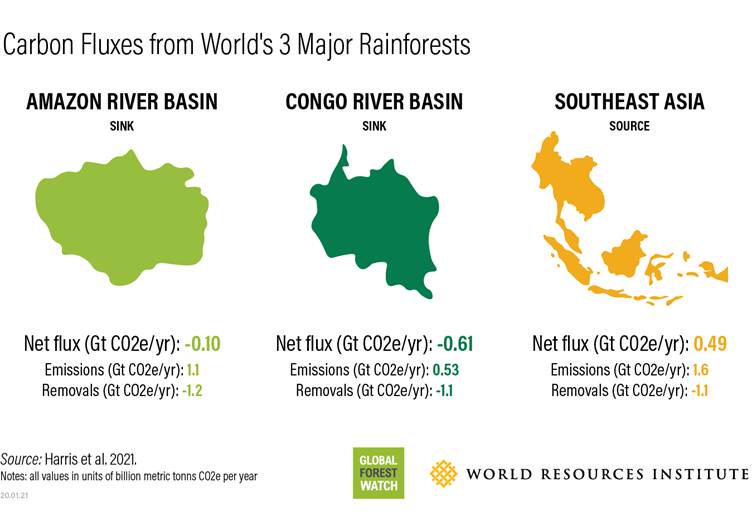
However, these forests still store hundreds of billions of tonnes of carbon.  

Unfortunately, the current Net Zero protocols reward the creation of plantation forests at the expense of ecologically diverse established native forests. There is little reward for maintaining and looking after real forests. It is seen as beneficial to degrade forest to build short term mitigation structures, not considering the long term effects. We are neglecting the natural world by concentrating too much on economic drivers. Even less-intensively managed land has been made a poorer cousin.

Adapted from Earth Syst. Sci. Data, 15, 1093–1114, 2023

What Will Happen to the World if Nature Stops Being a Net Carbon Sink?

We do need to cut emissions. It is not the basic concept of Net Zero that is the problem. It is how it is being implemented. We need a new way forward!

As temperatures climb, and land dries out, is there a tipping point? Of course there is!

Unfortunately, the current Net Zero protocols give the biggest rewards for the least effective behaviour.

How much more can we threaten our Australian forests before they crash and the eastern states become drier and drier and even hotter than necessary?

Please UN, COP and Australian Government find a way to reverse these trends. It is not too late!

A Big Hole in Net Zero Thinking

As described by the UN, Land “plays a key role in the climate system” as an essential carbon sink because its surfaces, such as forests, regulate the planet’s temperature and help to store carbon. In the last decade alone, land-based ecosystems absorbed around 30 per cent of the carbon emissions generated by human activities, such as the burning of fossil fuel. https://www.un.org/en/climatechange/science/climate-issues/land

This approach does not match the UN Net Zero approach as only direct anthropogenic activities to ease Climate Change can be counted.

Checking the Meaning of Net Zero

A deeper look at the wording of Net Zero statements puts little emphasis on Nature’s role in lowering GHG. For example, note the following Australian wording, with emphasis on “we”.

Net zero means balancing the amount of emissions WE produce with those WE remove from the atmosphere.

The UN says:

Put simply, net zero means cutting carbon emissions to a small amount of residual emissions that can be absorbed and durably stored by nature and other carbon dioxide removal measures, leaving zero in the atmosphere.

However, the UN reports use the following explanations:

Carbon dioxide removal (CDR): Refers to anthropogenic activities removing CO2 from the atmosphere and durably storing it in geological, terrestrial or ocean reservoirs, or in products. It includes existing and potential anthropogenic enhancement of biological or geochemical sinks and direct air capture and storage but EXCLUDES natural CO2 uptake NOT directly caused by HUMAN activities.

Land use, land-use change and forestry (LULUCF): A GHG inventory sector that covers emissions and removals of GHGs resulting from direct human-induced land use, land use change and forestry activities.

Ref: https://www.unep.org/resources/emissions-gap-report-2024#:~:text=As%20climate%20impacts%20intensify

What is the Effect of Using this Anthropocentric Approach?

Only 3% of the world’s budget for climate change mitigation is spent on forest protection, even though vegetated land surface is removing 30% of the emissions we produce.  As CO2 levels have risen, nature has kept taking CO2 out of the atmosphere, but the system is starting to show real strain for 2 reasons.

  1. We have undervalued natural ecosystems already in existence by not giving their conservation and protection a strong enough voice and role in the definitions of Net Zero. Thus, it becomes OK to knock down parts of a forest to build wind turbines or palm plantations or build a 4- lane highway for COP 30. Net Zero accounting only measures the actual land area cleared but forgets the edge effects that can dry out forest and soil lessening the ability of far greater areas of forest to continue sequestering carbon. Disturbed forest is more susceptible to wildfire and damage from storms leading to yet further degradation.
  • As temperatures climb, the ability to photosynthesise can become weaker in a wide range of plants. Unfortunately, almost all tree species have a C3 type metabolism that is not well adapted to hotter and drier conditions. Australia is lucky to have many C4 plants such as saltbush, spinifex and indeed almost all  of our Australian grasses. C4 crops include sugarcane, pearl millet, corn and sorghum. In some wetter years our savannah lands do a lot of sequestration. They need protection too.

C4 photosynthesis was an adaptation to less water and lower CO2. It is far more efficient in drought and high sunlight and dominates in tropical savanna areas. When grown in the same environment, at 30°C, C3 grasses evaporate approximately 833 molecules of water per CO2 molecule that is fixed, whereas C4 grasses lose only 277. This means that soil moisture is conserved, allowing them to grow for longer in arid environments.

It is possible that if we keep on our current pathway, Australia will turn our forests from net sinks for CO2 to net sources and then we could progress to losing them completely. What a tragedy that would be!  Imagine losing our moist Eastern Australia lands. Forests are a very important part of the water cycle and do a massive job of cooling the Earth and keeping it from drying out. Forests bring rain. Loss of biodiversity within forests degrades and ultimately kills forests. They are complex ecosystems where every living thing plays a role. I will expand the topic of forests as net sinks or sources in a future blog.

Reaching net zero is impossible without nature. In the absence of proven technology that can remove atmospheric carbon on a large scale, the Earth’s vast forests, grasslands, peat bogs and oceans are the only option for absorbing human carbon pollution, which reached  37.4 bn tonnes in 2023. https://www.iea.org/reports/co2-emissions-in-2023/executive-summary)

So far Nature has been doing much more to lower CO2 levels than all our anthropogenic efforts.

Why are we wasting money and other resources to build temporary structures by destroying the resource we already have that is busily working to moderate our climate ? How about we save our land from further degradation by using nuclear power in the longer term and gas now as part of a meticulously planned energy transition that includes carefully sited renewables?

The use of nuclear power and gas would help to preserve the land. Gas is a much lower carbon emitter than coal. By using more gas for industrial purposes for tasks that require high heat, a job that renewables cannot do, carbon emissions can be reduced without losing strategic industries we need to build our homes, produce food and export mining products. The Australian Government recognises a role for gas but seems to have done little to ensure a reasonably priced, adequate supply to industry. https://www.industry.gov.au/publications/industry-sector-plan/pathway-2050

Watch Mark Vassella, BlueScope Managing Director and CEO, address The National Press Club of Australia on “Australian gas prices are costing us our manufacturing, jobs, energy transition, and a future made in Australia.” https://youtu.be/HJoVbF1rtGI?si=LdTxvpatAGY-PDjO

We have already done so much damage, because Net Zero policies just don’t address the issues. Theoretically, Australia now has the Nature Repair Scheme which officially began with the Nature Repair Act 2023 which came into effect on December 15, 2023. Implementation finally started in 2025 with the first project improving land by replanting. The scheme is designed to” restore and protect” our natural environment, and participants can earn carbon credits. This scheme does not protect forests. It demands similar actions to Net Zero and still leaves our best remaining forests vulnerable. Our Environmental laws need strengthening not weakening to prevent building renewables in the wrong places and destroy the existing carbon sequestration capacity.

Next time – Are Our Forests Becoming Net Carbon Emitters or Sinks?

The Carbon Budgets of Natural Landscapes

Mother Nature is still doing a magnificent job removing carbon dioxide from the atmosphere. Over half of the carbon dioxide, we produce from fossil fuels and other carbon intensive activities is taken up by the ocean and vegetation on the land.

The Global Carbon Budget

There are many entities around the world, doing their best to measure and calculate the earth’s carbon budget. The clearest summary I have seen so far is shown below and copied from an overview article Carbon Stocks, Fluxes and the Land Sector  by Graham Diedrich February 07, 2022. https://www.canr.msu.edu/news/carbon-fluxes-and-carbon-stocks

The figure above shows global carbon stocks and fluxes. The boxes represent the stocks of carbon in its different forms, but the numbers always relate to the amount of carbon. The arrows show the movement of carbon in or out of these carbon storages. The annual carbon exchange flux is represented numerically in PgC per year units, in which 1 PgC is equal to 1 billion metric tons of carbon. Nature has stored away huge quantities of carbon over eons of time as coal, gas and oil. Even more carbon is stored in the deep ocean (37 trillion tonnes). Each year we are burning carbon so that about 7.8 billion metric tonnes of carbon join with oxygen and add to the carbon dioxide already in the atmosphere. Land use change adds even more as we desecrate forests and release carbon from soils.

Mother Nature is still doing a magnificent job removing carbon dioxide from the atmosphere. Over half of the carbon dioxide, we produce from fossil fuels and other carbon intensive activities is taken up by the ocean and vegetation on the land. The movement of carbon into the soil is very substantial but very variable and hard to measure. Note just how much carbon is stored in soil and permafrost.

Why Care About Natural Terrestrial Ecosystems

Nature provides a range of services such as:

  • Capturing and storing carbon.
  • Regulating climate – lowering the intensity of droughts and floods while stabilising temperatures.
  • Maintaining water balance – helping to make it rain and storing and cleaning water.
  • Providing biodiversity – bees to koalas to earthworms and magpies.
  • Creating jobs in ecotourism.
  • Providing resources for our use including our food.
  • Manufacturing soil.

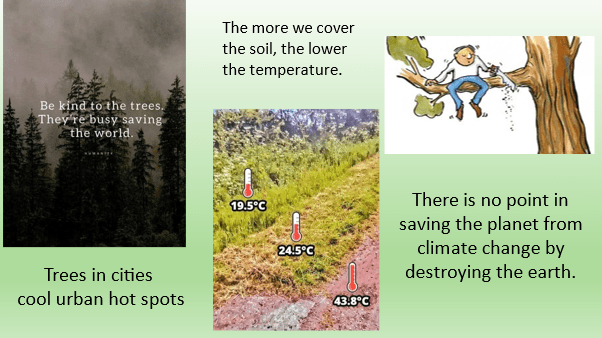
Forests are particularly important not just for providing shade and storing lots of carbon, but they lower the earth’s temperature by as much as a degree. They do this through evapotranspiration, a process similar to the cooling produced by evaporative air conditioning. Some trees such as our eucalyptus also emit chemicals that trigger cloud formation providing yet more cooling effect.

A slide from one of my talks

But Australia’s natural ecosystems are at risk from:

  • climate change and variability – extreme heat events and droughts,
  • fire – carbon stored in woody vegetation is vulnerable to increased fire risk through burning under climate change,
  • land-use change particularly land clearing,
  • disturbance including invasive species, and disease.

Death of vegetation from drought stress, extreme disturbance events, disease, and pests could also result in increased carbon release to the atmosphere and changes to CO2 emissions from soils. An issue often overlooked is the release of water from soil as vegetation cover lessens. Lower soil water levels reduce the rate of photosynthesis and hence carbon removal.

Factors That Affect Nature’s Role in Reducing Carbon Dioxide in the Air

The vegetation on Earth holds a lot of carbon, somewhere between 450 and 650 billion tons of carbon (PgC). Just how much carbon is sequestered as vegetation each year is a delicate balance between photosynthesis and plant respiration and horror – wildfires or as we know them in Australia bush fires. During photosynthesis plants take up carbon dioxide and convert it to carbohydrates while releasing oxygen. During respiration plants take up oxygen and release carbon dioxide.

Lots of scientists are looking at the factors that effect the rate of photosynthesis and respiration by plants. What would it take to tip the balance in the wrong direction? What we know is that increasing carbon dioxide levels in the air are increasing photosynthesis. But far more important is the water available to plants and the temperature. There seems to be a maximum temperature for many plant species. Increasing temperature increases photosynthesis until the maximum is reached then as temperatures become even higher, photosynthesis falls away – heat stress. Droughts decrease carbon uptake by plants. Very wet years in Central Australia can result in massive increases in carbon uptake even over a short period of time. Unfortunately, plant respiration seems to continually go up as temperatures climb.

Will plants adapt to the changing conditions? It has been noted that plants in dry northern Australia recover from fire faster now and become carbon sinks again after a fire made the area a carbon source.

It is not surprising that seasonal variation is found depending on the weather. Winters are cooler. Rainfall patterns vary considerably. In Australia, there are major differences between El Nino and La Nina years. Long droughts in Australia can cause the more arid regions to become carbon sources.

Forests Buffer Thermal Fluctuation Better than Non-forests

A systematic study of thermal buffer ability (TBA) of different vegetation types showed that forests and wetlands buffer thermal fluctuation better than non-forests (grasslands, savannas, and croplands). Notably, seriously disturbed and young planted forests displayed a greatly reduced TBA as low as that of non-forests at high latitudes. Canopy height was a primary controller of TBA of forests, while the TBA of grasslands and savannas were mainly determined by energy partition, water availability, and carbon sequestration rates. Protecting mature forests is critical to mitigate thermal fluctuation under extreme events. https://www.sciencedirect.com/science/article/abs/pii/S0168192320300964?via%3Dihub

An introduction to the Australian and New Zealand flux tower network – OzFlux

OzFlux is the regional Australian and New Zealand flux tower network that aims to provide a continental-scale national research facility to monitor and assess trends, and improve predictions, of Australia’s terrestrial biosphere and climate. https://bg.copernicus.org/articles/13/5895/2016/  and https://ozflux.org.au/index.html

Many universities and other research entities form the network and the OzFlux website provides hundreds of research articles if you wish to read more detailed information. OzFlux is part of a worldwide network FLEXNET.

Studies in Australia are measuring factors that effect photosynthesis and respiration, the effect of fires and other stressors. The earliest measurements were made two decades ago.  Since then, lots more monitoring points have been added and some removed.  The monitoring data collected by OzFlex and FLEXNET is used to calculate and understand the factors increasing carbon dioxide in the air to work out the best strategies to adopt to climate change and mitigate it. OzFlex has helped us to understand the major roles the savanna lands and arid desert play in Australia’s carbon balance.

The Protection of Our Ecosystems is Our Most  Important Action

We must do everything we can to slow the loss of natural vegetation in Australia. Otherwise, we face a future where our carbon sinks become carbon sources and Australia becomes one of the hottest places on Earth.

Regional climate protection is in our hands.  Global Climate Change is not. I will explain more in the next blog post and look at Australia’s carbon balance in more detail.

And for those readers who like a little more complexity, I include a few diagrams below from an older IPCC report. The numbers are outdated.

3d Land Use and Conservation Issues

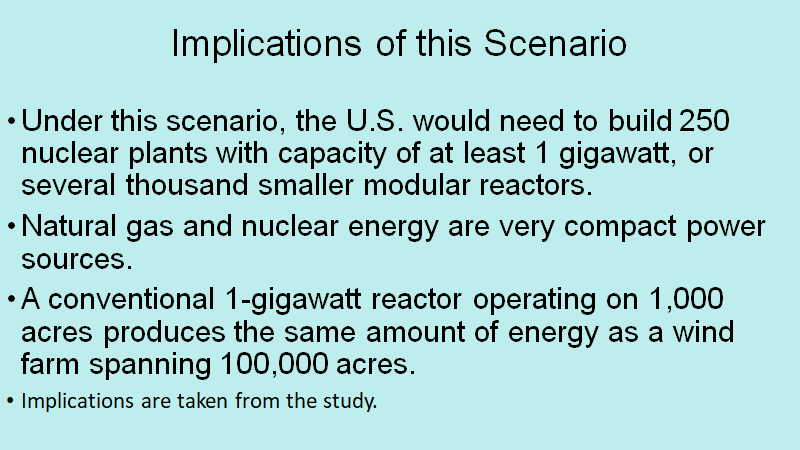
When I first put these slides together, I didn’t fully understand just how insightful Brook and Bradshaw had been. I love the paper because it compared the areas needed for different electricity production technologies and because it suggested that nuclear might have real advantages. I now have a greater understanding of the conservation issues associated with the different forms of power generation and how the siting of the power facilities might not only have an impact on the land area impacted but that it could be critical in terms of the benefit to cost ratios. Biodiversity is important to the survival of this planet. Loss of biodiversity will lessen resilience to changes in climate and our ability to grow food.

The destruction of remnant forest areas in Australia has no excuse on this basis. The cost of building renewable energy sources in forest or on food producing land is enormous. Forests do so much to mitigate climate change. Not only do they store and sequester carbon in the trees, the roots and in the soil beneath, they have enormous influence on the climate itself through the hydrological cycle.

A review published in 2017 by the North East Forest Alliance called Clearing our Rainfall Away by Dailan Pugh can be accessed as a download at

https://www.nefa.org.au/clearing_our_rainfall_away

We have known for centuries that clearing forests can reduce rainfall. Australia is a very dry continent. One thing we can all agree upon is that we do not want less rainfall on this continent. Unfortunately, removal of forest can also lead to increased flooding when it does rain.

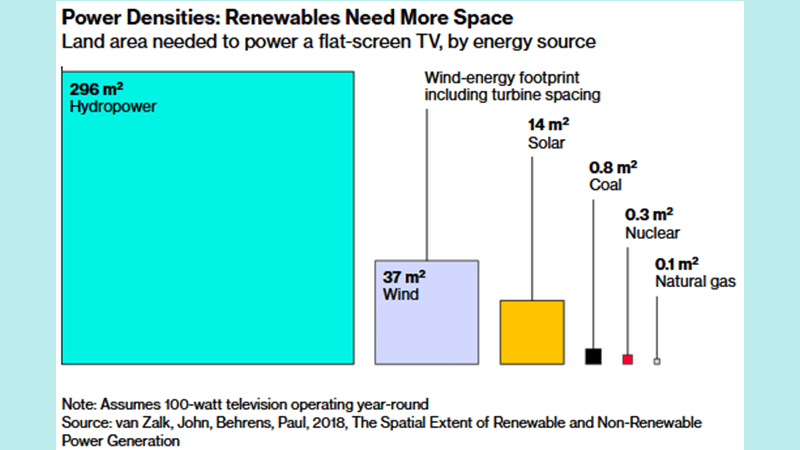
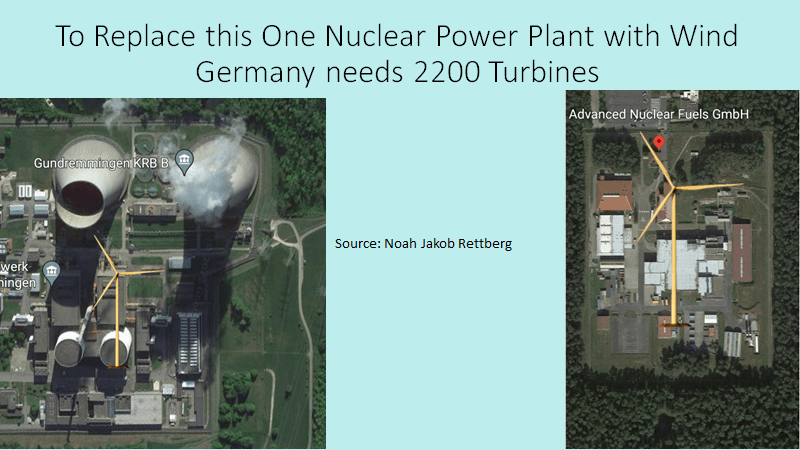
One area that is not agreed upon is the real footprint of land based wind turbines. Some assessments suggest that the only footprint is the size of the base of a turbine. This may be the case for a few isolated turbines on certain types of agricultural land. It is certainly not the case for turbines built in forests. The greatest area of land clearing can be the access roads which as turbines become bigger, become wider and wider. For example, the access roads for the Chalumbin project will be 70 m wide. The total area absolutely cleared to bare ground is about 1200 ha. Further disturbance and fragmentation of the surrounding forest with its critical biodiversity is much greater. Some estimates of wind energy footprints include turbine spacing as shown in the slide below.

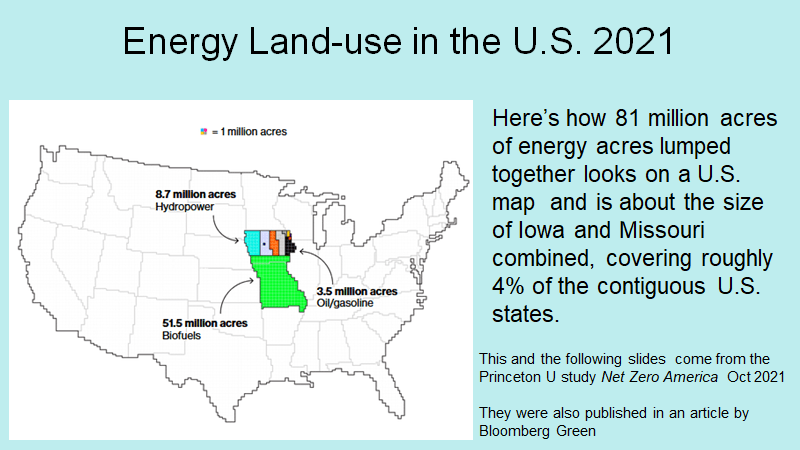
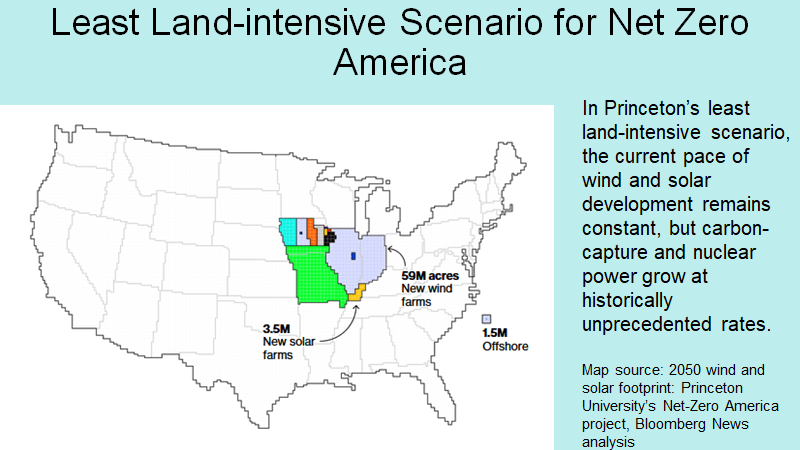
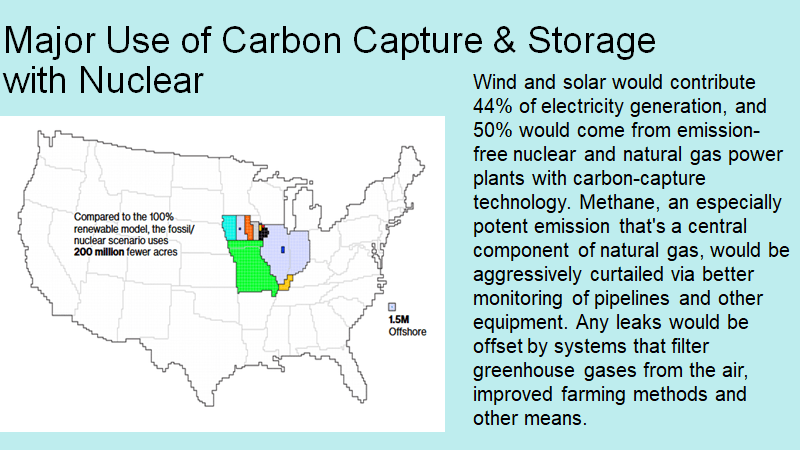
The next slides are based on a study undertaken by Princeton University. The first slide illustrates the area currently taken up by biofuels and other energy related land uses in the United States.

I am not sure whether the data above factors in all forms of energy that may need to replaced in a carbon neutral world. I doubt it.

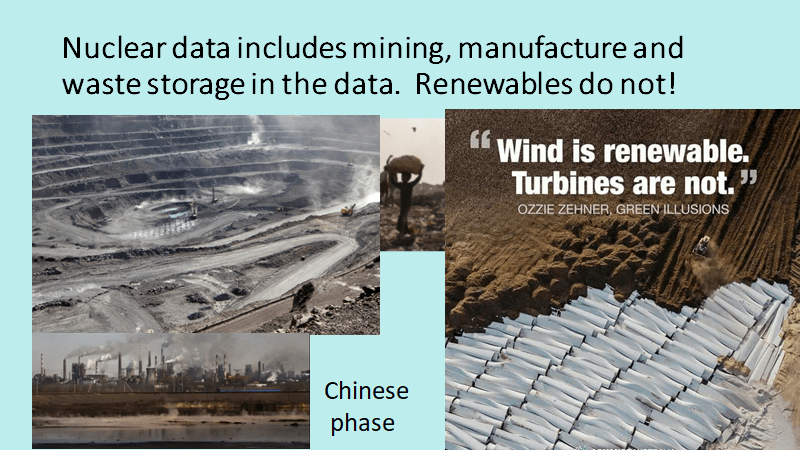
This slide has been taken from another of my presentations but serves to illustrate some of the issues not taken into account when looking at the land-use areas required by different sorts of power generation. I have not seen estimates of the mining areas required to build wind turbines, nor is final waste requirements taken into account. I am not sure whether the estimates of wind power land requirements only take into account the nameplate estimates of power produced and not actual power produced. Certainly in Australia, it is very common to see nameplate figures for wind power used as if this was the amount of power that would be produced. In reality, throughout the world, wind farms tend to produce 10% to 30% of their nameplate power.